Pacific Transport
pp. 83-85 · Read in the full issue
Aircraft Salesmen Are Flying
Samples In Papua New Guinea
From GUS SMALES in Port Moresby
V Japanese passenger aircraft and w will operate in Papua New inea during the busy Christmas iod to evaluate the aircraft for national airline, Air Niugini. fhe airliner will be the NAMC ■ll, a 64-passenger turbo-prop ich is new to Australia but has n in airline service for five years south-east Asia, Japan, Hawaii and ith America.
Niugini at present uses Fokker 7 Friendships which it inherited m Ansett and TAA. fhe YS-11 is being sent to PNG evaluation under an arrangement olving the manufacturers and the •anese and PNG governments. It expected to operate on internal nk routes in PNG for about 30 's. fhe PNG Pilots Association agreed Japanese crews operating the air ft under the supervision of senior its with Air Niugini. fhe general manager of Air Niu i, Mr Ralph Conley, would not ifirm any arrangements regarding possible purchase or charter of airliner.
EJe described the operation of the -11 as purely an evaluation test.
Fhe YS-11 first flew in its produc n form in November, 1967, and a short to medium-range passenger J freight aircraft. It is powered by j Rolls-Royce Dart turbines— :ger versions of the same engines ;d in the Fokker Friendship. It uses at 282 miles an hour and has range of just over 1,000 miles.
The maritime self-defence force in aan uses a version of the aircraft • patrol work. The YS-11 is in vice with Hawaiian Airlines, All ppon, Japan Domestic, Aerolineas gentinos and Filipinas-Orient.
Meanwhile, Air Niugini is going ead with plans to buy two more •kker Friendships surplus to the quirements of Japanese internal erators. Air Niugini crews were ing to Japan to take delivery of i Friendships.
The Australian Nomad aircraft, on a sales demonstration tour, attracted wide interest from the Civil Aviation Agency and the air transport industry in Papua New Guinea early in November.
But the chances of any early orders from PNG operators were considered fairly slim.
The immediate sales outlook has been dampened by a combination of two factors—the time at which the Nomad has appeared on the market and the type of operations to which it is best suited. The Nomad is a short take-off and landing (STOL) general purpose aircraft which fills a halfway gap between the English Britten-Norman Islander and the Canadian de Havilland Twin Otter.
Both the Otter and the Islander are already well-entrenched in PNG, with most of the associated operating compromises well-ironed out.
Two operators, Aerial Tours and Macair, could well have been interested in the Nomad despite its higher capitalisation but they committed themselves to Islanders several years a go. (Aerial Tours includes in its fleet the Islander which two years ago won the England-Australia Air Race).
And looking from the other side of the deal, Talair (formerly Terri-
tory Airlines) which invested heavily to enter Otter operations, could well have found the Nomad a better pro position if it had been available at the time.
This means that, for the immediate future, the section of the PNG air transport industry which would have been the most likely market for the Nomad is already equipped, Officials of the Civil Aviation Agency believe the Nomad would fill an outstandingly suitable role in the type of search and rescue opera tions which abound in PNG. These operations include hugging the coast for missing boats and small ships, and low-level land searches for
missing walking parties or wreckage
which is difficult to spot under heavy tree cover, However, the cost of maintaining an aircraft for this purpose alone is unlikely to find favour with the government or its agencies.
The Nomad demonstrated in PNG was flown to Port Moresby by the chief test pilot of the Australian Government aircraft factories at Fisherman’s Bend, Victoria, Mr Stuart Pearce, Five general aviation pilots in PNG were dismissed early in No vember, four of them from Aerial Tours and one from Macair. Aerial Tours, in letters to their pilots, said
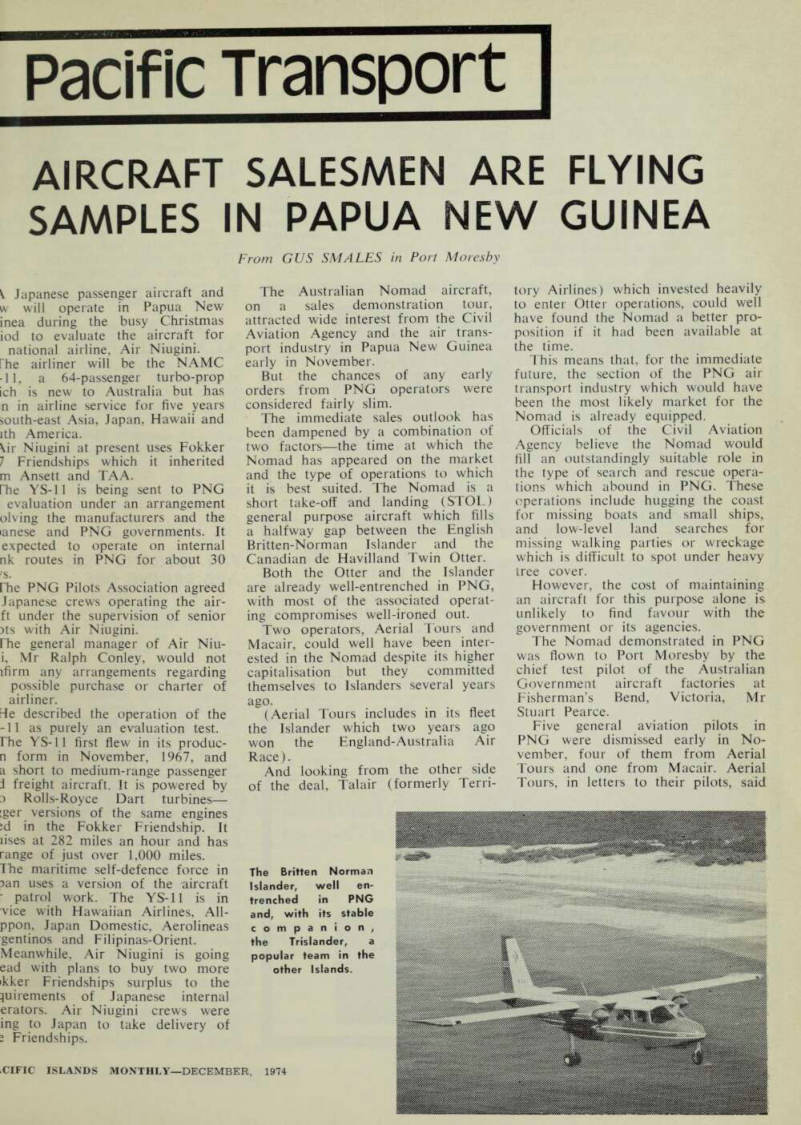
The Britten Norman Islander, well en trenched in PNG and, with its stable companion, the Trislander, a popular team in the other Islands.
the y were being retrenched because of ‘inflation . . . , and other econ omic factors”. The general manager of the airline, Mr Martin Mula, said the new pilots award was not the main reason for the dismissals. The airline had a close look at its estab lishment and decided it had four pilots too many.
The men concerned in Aerial Tours were Messrs James Alcock, the senior check pilot, Wayne Dawson, Reg Ross and Ted Brown. Mr Brian Allen, who was the Macair pilot dismissed, said he would go to South Africa, where he had worked before, to be a crop-dust pilot. Mr Allen
had twice been dismissed by Macair since September, and was reinstated after grievance board and arbitration hearings.
He was dismissed again on No vember 1. He refused to fly because his employers had not paid him his back pay, which was awarded at the recent pilots’ arbitration hearing.
The other dismissed pilots alleged that general aviation operators in PNG were trying to run their busi nesses “on the cheap”. They also claimed pilots were offered induce ments to go to PNG and when they arrived the promises were never ful filled.
Better Shipping
Service In Tonga . . .
An improvement in shipping ser vices between the main islands of Tonga, and two outlying islands to the north, Niuatoputapu and Niua foou, can be expected. King Taufa ’ahau Tupou, while at Niuatoputapu recently, said the government was looking at the possibility of buying a shallow-draught ship, specially for working cargo in the area.
Cargo handling at Niuatoputapu at present is in two stages—from shore to barge, and barge to ship.
The king said the time had come for harbour and shipping develop ment which would allow cargo to be handled in a single operation.
... And A Mess
At Vavau's Port
Primitive cargo handling facilities at Neiafu on Vavau were stretched to the limit recently when the Aoniu arrived with a cargo of desperately needed goods from New Zealand.
In the Customs House, after the cargo was unloaded, was a mess piled almost to the ceiling—smashed car tons, boxes, sacks, soap, toilet paper, nails, white sugar, and hundreds of cans of corned beef, the only meat seen there for several months. The local residents were not pleased.
Fiji Landing Fees
Are Taking Off
It will cost airlines 5 per cent more in landing fees each time they have an aircraft put down at Nadi in Fiji in 1975. TTe higher fees are expected to add about 1100,000 a year to government revenue. The average weekly number of inter national flights through Nadi is 69.
Added to that number are the daily flights by Air Pacific, and non scheduled flights by Fiji Air Services.
The average new fees for bigger aircraft are: Boeing 747, $1,220; DC 10, $921; Boeing 707, $558; DCS,
$522; Baciii, $76.
Stevedores Paralysed
Port Moresby
Port Moresby’s 600 stevedores paralysed the port for two days early in November when they went on strike for shorter working hours and longer holidays. Chief Minister Michael Somare, in Australia to meet the Japanese Prime Minister, Mr Tanaka, hurried home to see what it was all about, and then set up an arbitration commission to mediate.
The stevedores are demanding a 40-hour week, long service leave, leave fares, compassionate leave, 10
days’ annual sick leave and two days’ travelling time to be added to their annual holidays. The Employers’
Federation called the strike “ridi culous”. The executive director of the federation, Mr Maurice Wells, said some demands had been agreed to, and an arbitrator had been called for to hear the rest.
A union spokesman said the men were “very discontented” with cur rent working conditions. They aver aged less than $4O for a 44-hour week.
The strike stopped unloading of three cargo liners. Overseas shipping started to bank up alongside smaller coastal ships. The resumption of work, while ensuring vital supplies were unloaded, was too late to save Christmas mail from Australia.
About 500 bags of letters and packages in the cruise ship, Marco Polo, were still in the ship when it sailed to Hong Kong. The strikers turned a deaf ear to postal officials who pleaded with them to unload this mail. • UTA French Airlines opened a Noumea-Tokyo return air service on November 7, using a DCS. The route will function as a “joint oper ation formula” with Japan Air Lines.