Change
p. 78 · Read in the full issue
London
All
For The
World
Changing continents these days is as simple as changing a £2O note. You might get a second glance at the colour of the note or the destination on the ticket but after that it is plain flying.
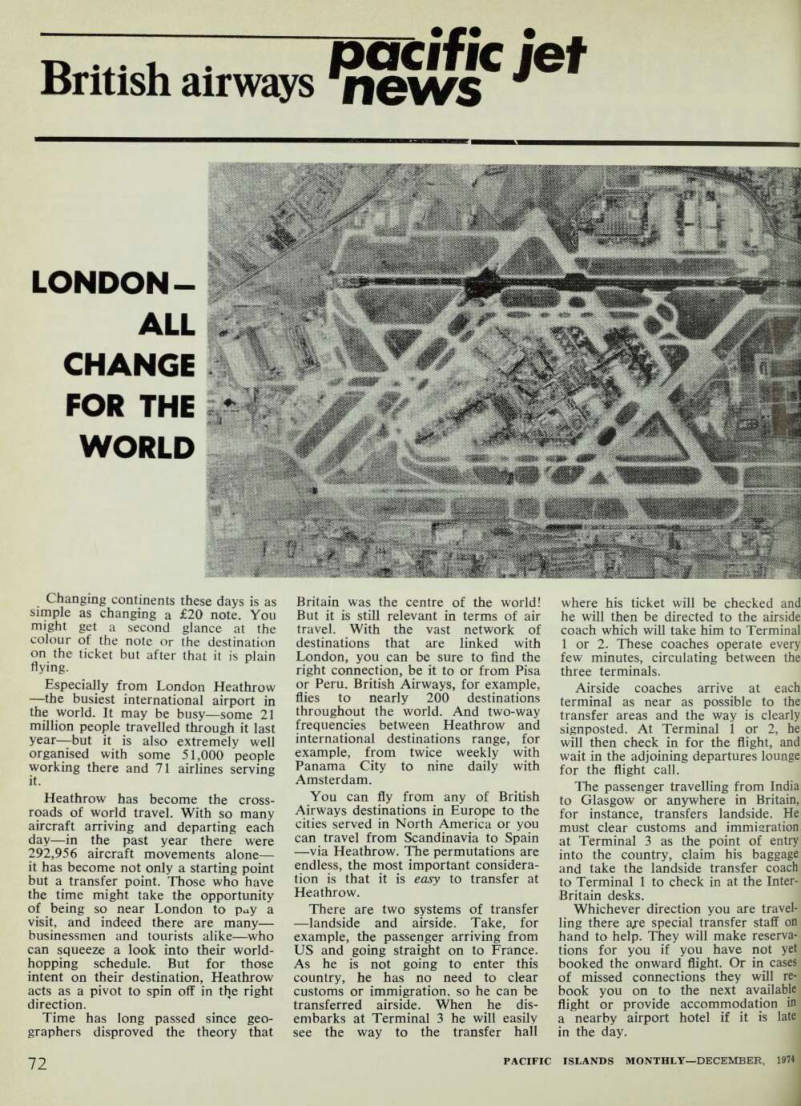
Especially from London Heathrow —the busiest international airport in the world. It may be busy—some 21 million people travelled through it last year—but it is also extremely well organised with some 51,000 people working there and 71 airlines serving it.
Heathrow has become the cross roads of world travel. With so many aircraft arriving and departing each day—in the past year there were 292,956 aircraft movements alone— it has become not only a starting point but a transfer point. Those who have the time might take the opportunity of being so near London to pay a visit, and indeed there are many— businessmen and tourists alike—who can squeeze a look into their world hopping schedule. But for those intent on their destination, Heathrow acts as a pivot to spin off in the right direction.
Time has long passed since geo graphers disproved the theory that
Britain was the centre of the world!
But it is still relevant in terms of air travel. With the vast network of destinations that are linked with London, you can be sure to find the right connection, be it to or from Pisa or Peru, British Airways, for example, flies to nearly 200 destinations throughout the world. And two-way frequencies between Heathrow and international destinations range, for example, from twice weekly with Panama City to nine daily with Amsterdam.
You can fly from any of British Airways destinations in Europe to the cities served in North America or you can travel from Scandinavia to Spain —via Heathrow. The permutations are endless, the most important considera tion is that it is easy to transfer at Heathrow.
There are two systems of transfer —landside and airside. Take, for example, the passenger arriving from US and going straight on to France.
As he is not going to enter this country, he has no need to clear customs or immigration, so he can be transferred airside. When he dis embarks at Terminal 3 he will easily see the way to the transfer hall
where his ticket will be checked and he will then be directed to the airside coach which will take him to Terminal 1 or 2. These coaches operate every few minutes, circulating between the three terminals.
Airside coaches arrive at each terminal as near as possible to the transfer areas and the way is clearly signposted. At Terminal 1 or 2, he will then check in for the flight, and wait in the adjoining departures lounge for the flight call.
The passenger travelling from India to Glasgow or anywhere in Britain, for instance, transfers landside. He must clear customs and immigration at Terminal 3 as the point of entry into the country, claim his baggage and take the landside transfer coach to Terminal 1 to check in at the Inter- Britain desks.
Whichever direction you are travel ling there aje special transfer staff on hand to help. They will make reserva tions for you if you have not yet booked the onward flight. Or in cases of missed connections they will re book you on to the next available flight or provide accommodation in a nearby airport hotel if it is late in the day.