dubious 'moment of truth'
pp. 67-69 · Read in the full issue
Papua New Guinea's very dubious 'moment of truth'
According to its foreword, Papua New Guinea—Moment of Truth “deals with the story of this fascin ating group of tropical islands and with the political and economic horizon of the youngest nation in the world”. Is this then the long awaited, carefully-balanced collation and interpretation of enough material to help us understand the emerging nation without having to talk with many of its people and to read much more?
No matter how one judges past and present foreign business enter prise in Papua New Guinea, there is no denying its importance in the country’s economic history. By omit ting the activities of expatriate trad ing companies and “thousands of business pioneers who risked their lives, as well as their money, to lay the cornerstone of Papua New Guinea’s economic growth”, author lan Todd has failed to provide a balanced, useful account. By arguing that “to mention one, or a few, it would have been necessary in all fairness to mention all, or at least most. And this was quite impossible”, he shows a deplorable lack of under standing how history is written.
Other parts of this book, eg those
dealing with the country’s history in
general, the social structure and mores of its people, and political development, also suffer from the author’s inability to sort chaff from grain. Much of this book consists of extracts from official reports and statistics, and there are many quotes from books, journals and newspapers.
It is therefore most perturbing that the sources of most of those extracts and quotes are not given. There are no footnotes or even just a biblio graphy.
Take, for instance, the author’s observation (p 110) that Peter Hast ings, an Australian journalist, “has accurately described cargo cult as
. . . ‘a baffled, frustrated expression of black aspirations to white skills and goods’ It is clear from no less than 15 pages dealing with or ad verting to cargoism in his New Guinea: Problems and Prospects that Hastings would see the author’s quote as jejune and likely to mis lead.
Some of the acknowledged quotes are misused. The Department of In formation press release about the Upper Strickland patrol in 1972 does not, as the author claims, give the best idea of “what happens in the three-quarters of the country which are not serviced by any form of re
gular transportation system”. The
people of the Nomad River are among the least contacted, and there are very few like them elsewhere.
Hardly anyone who has read studies of groups in various parts of the country by anthropologists such as Read, Lawrence, Reay and Good enough will agree with the author that two reports on the Mount Turn cargo cult in 1971 by a New Zea land journalist are “perhaps the best way to understand the cargo cults”.
And, contrary to what this book tells us, cannibalism is not de rigueur in the more remote areas of the New Britain districts; one would be hard put to find more than a
handful of practising anthropophagi
anywhere.
The author does not do much bet ter when he makes his own observa tions. The government’s newspaper, Our News, and its Pidgin edition, Nius Bilong Yumi, —not “Nuis” as this book has it—may or may not have the largest readership among New Guineans. The most influential newspaper by far is, however, the Post-Courier, which is read by the urban elite and others who walk the corridors of power or may yet do so.
And what about Wantok, pub lished by the Catholic Church, which
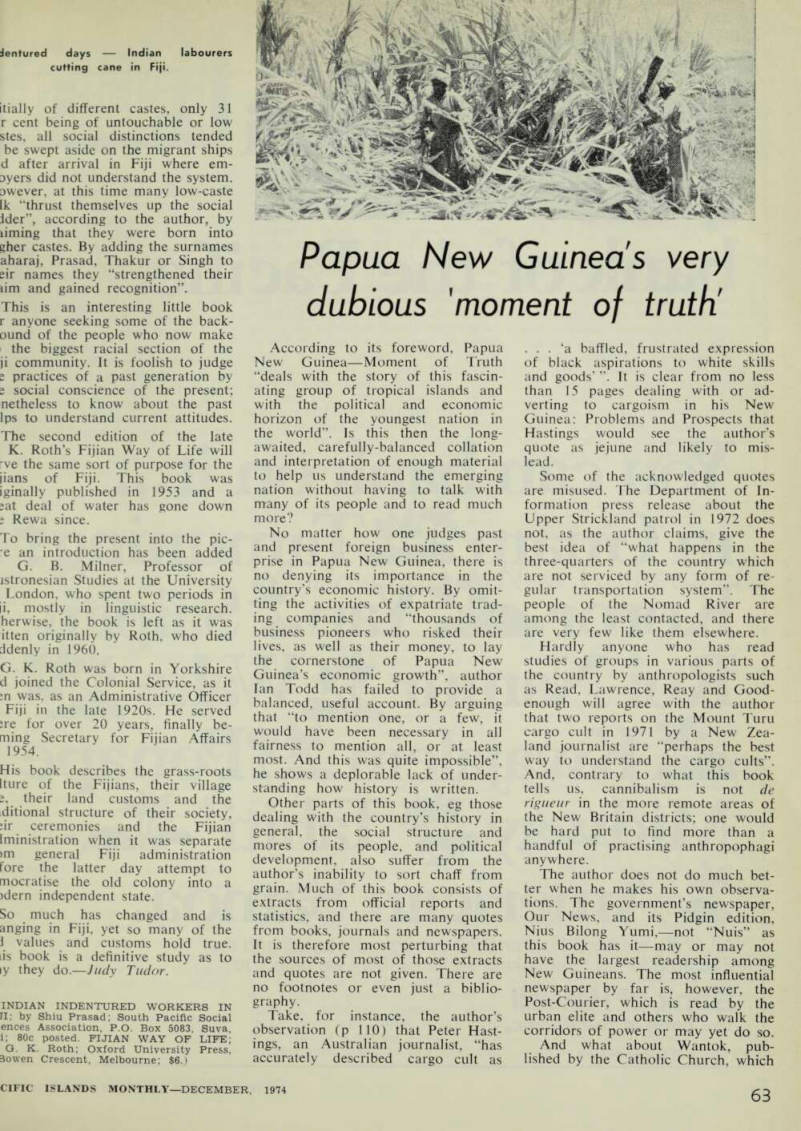
[?]entured days-Indian labourers cutting cane in Fiji.
icerns itself with grass roots poli » and is fairly widely distributed the New Guinea mainland?
Ihere are brief sketches of several ders—Somare, Guise, Kiki and putin—in order to “guess the »wers” to questions such as “Are billions of dollars of foreign in itment safe?”, “Is communism sly to take over?”, and “Are there ng to be massacres of the Congo •e, or murderous civil wars?”
'Xpart from some inaccuracies, eg Guise’s grandfather was a trader, a government official, these tches do not give sufficient cover of the current leadership: saipwalova, Hannett, Abal, Chan 1 Ave are just a few who come to ad.
Even worse than misquotes, lissions and errors of judgment, falsities. A glaring example of se is the following description of >al warfare: Roaring their individual or tribal var cries, fearful-looking painted md decorated men wade into each ither. Sometimes to the skirl of lative pipe bands playing well cnown Scottish tunes, more often o the drum and saxophone music if nightclub bands playing some if Tom Jones’ latest hit tunes.
Worst of all is the undisguised ropean ethno-centricity which per les this book. It is incredible to d, in 1974, that “in the years to ne, when Aussies and Kanakas et abroad and watch this fascin ng country take its rightful place the world community of nations, y can justly say: ‘we did it to iler”’ (p 140). One can but hope it any New Guinean reading this ik decides that dismal ignorance, intentional offensiveness, has >duced it.
Newsprint is not only expensive vadaysr, it is also scarce. Bad iks are therefore rarely reviewed, lave made this exception because iua New Guinea—Moment of ith is the worst book I have come oss in recent years. I recommend t you buy it, not at its present ce of $9.95 but when it is being naindered for, say 50c. —Harry kman.
Papua New Guinea—Moment Of
UTH. By lan Todd. Angus & Robert , P.O. Box 177, Cremome Junction, N, 2090. $9.95.)