Books, Reviews, Writers
pp. 65-67 · Read in the full issue

Slavery In The Canefields And A
Free Life In The Fijian Village
The abuses of the indenture system der which recruits from India pro ?led the plantation labour in Fiji ?un 1879 to 1916 are mentioned in ?st accounts of Fiji’s modern history. But mentioned only.
A small booklet by Shiu Prasad Indian Indentured Workers in Fiji, published by the South Pacific Social Defences Association now goes some way towards filling the gap and is all the more acceptable because it manages to remain objective and without the emotionalism one might expect under the circumstances.
By the time Britain had made Fiji a colony in October, 1874, there were already over 600 European plantations in Fiji, most of them using Pacific Islanders, from the Solomons, New Hebrides, Gilberts etc, as labourers because Fijians found nothing attractive in this sort of work.
Many of these “other islanders” had been recruited illegally—black- ?ded was the term used at the time and it was partly in order to pre vent this practice that Britain rereluctantly agreed to annex Fiji. But since having done it, and put a brake on the activities of South Seas re- ?iters, the question of labour for existing plantations arose and as indentured Indian labour had already come to Mauritius and the West Indies, this appeared to be the solution for Fiji.
In all, over 60,000 Indians were indentured during the 37 years the system operated. The majority of ?m remained in Fiji after their indentures were completed and bebecame the nucleus from which the ?ge Indian population of today’s ?i has descended.
The recruits had many reasons for ?itting India for a new life but it is pretty obvious that the recruiters in India were not very different from the old Pacific blackbirders and had very much the same line of patter.
Fiji appears to have been presented with an earthly paradise in some cases and to have been located somewhere close to Calcutta in others. Men and married women with husbands were recruited but in a proportion of 100
of the former to 40 of the latter—a fact that was to cause considerable immediate social trouble and a dis proportion of males to females in the Fiji Indian society for generations to come.
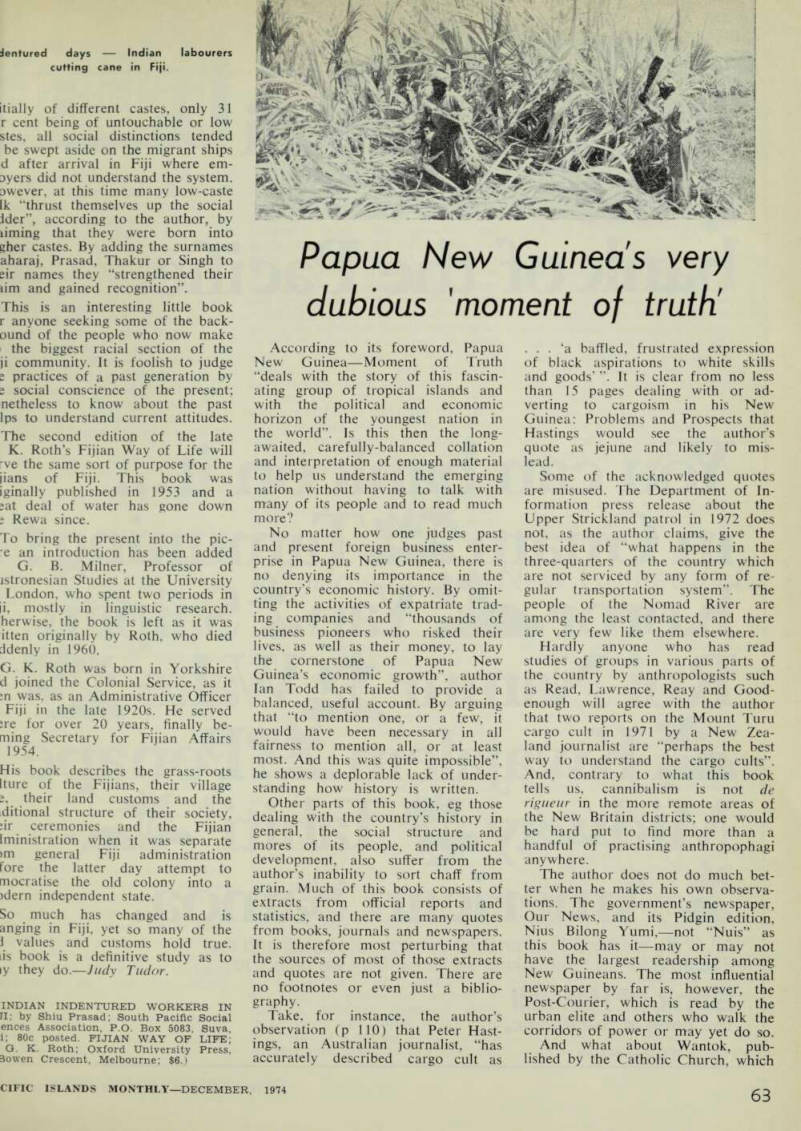
Mr Prasad describes the conditions which these people met in Fiji through the eyes of those still living and who experienced the system. Most went into the labour lines for plantation labour, others, according to the author, were chosen for other work, pretty much on physical appearance.
Sardars — foremen — were usually persons who looked strong or were smart and talkative; stablemen were those who “showed admiration and care for the animals”. Gardeners were often “physically weak”, so were water carriers—a job also frequently given to women. Cooks and domestic servants were “usually chosen from those who respected white men, appeared clean, looked delicate in constitution . . . could understand the white man’s Hindu stani . . .”
To be a cook was a good cop although cooks could have their problems, especially with nagging housewives. One ex-indentured cook explained to the author: “Whenever the sahib was absent she compelled me to do the same piece of work over and over again . . . I refused to obey her one day and she rushed to me with unexpected anger. As she passed over a lying sack I pulled one end of it. She fell on her back. I darted out of the room, across the lawn and reached my friend’s house.
In the afternoon the sahib came to see me and took me back. On the way I explained to him why I had run away. He did not say anything but patted my back. From that day on ward she never dared to quarrel with me but often helped me and talked to me politely.”
Which proves that even in the dark days of 1879-1916 there was man to man rapport between employer and servant when it came to reaction to nagging females.
Although the immigrants were
itially of different castes, only 31 r cent being of untouchable or low stes, all social distinctions tended be swept aside on the migrant ships d after arrival in Fiji where em ayers did not understand the system, owever, at this time many low-caste Ik “thrust themselves up the social Ider”, according to the author, by liming that they were born into gher castes. By adding the surnames aharaj, Prasad, Thakur or Singh to eir names they “strengthened their lim and gained recognition”.
This is an interesting little book r anyone seeking some of the back ound of the people who now make the biggest racial section of the ji community. It is foolish to judge s practices of a past generation by 2 social conscience of the present; netheless to know about the past Ips to understand current attitudes.
The second edition of the late K. Roth’s Fijian Way of Life will we the same sort of purpose for the iians of Fiji. This book was iginally published in 1953 and a ;at deal of water has gone down 2 Rewa since.
To bring the present into the pic •e an introduction has been added G. B. Milner, Professor of istronesian Studies at the University London, who spent two periods in ji, mostly in linguistic research, herwise, the book is left as it was itten originally by Roth, who died ddenly in 1960.
G. K. Roth was born in Yorkshire d joined the Colonial Service, as it ;n was, as an Administrative Officer Fiji in the late 19205. He served ;re for over 20 years, finally be ming Secretary for Fijian Affairs 1954.
His book describes the grass-roots Iture of the Fijians, their village 2, their land customs and the ditional structure of their society, fir ceremonies and the Fijian Iministration when it was separate >m general Fiji administration fore the latter day attempt to mocratise the old colony into a idem independent state.
So much has changed and is anging in Fiji, yet so many of the 1 values and customs hold true, lis book is a definitive study as to ly they do. —Judy Tudor.
Indian Indentured Workers In
II; by Shiu Prasad; South Pacific Social ences Association, P.O. Box 5083, Suva, i; 80c posted. FIJIAN WAY OF LIFE; G. K. Roth; Oxford University Press, 3owen Crescent, Melbourne; $6.)