A Villager
pp. 58-60 · Read in the full issue
Short story
By Francis Tekonnang
THE sun was rolling slowly down
the western sky. Buta pulled in his line, and looked towards the east, estimating the time when he would arrive home. He noticed that the wind was in his favour; he wouldn’t have to change course to get home.
I don’t think I’ll get all my toddy trees done before night-fall, he
thought.
He set his sail, and his canoe be gan to cut through the water.
I wonder what Mere has been doing all this time? I mustn’t be suspicious, but she should meet me on my return. Last time, she didn’t meet me because she was too busy playing bingo. I wonder what her story would be this time?
The wind dropped and he pulled on the rope he was holding. He looked down into his canoe, and sized his catch.
There are her parents to be given some fish; there are our neighbours who remember us often when any thing comes their way. Mere will see to these people.
He remembered once when he had argued with her about the distribu tion of his catch. It had been his un lucky day, and yet, Mere insisted on giving her parents more fish. He remembered how she had accused
him of being a mean person, and he had slapped her for it.
She doesn’t realise that we have children to feed, and school fees to pay - He felt the tug of the sail pulling the rope in his hand, and he let it run through his hands mechanically, before holding onto it again.
There is the 1.0. to collect our head tax, our land tax, and our bicycle tax. There is Mr Tabemeang’s daughter to be married, and my brother’s daughter too. One of these days, there will be foreigners invited by their relatives into our village; then we’ll have to give them break fast or supper. And yet, cents are hard to come by.
A wave bashed against the side of his canoe, and splashed into him. He suddenly remembered how once his canoe capsized. He was a bachelor then, had no wife and children to worry about. Yet, it was the bitterest experience of his life. He thought with envy of those who had gone to school, and who were now working in the white men’s offices.
What do those people worry about? Cents came to them regularly.
He remembered that his eldest son was sitting the secondary school entrance exam that year.
Poor Bero. 1 hope copra prices will be good soon. Otherwise, you
end up like me. I will try my for you, son, if you are lucky, he wind dropped again, and he isted the rope in his hands auto ically. He noticed a roll of fish line near the mast, and he embered how Mere’s parents had mmended him to her. But that not the only reason. He also e from a family with a good rd and enough land. And added lis credit were his industriousness fishing skills. He remembered disappointed they were with > for not getting good marks in school subjects. want him to work hard and go i secondary school, e remembered scolding Bero a he didn’t attend school.
'hat is this all about? he remem d asking him, threateningly. If don’t change your behaviour, 3 is a canoe for you, there is a e, my toddy knife and my axe, you’ll see how hard this life is, you will envy your age-mates have gone for further education, it did Bero say he was learning :hool? Yes, English, Maths, His and . . . nother wave bashed against the of his canoe, and he noticed a strands of sea-weed stranded on :anoe.
E tide was already in, he real ised, scanning the beach, and he :ed four children running about t. ley want nothing to eat but d, buns, and rice. Mm . . . there is. He was glad. He pulled in his and lowered it onto his canoe, cached out for his paddle under sail, and he began to paddle re. lis is my bit, he accepted it. long will this last us? ere walked over to meet him. low is it?” she inquired, got a few”. 3 jumped down and pulled his e a few yards parallel to the h. She joined him, looked into :anoe, and, satisfied, she shouted a basket. lang on to the canoe. I am I to take these up first”, he told 3 took the sail and the mast to shed, and when he returned, re was already there and she emptying his catch into a bas- He unloaded his fishing gear the beach, and waited for her nish emptying the catch, hat’s all”, she said. 3 pushed the canoe out a few s from the beach, dropped its or, and then joined Mere and re.
THEY had three separate huts which were not far from the beach. They were typical huts, but their sleeping hut gave the impression that it was very new. The roof was made of coconut leaves, the wall of evenly spaced mid-ribs of coconut fronds, and the floor was gravel, and covered with coconut mats. Tucked at the back were the family belong ings. Pandanus sleeping mats, care fully folded, were placed on top of a large suitcase. Left of it, about two or three feet away, was a small box with a small radio on it. A mos quito net hung on a line at the back of the hut.
Behind this was a smaller hut where Mere did her cooking. A few yards further back towards the beach was their canoe shed. Around them were other huts of the village.
Buta left Mere and Maure in their cooking hut, and went over to their sleeping hut. He washed his legs in a wash tub near the entrance, and went in. He took out his cigarette tin, and rolled himself a small cigar.
I wander what the time is now?
He crawled over to the radio, and switched it on.
I wish I knew English.
The radio invited applications for vacant posts: the people wanted had to be able to understand and speak English. It was a few minutes to five, and he knew he had to get going.
He switched the radio off, went over and pulled out his toddy knife that he had thrust into the veranda of the hut, took his toddy shells, and went over to his bike that was still leaning against a coconut trunk. The main road was about a hundred yards away, and he had to push his bike past a couple of huts, before he could get on to the road.
I wonder what Tebanti has been
doing today?
He saw Tebanti’s wife feeding her cooking fire, and inquired.
“Where is Tebanti?”
“He is not back from Tauma”.
“What are you cooking?”
“Our supper”.
He went past Koura’s hut but saw no one around.
These people aren't home, they must be out playing cards.
He thought of them with pity and contempt.
I wonder how old Bebeia is now?
He is very lucky to have a job. When they returned many years ago, they had three children. Someone said that his two eldest boys are in KGV now.
He saw Bero playing with other boys of his age, and sighed.
Shall I take him with me? No.
We will be late.
He got on his bike, and rode to the main road before he disappeared into the bush.
THE fire was already alight. Mere was cleaning the entrails of his catch in a basin full of sea water.
Maure had gone with a basket of fish for her grandparents.
Mere finished cleaning the fish and she started cooking them over the red charcoal.
That one too. Bring that to the middle. Put another one in. That’s a tasty one. That must be cooked.
She raised her eyes. I hope Maure will be back soon. “Bero O!” she called. She removed the cooked fish to the edge of the fire, and went to get a dish. “Come here!”
Bero allowed himself reluctantly to go to her. She removed the cooked fish onto the dish, and took in another one.
That one is cooked too. Turn that one over. Push that one a bit this way, and that the other. That must be burnt. Move that a bit this way.
This one is cooked.
Maure appeared.
“Take these to Tebanti”. She saw Bero drag himself behind her. “And you, take these to Tora. It’s getting dark, so that is enough of your play”.
She removed the cooked ones onto the dish, and took in others.
BUTA had worked on his favour ite trees, and was returning home. He came to a fallen coconut trunk and jumped down. How long will this remain here? I hope some one will remove it soon. He remem bered the huge machines he had seen during his period of service on Ocean Island. What do they call them?
Teburutoutia’ or something. He lifted his bike over the trunk, and jumped on it again.
The path was narrow, like a giant
snake running through the shrubs, under thick foliage and by the pits.
Sometimes he almost bumped into someone around the curves, but he knew the traffic rules, and was always aware of the dangers. He passed a ‘babai pit’—there was only dry sand in it. He passed another—there was dry mud and scattered pools of water in it. Then another one. Then another with weeds. He came to a long valley, and jumped down. He pushed his bike up the other side, and back to his village.
Darkness crept in from nowhere and spread herself out through the village over the sea and the horizon beyond. And as ‘Tai’ dived further and further into the depths of the ocean, she made herself thicker and thicker, and hurricane lamps were lit to push it back.
A dish of roasted fish, peeled fresh coconut and a bowl of toddy were laid between two mats, outside the sleeping hut. A hurricane lamp, which hung from a hook under the veranda of the hut, cast pale red light over Buta and Mere and Bero and Maure. They were eating in silence, save for the sound of fresh coconut being crushed between jaws.
“Have they finished those buns?”
Buta asked Mere.
“No. We will have them to morrow”.
“Give some to me”.
Mere lifted herself up and went to get them.
“There you are”, she said reproachfully.
Bero and Maure took them timidly, but soon forgot the em barrassment, and they began to eat more fresh coconut.
When they had finished eating, Buta and Mere retired into their sleeping hut. He talked about selling his catch to his neighbours, and she talked about making and selling buns. He talked about men like him who had gone to Tarawa and had found jobs there; and she talked about starting a bakery if they ever went there.
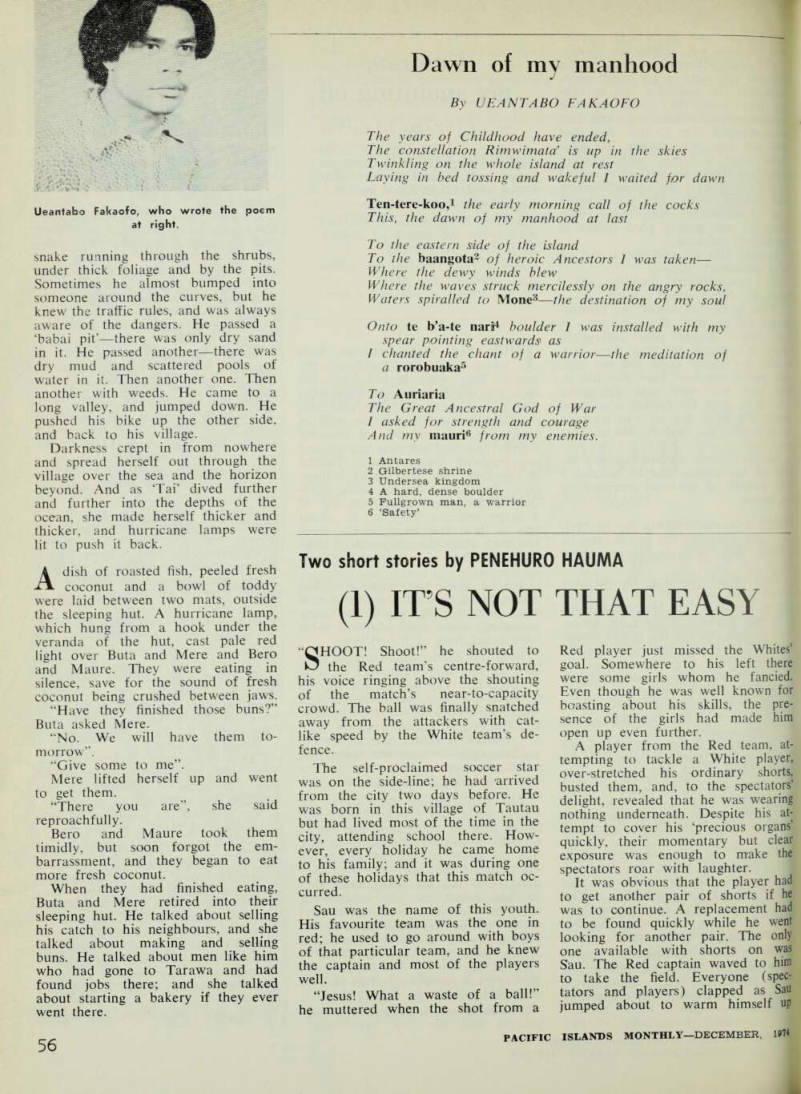
Ueantabo Fakaofo, who wrote the poem at right.