Portland, Oregon
pp. 41-45 · Read in the full issue
Captain Cook is in Portland, Oregon
From Patricia Matheson,
Meeting an old friend in an un :xpected place is always a joy . . . ind so it was with a feeling of sur mise and pleasure that I learned a ew days ago that Captain James rook was in Portland, Oregon.
I met Cook first a long time ago n my school books, but it was when came to share his great love for he world of the Pacific that I began o know him better. Then I read his ournals in the monumental Beagle lole edition and came to appreciate he mental energy and moral honesty if the great navigator.
From time to time, I picked up ome new fact about his life or his york, until I came to feel that, in pite of the barrier of two centuries, a spite, too, of the fact that he was ;ne of the truly great men of all ime, he had become a friend.
How did he happen to be in Port and, Oregon? He came at the invita ion of Thomas Vaughn, executive
director of the Oregon State His torical Society, who has long been interested in Cook’s three voyages of Pacific exploration. To make Cook come to Portland meant to Vaughn the assembling from all over the world of material associated with the explorer. Museums and private col lectors of many lands were contacted and responded so generously that it is no exaggeration to say that the Oregon exhibit is the greatest collec tion of Cook that has ever been shown.
Vaughn was particularly fortunate in obtaining practically the whole Cook gallery from the National Maritime museum in Greenwich, England. With that to form the basis of the exhibit, with important items from Australia, New Zealand, Cana da, Ireland and Russia, its success was ensured.
There was an international flavour to the opening festivities of July 1,
1974 when Admiral Sir Charles Madden, chairman of the Board of the National Maritime Museum in Greenwich introduced Capt James Cook to Portland, Oregon. Present also were Consul-General of New Zealand S. M. Hope and Mrs Hope, Consul-General of Australia R. L.
Dean and Mrs Dean and the Consul- General of the USSR, Alexander Zinxchuk. Since then the exhibit has
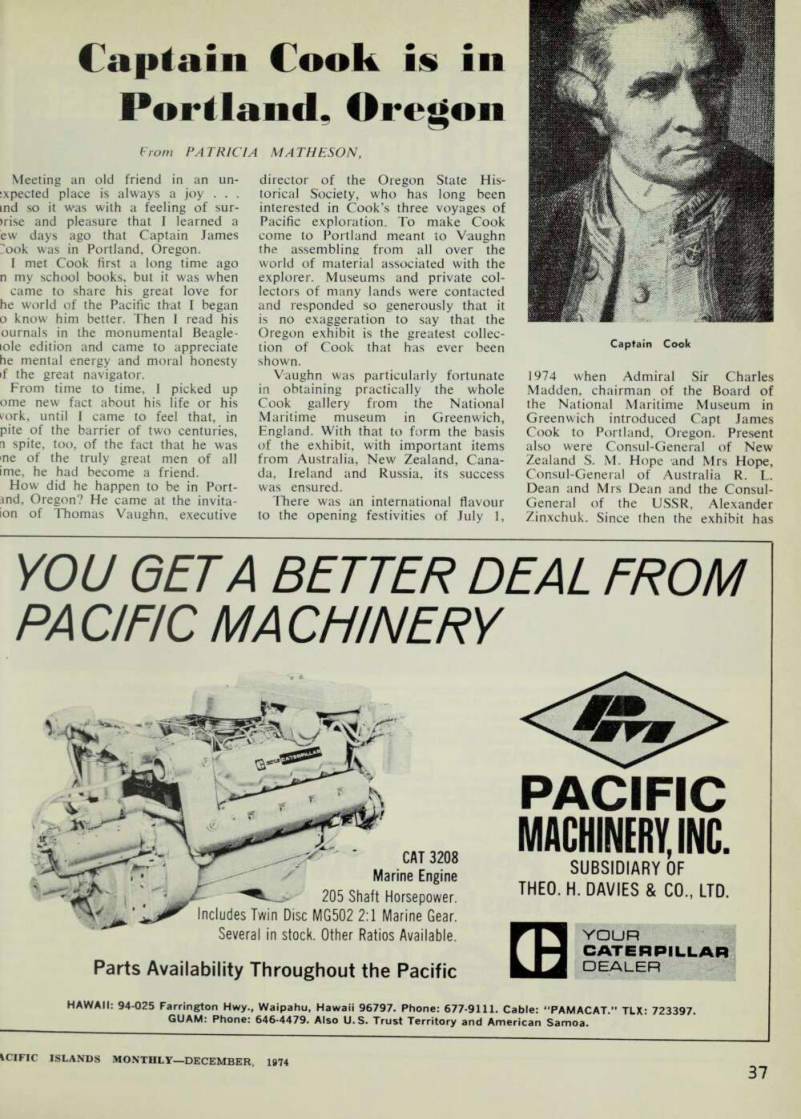
Captain Cook
been attended by a constant stream of visitors eager to feel the thrill of being in the presence of a great man.
And how do you come to know a great man? In exactly the same way in which you become acquainted with an ordinary friend. You share his thoughts, meet his comrades, interest yourself in his work and learn the circumstances of his daily life. All those things, I did with Capt James Cook at the Oregon Historical Society in Portland the other day.
I found myself being thankful that the camera had not been invented when Cook sailed; for the artists who accompanied him on his travels and those who portrayed both him and his contemporaries added a personal touch that photography could never have given.
I was particularly interested in the portraits of the men who had sailed with Cook—his fellow captains, King and Clarke and the steady American, Gore, whose sad duty it was to lead the last expedition back to England after Cook had been killed. There was Bligh, too—not yet the implacable captain of the Bounty, but already showing, as the 21-year old master of the Resolution, some thing of both the headstrong stub bornness that led to the mutiny and of the persistence and skill which enabled him to sail in an open boat from the Tongan island of Tofua to the East Indies.
There are several pictures of the young Joseph Banks, the nobleman whose aristocratic ideas brought him into conflict with the practical Cook, but who, nevertheless, did more than any other man to acquaint the world with the wonders of Pacific flora and fauna. There are also portraits of the other great explorers of Cook’s time as well as of the men in Eng land who backed him at the Ad miralty.
Finally, there are paintings of the artists themselves—of Sydney Parkin son, the brilliant young artist of the first journey who lost his life in Bata
via on the homeward journey—of the father and son naturalists, the
Forsters, and of John Webber of whom it was written, “The peoples, seas, and landscapes of all the oceans of the world came under his brush”.
Turning to the paintings, engrav ings, and drawings of the travels, it is easy to feel all the excitement that swept through the world when the islands of the Pacific first cast their romance and mystery over the minds of men. Never before had the old world seen the kangaroo that in Par kinson’s drawing stands erect with ears cocked suspiciously, nor had it ever known the lushness of island landscape nor the majesty of island peoples as Webber portrays them in
painting after painting of Tonga and Hawaii.
Cook valued his artists, but he was not content to let their im pressions give the whole record of the trips. He kept meticulous iournals —some of which, written in tiis own clear hand, can be seen at he exhibition. He also collected nany artifacts. Especially note worthy is the Tongan collection and he beautiful Hawaiian feather cape which was lent by the USSR.
Cook’s nautical instruments are here, too, and it is interesting to lote that they were all the most up o-date of his day. There are, too, )lans of his ships and copies of the :harts he made of all the new lands le found.
Of the little things of common, veryday life, there are many—the utlery he used at table, his gold cuff inks, his ivory rule, his inlaid dress tig case—all, like the man himself, ood, solid, durable.
And, finally, there are several epresentations of Cook’s tragic death t Kealakekua Bay on February 14, 779 of which the best is probably lat by Clevely. There is a copy of le coat-of-arms which George 111 estowed posthumously on Cook and record of the even greater tribute lat he paid by standing weeping ith bowed head when the news was rought to him of the explorer’s eath.
Because the exhibition is to con nue until January 1975, I write lis in hope that all Pacific people ho are travelling in the United tales in the next few months, will ut Portland, Oregon, on their inerary, visit the exhibition at the regon Historical Society and come » know better that great man, Cap in James Cook.
E Was Also
N Norfolk
Captain Cook was also on Nor ►lk Island in October. As part of e Cook Bicentenary Celebrations, e islanders re-enacted Cook’s nding there on October 10, 1774. eading his party, all garbed as x>k described the landing party, is George (Mac) Adams as Cook, ley followed to the letter every -P the famous navigator took— e walk along the beach, the climb ► the rocks, inspection of the flax ant, the walk into the pine forest hind Emily Bay, and the cutting •wn of the pine tree, which was ken back to the ship. Attending r celebrations were Australia’s ime Minister Gough Whitlam and rs Whitlam, and Minister for the ipital Territory Gordon Bryant.