Pacific Transport
pp. 83-87 · Read in the full issue

Fewer Carriers To Cross Pacific
British Airways will disappear from transpacific flights by the end of March, 1975. In its place it las a unique arrangement with Air New Zealand, which will allow passengers to fly from Auckland d London without changing aircraft. Five carriers will remain on routes from Australia or New Zea md to the US and Canada—Qantas, Air New Zealand, PAA, UTA and CP Air.
British Airways’ withdrawal is part f a changing pattern of air transport i and across the Pacific. Earlier this jar American Airlines and Air-India ithdrew from Pacific services be mse they were not profitable. Qantas irvices across the Pacific now end at m Francisco—they have eliminated ieir flights across the US to London, id thus ceased to be a round-the orld carrier, using their own aircraft id crews.
The change to British Airways jcurred because Britain and Australia ive concluded an air services agree ent which came into force on ctober 1. To balance the withdrawal : Qantas services through the US id Mexico to London, the British overnment agreed that British Air ays services on the South Pacific jute should be withdrawn at the end March, 1975. This is expected to duce excess capacity on the South icific, as British Airways offers about )0 seats a week.
However, a move by PAA to in ease the number of services from the S west coast to Australia from ree to six a week, will probably Fset the reduction in capacity. There also a very remote possibility that merican Airlines could come back the South Pacific.
The deal under which American irlines was to swap its Pacific rvices with PAA for PAA’s routes Bermuda and the Caribbean may )t now go through. A US Civil eronautics Board administrative dge. Judge William H. Dapper, has commended disapproval of the agree ent. He called it a very good agree ent for American, but a very bad :al for PAA. PAA had financial oblems, and approval of the agree ent would exacerbate them. There e two further steps before the deal approved or vetoed—it has to go the Civil Aeronautics Board itself, id President Ford.
Mr Albert V. Casey, chairman and esident of American Airlines, said : did not see how PAA’s financial
state could be improved in any way if American Airlines reinstated com petition on South Pacific routes.
British Airways, under its arrange ment with Air New Zealand, will take over Air NZ’s DClOs at Los Angeles and fly them to London and back, using its own crews. This service will be an extension of the daily Air NZ Auckland-Los Angeles services, five of which are via Honolulu and two via Papeete. One of the services via Honolulu puts down at Nadi, and it is expected that this arrangement will continue.
British Overseas Airways Corpora tion, which later joined with British European Airways to form British -sny oj 90IAJ9S n paqounnj ‘sAn/vuiy tralia from London, via the US and the South Pacific in 1967, using Boeing 7075. British Airways will
continue to fly into Australia, via South-East Asia.
Air Pacific is expanding its regional services. A second service from Tonga to Auckland is a probability.
The Fiji-Auckland weekly service, via Nukualofa, designed mainly to help illegal Tonga immigrants in NZ to get home, is running almost at capacity, and now it is expected a second service will be in operation by November.
Tonga is understood to be negotiat ing for some form of reciprocation, including a claim for promotional fares, inclusion of Tongan air hostes ses in air crews, and training of Tongans as air crew and ground staff.
Air Pacific is also planning to intro duce a Brisbane-Noumea-Fiji-Tonga service, which would bring French
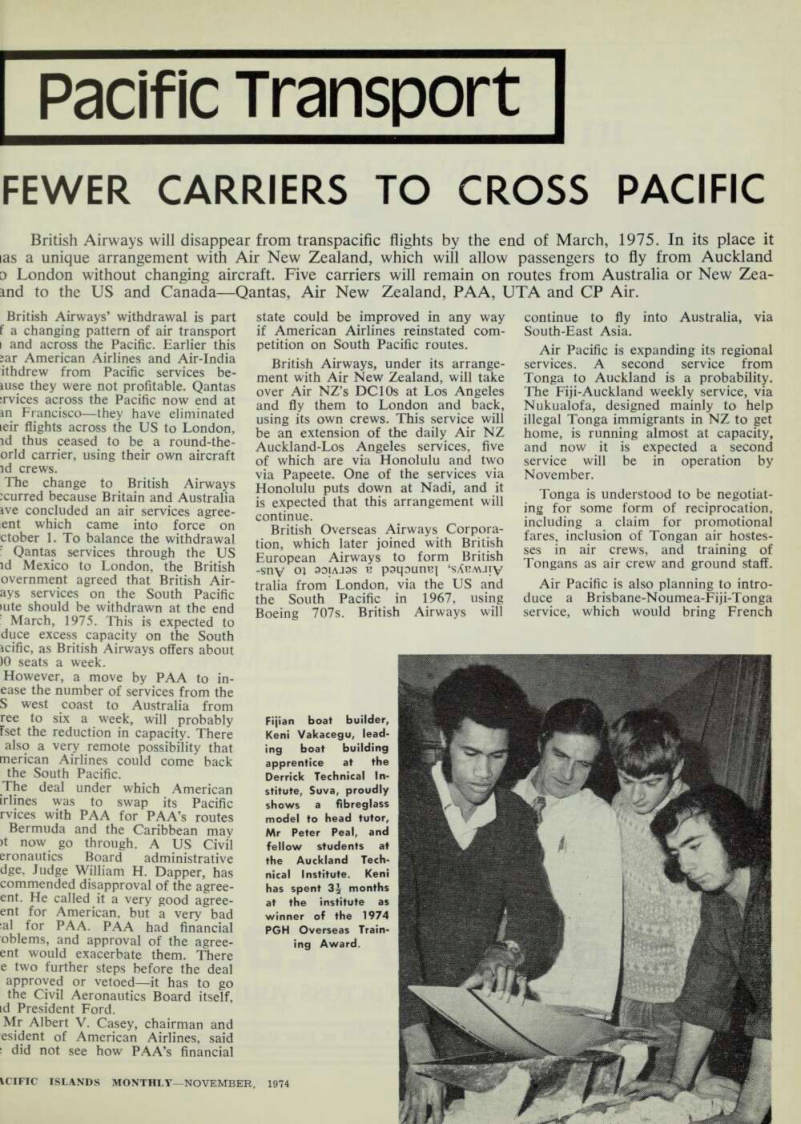
Fijian boat builder, Keni Vakacegu, lead ing boat building apprentice at the Derrick Technical In stitute, Suva, proudly shows a fibreglass model to head tutor, Mr Peter Peal, and fellow students at the Auckland Tech nical Institute. Keni has spent months at the institute as winner of the 1974 PGH Overseas Train ing Award.
ourists to Tonga. It launched a weekly flight Tonga - Suva - Nadi ioniara - Port Moresby on September 9.
These new services, just before the rrival of the first two of four Tris ander aircraft, and a loan equivalent FI million from Australia, have elped to give a lift to the airline’s respects. It now has rights for 12 lonths at Pago Pago and Majuro, Ithough no announcement has yet een made when it will take these up.
Tie US Civil Aeronautics Board limit d the rights to 12 months so that at le end of a year it could review the •wnership of Air Pacific. The US could ress for a shareholding for PAA in iir Pacific, a move suggested some me ago and welcomed by the Fiji rime Minister, Ratu Sir Kamisese fara.
There has been a change in the lanagement of Air Pacific. Mr Stanley »uigg has been appointed general lanager in place of Mr Chris Ritchie, [e acted as general manager from .ugust when Mr Ritchie returned to .ustralia on medical advice. Mr itchie will resume duties with Qantas, om which he was seconded, when he jeovers. He was in Fiji as manager f Fiji Airways (now Air Pacific) om 1959 to 1965.
Low Progress On
He Law Of The Sea
Governments will have to consider ow to reach general agreement on II elements on a package deal on iws for the seas before the next ;ssion of the Law of the Sea Con :rence.
As the next session, the third of le third United Nations conference ti the law of the sea, is scheduled • start in Geneva on March 17. )75, governments do not have uch time to reconcile many con cting views. The second session of e third conference was held at aracas in June and July.
PNG has said it will pay close tention to developments to protect MG’s interests.
Papua New Guinea’s views are milar to those of Indonesia and Fiji, at the physical and political area an archipelago should be every ing within a dotted line drawn und its most outlying islands, islets reefs. Micronesia is after an ex usive economic zone extending 200 iles beyond dotted line boundaries. 5 views were put at Caracas by e US which, however, does not :cessarily agree with Micronesia’s ews.
Japan, which depends so much on e sea for a big part of its food, tiich it secures from the Pacific, ants reasonable proportions main
tained about the outer limits of an archipelago. While there is plenty of “free” ocean in the Pacific, there are also plenty of fishing grounds inside the 200 miles of outer limits of dotted lines drawn round archipela goes.
Sir Albert Henry, for the Cook Islands, asked the last meeting of the conference to give special attention to the Pacific, which was economi cally poor. If minerals were dis covered in the seabed of small coun tries, and could be extracted, those countries should receive some of the benefits. He had in mind (naturally) the recent discovery of manganese nodules in the seabed round the Cook Islands,
Britain’s view, a typical British compromise, is that the area under the sovereignty of an archipelago should be limited to a maximum of five times its total land surface.
The Caracas session was attended by 130 countries. Fifty new countries, which did not take part in the pre paratory work, were negotiating on law of the sea issues for the first time, and this made progress slow.
Progress can be expected to continue being slow on such an important set of issues,
Micronesian Princess
On The Job
The Micronesian Princess, the first new ship specially built for the Micronesian inter-island service, arrived at Saipan on her delivery voyage in September.
The Micronesian Princess, 1,300 tons, is 242 ft long, and is capable of a top speed of 15 knots. There is deck capacity for more than 100 passengers, and cabin accommoda tion for 12. The ship can also carry 36 20 ft containers. The crew of 12 is under Captain John Ongrung, of Palau. The ship is the first of eight to be delivered over the next few years.
Concrete Proposals
Soon For Regional
Shipping?
It s now several years since a South Pacific regional shipping line was first mooted seriously and it hasn’t yet got to sea. But when the South Pacific Forum holds its next meeting at Nukualofa in July, 1975, it will probably have before it concrete proposals for getting a shipping line into operation.
The eight South Pacific Forum countries who met at Nukualofa late in August (PIM, Oct, p 83), agreed that Suva would be the best place to set up the headquarters of a shipping corporation. In addition to its central position, it had the necessary communications and banking facilities.
The director of the South Pacific Bureau for Economic Co-operation (SPEC), Mahe Tupouniua, said an investigation showed that a regional shipping line in the South Pacific would have shown total freight savings of at least $F3.7 million on the 1973 freight rates. For too long services in the South Pacific had been owned and operated from outside the region. Problems such as unsuitable ships, wrong union attitudes and an imbalance of trade all contributed in
varying degrees to the overall difficult situation.
Sou* Tacific Regional° “hipping
Council with President Hammer Deßoburt of Nauru as first ™n TTte meedns also set ud an Xsory boa“hh Mr Bob Dods ptu Secretarv for Transnort and
chaiS ' SPEC
w j|i provide secretarial services for the council The advisory board will make a detailed proposal about the corporat ion for consideration by the next mee ting of the council, in Suva, in April or May, 1975. As a short-term objective the council will organise the shipping line on a pooling basis. The various nations agreed that was the best arrangement till the corporation was financially strong enough to buy its own ships.
The Australian delegation advised that Australia would provide up to $50,000 towards the cost of consultants for the shipping venture in the coming year.
Forum countries represented at the meeting were New Zealand, Australia, Fiji, Nauru, Papua New Guinea, Western Samoa, the Cook Islands and Western Samoa. The GEIC sent an observer.
Hold-Up For Fiji's
Uluilakeba Replacement
The Tabu Soro, bought in Norway by the Fiji Government to replace the Uluilakeba in the Lau service, is P rovin S more expensive than plan “d - Parliame "' n expenditure of $305,457 for the ship,
Sf, pdce f °f
*187,742, *60,000 for delivery, fuel an( * s P ecia l fittings for the voyage, $lO - 000 f ° r insurance and travelling expenses for two officials, *32,000 for a l teratlons in Fiji and $14,546 fo^ on t in p n 9 ies - The Tabu Soro ran into expensive trouble soon after leaving Norway on . the delivery voyage. A fuel pump feded and the engine broke down, Jh. e shi P P ut int 9 P 9F t ? f . S P ain ’
Trinidad, for repairs. She left there °. n dul y 7 and arnved at Panama SIX days later.
There were still problems with the engine, including cooling trouble, and more work was necessary. About mid-September, the Tabu Soro was on sea trials at Balboa to ensure she was fit enough to cover the remain ing 6,500 miles, The extra money involved in the trouble will be at least $35,000.
The Tabu Soro is unlikely to go
ito service before 1975, and in the leantime is missing out on lucrative □pra cargoes.
The government intends to take sgal action to recover the extra toney spent on repairs to the Tabu oro during its delivery voyage on re grounds that the ship was sur ged and certified fit for her voyage, he Assistant Minister for Roads and larine Transport, Mr Ted Beddoes, rid in Parliament in reply to a ques on that the ship was inspected by ic Fiji Director of Marine in March, id was reported suitable.
It was agreed to buy it, subject to passing a special survey for classi ;ation under rules of Det Norse eritas (the Norwegian equivalent of loyds), and any recommendations ere to be complied with by the vners. To ensure it was properly luipped and capable of making the mg delivery voyage, Det Norse eritas was asked to make a further irvey. The Harbour Master, Suva, ho was in Britain on leave, accepted divery of the ship in Oslo in April i behalf of the government. The >ecial survey had been completed id certificates issued. Afterwards, ie Harbour Master, while still in ritain, resigned from the Fiji Civil irvice.
Luge Transpac
Uit For Damages
Transpacific Lines Inc (Transpac), ie former shipping line which served ie US Trust Territory and which now in receivership, is again the ibject of a massive court action, ormer shareholders in the line have ied a suit against the TT Govern icnt for SUS3I million, plus puni ve damages of SUSIO million, aimed as defendants are the High ommissioner, Mr Edward E. ihnston, the Attorney-General, Mr ichard I. Miyamoto, and the trans it consultant, Mr Wayne C. hiessen.
The plaintiffs allege that Messrs ihnston, Miyamoto and Thiessen ded oppressively and maliciously i interfering with their contract ghts. The 24 plaintiffs include eorge C. Kiskaddon, former head : MILI (Transpac’s predecessor), ie Yap Shipping Co-op Association id Micronesian citizens, Pedro . Guerrero, Manuel D. Muna, arlos A. Shoda, Segundo Sablan, id Herculano Kohler.
The latest suit followed an earlier :tion in the US Court of Claims, hich was dismissed for lack of risdiction. In that suit, 16 Transpac lareholders sought recovery of lancial losses from the US, alleging
that their private property was taken for public use by the US.
The plaintiffs allege that the Trust Territory did not live up to a con tract, negotiated in August, 1968, with Micronesia Interocean Line Inc (MILI), which subsequently became Transpac. They claimed the TT Government was to furnish reason able port facilities and did not, caus ing financial loss to them.
“The TT engaged in management practices causing a terminal financial crisis and destruction of Transpac, making the performance of the con tract impossible”, they said.
They also alleged that the actions of those placed in operational con trol of Transpac contributed to the financial and operational destruction of Transpac, causing the company to be put in receivership. They based the $3l million claim on past and future earnings of Transpac which, they argued, would have resulted but for the actions of the defendants.
New Hebrides Tightens
Rescue Procedures
The New Hebrides condominium, appalled at the cost of search-rescue operations, in some cases unneces sary, are to lay down conditions under which they will be launched.
This action was sparked by a search for a launch, said to be missing, with seven people. Aircraft of Air Melanesiae and Air Pacific, merchant and naval ships, were diverted to look for the launch. It transpired that the launch had not put to sea.
A committee is now considering a search and rescue instruction, after which firm new procedures are ex-
pected to be introduced. In the mean time, the administration will not divert ships and aircraft for -a search unless there is a good reason to be lieve a vessel is overdue. Anyone anxious about a vessel has first to find out whether it set out in the first place, whether it may have anchored on the way, and be certain it has not turned up elsewhere. No full air/sea search will be launched until those three conditions have been met.
PNG Defence Force naval officer, Lieu tenant Sevese Peter Raepa, pictured in Melbourne in September during an Australian-sponsored training course for Search and Rescue Co-ordinators directed by Mr Max Miles (left), and attended by men from many countries.