Twenty million
pp. 78-80 · Read in the full issue
fans can’t be wrong
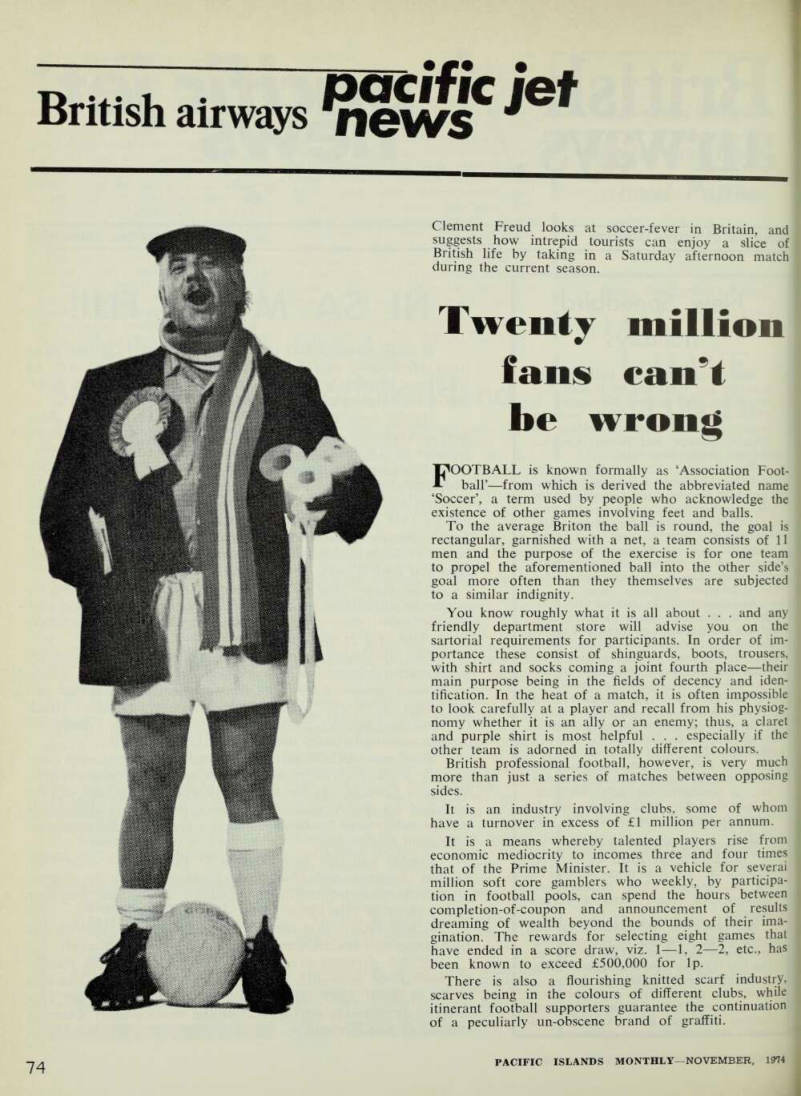
FOOTBALL is known formally as ‘Association Foot ball’—from which is derived the abbreviated name ‘Soccer’, a term used by people who acknowledge the existence of other games involving feet and balls.
To the average Briton the ball is round, the goal is rectangular, garnished with a net, a team consists of 11 men and the purpose of the exercise is for one team to propel the aforementioned ball into the other side’s goal more often than they themselves are subjected to a similar indignity.
You know roughly what it is all about . . . and any friendly department store will advise you on the sartorial requirements for participants. In order of im portance these consist of shinguards, boots, trousers, with shirt and socks coming a joint fourth place—their main purpose being in the fields of decency and iden tification. In the heat of a match, it is often impossible to look carefully at a player and recall from his physiog nomy whether it is an ally or an enemy; thus, a claret and purple shirt is most helpful . . . especially if the other team is adorned in totally different colours.
British professional football, however, is very much more than just a series of matches between opposing sides.
It is an industry involving clubs, some of whom have a turnover in excess of £1 million per annum.
It is a means whereby talented players rise from economic mediocrity to incomes three and four times that of the Prime Minister. It is a vehicle for several million soft core gamblers who weekly, by participa tion in football pools, can spend the hours between completion-of-coupon and announcement of results dreaming of wealth beyond the bounds of their ima gination. The rewards for selecting eight games that have ended in a score draw, viz. I—l,1 —1, 2 —2, etc., has been known to exceed £500,000 for Ip.
There is also a flourishing knitted scarf industry, scarves being in the colours of different clubs, while itinerant football supporters guarantee the continuation of a peculiarly un-obscene brand of graffiti.
Football in Britain, with all the ittendant publicity it receives on adio and television, is the most alked about sport, the most written bout sport, and, it is generally recog lised, the sport that most accurately epresents the people of the country.
Go into a hostelry and say ‘How re things going?’, and provided that lie question is asked between August ,nd early May, the question will be •resumed to refer to the fortunes of he local professional football club.
In the period between the wars, t was felt by sociologists that the ittle man who had led a tediously aonotonous life harnessed himself □ his weekly 90 minutes of glamour ►y supporting his team and basking a the reflected glory—if any. What 5 certain is that a prosperous team aeans a great deal to the com aercial well-being of a town, which 5 why Burnley, with a population >f 74,000 and a First Division team, aeans much more to the people of mgland than, say Bradford, which •as 300,000 and a team in the Fourth Division.
But football in Britain is even aore than just a game of skill, an xcuse for cheap week-end travel, a aeans of turning Ip into a fortune iid a star on to which you can lang your humdrum life.
By identifying with the club of our home town, men and women •f Britain can have weekly moments •f joy and misery . . . and in several ases, history has been changed adically as a result of the game, 'or instance, in 1970, when England /ent to Mexico to defend the World mp they won in 1966, Mr Wilson’s jovernment wooed the national team nd players with Downing Street •arties prior to departure, messages •f encouragement in the preliminary ounds . . . and when England were nocked out of the competition by
West Germany, in front of a home TV audience exceeding 20,000,000, the national feeling of misery was generally felt to have caused Labours defeat at the polls a week later.
This blind and continued support for the team of one’s first patronage is a strange phenomenon. The manager has long since retired to run a tobacconist or sports equipment shop near the ground. The players are scattered and forgotten, the ground has been rebuilt and the club colours changed when, after an inevitable cash crisis, a new chair man took over and his wife decided that green and white might look nicer than the discredited orange and black.
But come hell or high water, the old age pensioners still talk about ‘our team’ . . . and when the results are announced at 5 pm on a Satur day, victory for their erstwhile heroes (alas, all dead) still calls for celebration.
Naturally, the game has changed significantly as more money and more skill became available for training
and management. The stars of my youth had bullet heads with which they transferred a fierce ball crossed from the wing into the back of the net with not so much as a late night headache to show for it. Other stars had amazingly strong left or right foot shots and they distinguished themselves mostly by idiosyncrasies of dress—like long shorts or heavily brilliantined hair.
Until the mid 19505, footballers were on a maximum wage which compared with junior schoolmasters and, from a social point of view, professional football got no one any where.
Today, the stars of football nego tiate their contracts, some of them through agents. They drive large cars, endorse clothes, hair tonics and beer, are seen in the best night clubs and attend smart dinner parties. Even on the field of play, where their elders would solemnly shake the hand of a man who has scored a goal, these young lions jump upon the scorer and smother him with kisses, em braces and 1 know not what.
And yet, while so many of the trimmings of the game have changed, much of the intrinsic character has remained. If you are a masochist, you still go and watch Chelsea . . . a side of great talent with an un canny way of losing against bad teams, beating the good ones.
At Bolton, they play it as hard today as they did when they had defenders with legs like oak trees whose second or third kick was actually directed at the ball. At Aston Villa, Birmingham, they get huge crowds out of all proportion to the allure of the game, and at Ipswich, where the games are skilful and the team succeeds more often than it fails, the crowds are small.
If there is change it has come in cities with two first class teams . . . like Manchester, where United ruled supreme for the twenty post-war years . . . only to sink into the Second Division this spring, leaving Manchester City to represent Man cunian honour. While the world will watch the results of Manchester City, the supporters of United will remain loyal ... at least for the next five years.
Perhaps if one wanted to be in doctrinated into the arts of being a
supporter, the Kop at Liverpool’s Anfield Road ground would be the place to go. A huge mass of swaying, chanting humanity singing with the pitch of a church choir; shouting ad vice with the heavy wit of cockney taxi drivers.
What they do in Liverpool, they do very very well. During the foot ball season, from late August to early May, there is an immense choice of soccer matches being played all over the country on a Saturday afternoon.
At this time of the year, and again at the end of the season, there are also a number of midweek matches.
Some cities like Manchester and Glasgow have more than one pro fessional side and in London there are 11 clubs playing top class foot ball.
The difficulty for the uninitiated is to know which game to choose.
An indispensable handbook as to who’s who among the teams is the Playfair Football Annual. This lists the clubs, and the addresses of their grounds, tells you which belong to the Ist Division of the Football League, in other words which clubs have had the greatest success in the previous year, who their players are, which teams they are playing
throughout the season and the nearest railway station to the ground.
Local newspapers too are useful for information on forthcoming fixtures and the fortunes of the local sides.
Tickets are normally available only from the Club direct, although in London there are theatre ticket agencies who hold tickets for some games. The only type of ticket you can buy in advance is for the Stand, which in fact entitles you to a seat.
These are sold initially by post from the ground, two or three weeks be fore the match, and any that are left are sold on the day. If you are prepared to stand —normally with out cover —for the 90 minute dura tion of the game, then you simply pay to enter the ground. Price of admission does vary but for a League game this will usually be about 50 p. A seat is from £l.