changing
pp. 75-76 · Read in the full issue
Keeping up with fast changing Papua New Guinea
As everybody knows, at this
moment they are remaking
Papua New Guinea. It became self-governing last December and it will become independent some time in the next few months, although for most purposes it is
independent now.
These are big changes in a group of islands comprising 21 million people who can’t yet be said to form a nation, although leaders like Chief Minister Michael Somare are making a valiant effort to turn the islands into a nation.
It follows that the changes are re flected in every aspect of the society, from top to bottom—and not the least in the Public Service, where responsibilities change almost daily as departments and senior personnel are moved around like musical chairs. In this time of great expansion, trained New Guineans naturally are in short supply, and the fellow who runs the information services in Port Moresby one week is likely to be consul in Sydney the next, and the fellow who runs the airline is likely to be com missioner in Jakarta.
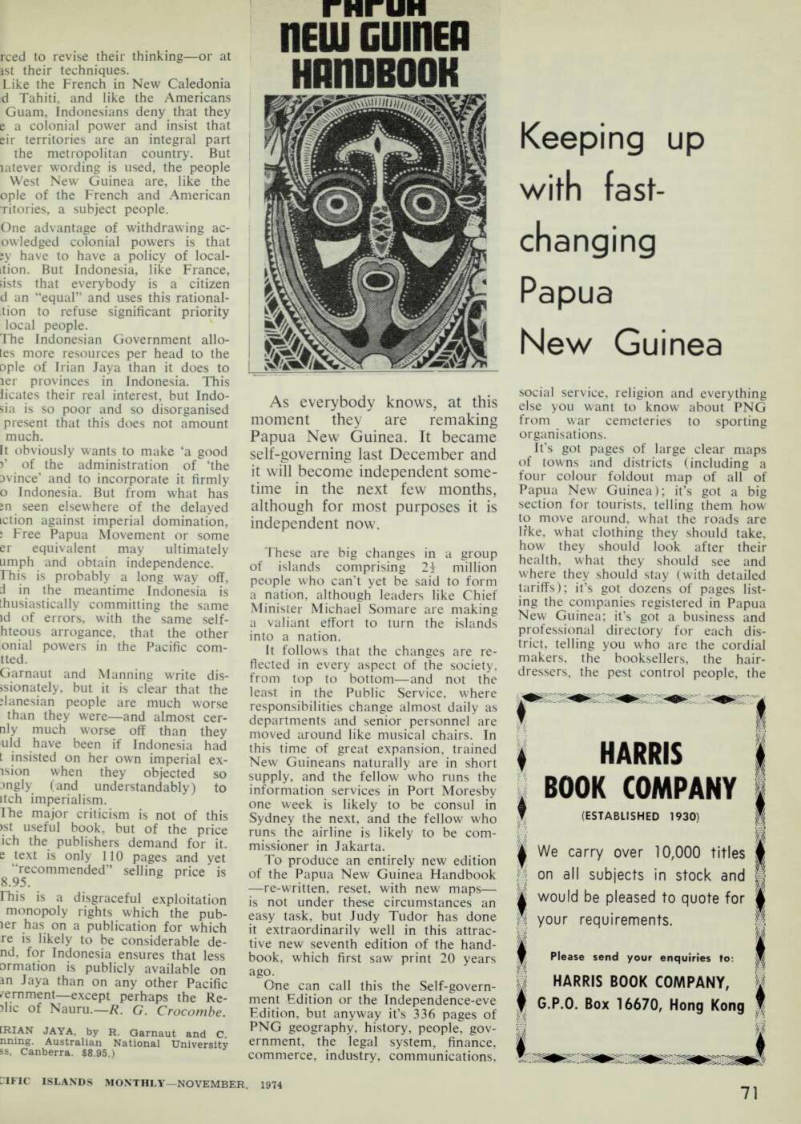
To produce an entirely new edition of the Papua New Guinea Handbook —re-written, reset, with new maps— is not under these circumstances an easy task, but Judy Tudor has done it extraordinarily well in this attrac tive new seventh edition of the hand book, which first saw print 20 years ago.
One can call this the Self-govern ment Edition or the Independence-eve Edition, but anyway it’s 336 pages of PNG geography, history, people, gov ernment, the legal system, finance, commerce, industry, communications.
social service, religion and everything else you want to know about PNG from war cemeteries to sporting organisations.
It's got pages of large clear maps of towns and districts (including a four colour foldout map of all of Papua New Guinea); it’s got a big section for tourists, telling them how to move around, what the roads are like, what clothing they should take, how they should look after their health, what they should see and where they should stay (with detailed tariffs); it’s got dozens of pages list ing the companies registered in Papua New Guinea; it’s got a business and professional directory for each dis trict, telling you who are the cordial makers, the booksellers, the hair dressers, the pest control people, the
accountants, the motor garages, the child minding services, the customs agents, etc. It tells you about the drinking hours and names those who hold the liquor licences.
It also tells you how the govern ment departments are organised, what they do and who runs them, but in this respect this self-government issue differs from the six previous editions which gave not only the name of the permanent secretary but the names of all the other personnel who held senior positions in the department.
But such have been the extra ordinary and continuing changes in this last 12 months that editor Judy Tudor decided to retain only the names of the departmental heads, and list the senior positions in the depart ments and not the people who hold them, because to do otherwise was
impossible.
Nevertheless, despite problems like this the seventh edition of the Papua New Guinea Handbook is remarkable for the accuracy of its information, which was still being updated in some sections only a month before publica tion. In any case, the publishers say in a foreword that they plan to pro duce an early revision of the hand book soon after independence and to update in more frequent, but smaller, editions from then on. In the meantime, they point out, they have done their best “to ensure that the information in this new edition is, at the time PNG approaches indepen dent status, as up-to-date as it is possible for any handbook to get”.
(Papua New Guinea Handbook.
Seventh edition. Published by Pacific Pub lications (Australia) Pty Ltd, GPO Box 3408, Sydney, $5.50.)