Polynesia's
pp. 37-41 · Read in the full issue


Problems of Polynesia's biggest city
By W. G. Coppell
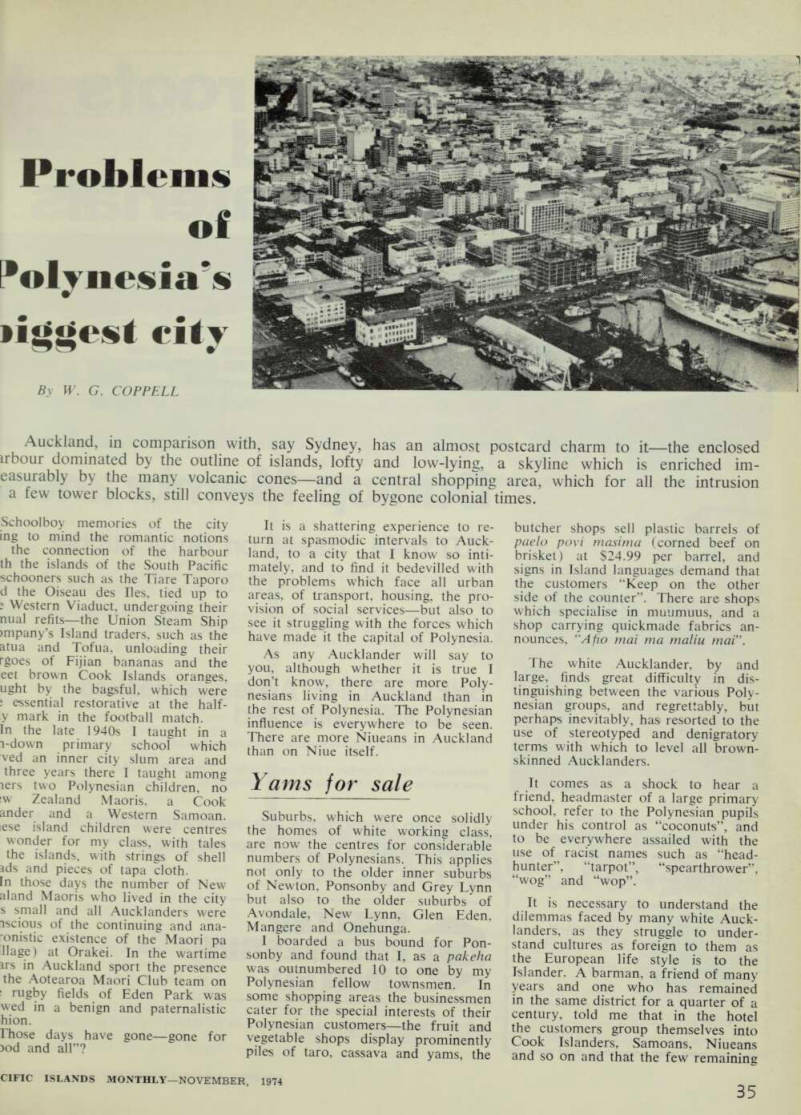
Auckland, in comparison with, say Sydney, has an almost postcard charm to it—the enclosed trbour dominated by the outline of islands, lofty and low-lying, a skyline which is enriched im easurably by the many volcanic cones—and a central shopping area, which for all the intrusion a few tower blocks, still conveys the feeling of bygone colonial times.
Schoolboy memories of the city ing to mind the romantic notions the connection of the harbour th the islands of the South Pacific schooners such as the Tiare Taporo d the Oiseau des lies, tied up to ; Western Viaduct, undergoing their nual refits—the Union Steam Ship )mpany’s Island traders, such as the atua and Tofua, unloading their rgoes of Fijian bananas and the eet brown Cook Islands oranges, ught by the bagsful, which were ; essential restorative at the half y mark in the football match.
In the late 1940 s I taught in a i-down primary school which ved an inner city slum area and three years there I taught among icrs two Polynesian children, no ;w Zealand Maoris, a Cook ander and a Western Samoan, ese island children were centres wonder for my class, with tales the islands, with strings of shell ads and pieces of tapa cloth.
In those days the number of New aland Maoris who lived in the city s small and all Aucklanders were ascious of the continuing and ana onistic existence of the Maori pa llage) at Orakei. In the wartime ars in Auckland sport the presence the Aotearoa Maori Club team on • rugby fields of Eden Park was wed in a benign and paternalistic hion.
Fhose days have gone—gone for aod and all”?
It is a shattering experience to re turn at spasmodic intervals to Auck land, to a city that I know so inti mately, and to find it bedevilled with the problems which face all urban areas, of transport, housing, the pro vision of social services—but also to see it struggling with the forces which have made it the capital of Polynesia.
As any Aucklander will say to you, although whether it is true I don’t know, there are more Poly nesians living in Auckland than in the rest of Polynesia. The Polynesian influence is everywhere to be seen.
There are more Niueans in Auckland than on Niue itself.
Yams for sale
Suburbs, which were once solidly the homes of white working class, are now the centres for considerable numbers of Polynesians. This applies not only to the older inner suburbs of Newton, Ponsonby and Grey Lynn but also to the older suburbs of Avondale, New Lynn, Glen Eden.
Mangere and Onehunga.
I boarded a bus bound for Pon sonby and found that I, as a pakeha was outnumbered 10 to one by my Polynesian fellow townsmen. In some shopping areas the businessmen cater for the special interests of their Polynesian customers—the fruit and vegetable shops display prominently piles of taro, cassava and yams, the
butcher shops sell plastic barrels of paelo povi masima (corned beef on brisket) at 524.99 per barrel, and signs in Island languages demand that the customers “Keep on the other side of the counter”. There are shops which specialise in muumuus, and a shop carrying quickmade fabrics an nounces, “Afio mai ma maliu mai”.
The white Aucklander, by and large, finds great difficulty in dis tinguishing between the various Poly nesian groups, and regrettably, but perhaps inevitably, has resorted to the use of stereotyped and denigratory terms with which to level all brown skinned Aucklanders.
It comes as a shock to hear a friend, headmaster of a large primary school, refer to the Polynesian pupils under his control as “coconuts”, and to be everywhere assailed with the use of racist names such as “head hunter”, “tarpot”, “spearthrower”, “wog” and “wop”.
It is necessary to understand the dilemmas faced by many white Auck landers, as they struggle to under stand cultures as foreign to them as the European life style is to the Islander. A barman, a friend of many years and one who has remained in the same district for a quarter of a century, told me that in the hotel the customers group themselves into Cook Islanders, Samoans, Niueans and so on and that the few remaining
hite patrons have retreated to a >rner of the saloon bar.
However, Auckland is in the >sition now that its way of life is tally dependent upon the Poly ;sian. Step aboard any bus and the lances are 10 to one that the driver ill be brown-skinned; in the laun ies and clothing factories Islands 3men represent by far the largest irt of the work-force. I have a iend who was matron of a hospital the South Seas, and now a matron a large Auckland hospital, who mits that if the Island women who rry out the duties of cleaners, iindry workers and many of the un illed tasks about the wards were go, her hospital would cease to riction.
In the present economic environ mt the Islander is fortunate in ickland, there has been no unem 3yment in the city throughout 1974, man reporting himself as out of a ) in the morning is suitably placed afternoon. For the sake of the my Islands people, whose stake in :w Zealand is slight, it must be ped that unemployment will not :ome a blight upon them.
Many attempts are being made to d ways of fitting the Polynesian 3ple into Auckland in as sympa tic and understanding way as is ssible. The Auckland regional hority is currently examining sites, ere a combined Islands mare (meet place) will be established, with arge meeting hall and with Island
style houses grouped about the grounds. The government is making provision for some rented State houses to be reserved for Island families and young Islanders are receiving apprenticeship training in the skilled trades social nroblems inere L are social problems
Tdentity and
of cultural hn y ks "" preSerVa,lOn The Pacific Islanders’ Church in Edinburgh Street, Newton, is a prime example of the approach of voluntary organisations to the problems faced by he Js land «; T . h e Rev R. L Challis, together with ministers from the Cook
Islands, Western Samoa and Niue, direct the activities of a very large and diverse congregation. , „ , . , ,„ . , ln all there are ei B ht full-time ministers, and on a Sunday 21 ser vices are conducted m the city and at Glen Eden ’ Te Atatu, Manurewa, nriph]in „„ „ nH AvrmHak a thrm sand children attend the Sunday school and up to 1400 people majr p tcel ?. d **J®. A' oC i!°o servlce in Engllsh at Edinburgh Street.
The church is involved in activities typical of its work in the Islands; there are youth clubs, boys brigade, girls brigade, clubs for the middle-
»ed and the lay preachers’ class, he church devotes much of its time ) choir practices, and in the foyer e trophies won by the Sunday hool choirs. Sporting activities are so sponsored by the church and it is teams which compete in cricket id basketball, but it has decided, >r rather obvious reasons, that it ill not sponsor rugby league or igby union teams. The needs of the lands children in the local schools e met in some small degree by the inisters taking part in Bible classes 1 a once weekly basis.
The police, on the other hand see e problems from an entirely dif rent point of view.
Thev are basically concerned to en re that the Islanders keep out of aiible and when trouble occurs that is dealt with judiciously and fairly, lere is a task force of police which charged with dealing with affrays
volving Polynesians.
linor crimes
Interestingly enough, a senior police ficer told me that experience has own that much of the trouble lich occurs is not between rival ands groups, but more frequently solves members of the same family. 2 also said that many of the anders who come under the notice the police do so for minor in ictions, which often take place be use of ignorance of standards of haviour acceptable in Auckland.
The police are now more concerned establishing a preventative role and 2 so-called “J-Teams” (for Joint ams) have been created for Auck id Central, Henderson and Ota hu. These teams are made up of e member of the police force, a jresentative of the Department ’ of aori and Island Affairs and a
minister of religion. The general philosophy being adopted is that the police members are not on the teams to detect offenders, but to support community workers and convey the police point of view.
To understand, even to some slight extent, what is happening to the burgeoning Polynesian community in Auckland and elsewhere in New Zealand is a task of some magnitude and it is essential that hasty judg ments are not taken. There is great danger in the proposition put forward by a very prominent politician that the solution lies simply in sending the Polynesians back home.
There seems no doubt that the child born of Island parents in New Zea land will become a New Zealander; there is so little to attract him to return to his ancestral home.
A Mangaian said to me that he had felt sad when he had first arrived in Auckland, having left his land, but now he could see so many ad vantages for his children, he had gained so much from his job, and there was so much happening in Auckland, that he didn’t think that he would ever return to Mangaia.
A Rarotongan girl spoke to me in Queen Street and told me in nostalgic terms about her family and friends in Rarotonga but when I asked her if she was going to return home, she thought not as her father had died and would not be able to support her in Rarotonga.
And yet the ties with the Islands are being kept very much alive for many people. Mangere airport must be one of the most crowded airports in the world for its size, and when ever there is a plane leaving from or arriving from Island destinations, the numbers of Island people in the passenger lobby is astounding.
There are more Niueans in Auckland than on Niue. Here Niueans farewell departure of family and friends at Niue's airport.