Brewing Again
p. 29 · Read in the full issue
Storm In Fiji's
Tea-Cups Is
From VUENDRA KUMAR, in Lautoka In Fiji, people take their cup of tea seriously. Not ily is it the commonest offering to a guest who may rop in at one’s home, but it is also part of the staple et in the rural areas.
But like so many consumer goods, tea is becoming scarce commodity in Fiji these days. Supermarket lelves are always running out.
Tea drinkers’ problems really started when the gov nment slashed tea imports by 50 per cent to encourage id protect a faltering local tea blending company. :uch of the current public wrath is directed at the cal company, Domino Pacific Inc Ltd, which has wer been able to fully supply the market. Added to e supply problem is that tea drinkers seem to dislike e locally blended tea. They say it is too weak and atery.
“You’ve got to empty virtually the whole packet in kettle of water before you get reasonably concentrated a,” one housewife told me.
Although the government has recently allowed mer tants to import more overseas blended tea, consumers nerally cannot get enough of their favourite brand, ishells, which is Ceylonese tea blended in Australia, ther brands like Lipton seem not to have caught on, spite heavy radio and newspaper advertising.
Domino Pacific Inc Ltd, which has its factory at ausori, 12 miles north of the capital city of Suva, is been plagued by troubles. Its managing director, r Mohammed Khalil, said poor shipping services tween India (where he gets his tea from) and Fiji ve been causing him trouble.
The factory is the brainchild of the Indian High unmissioner, Mr Bhagwan Singh, who helped Mr lalil, a former driving instructor, to launch the nture on a shoe-string budget.
Mr Khalil’s refusal to let press representatives into > factory aroused suspicions that all was not well, msumers were asking who were the experts blending Tea drinkers, who generally know little about what es on inside a tea-blending factory, were somewhat
alarmed when a company spokesman announced that his company would import tea leaves from anywhere.
One Bushells fan told me that he feared that the company might use some of the local “bush” tea as well!
But despite all the objections to the local Tui brand tea, I believe that a lot of people are prejudiced against it simply because they do not want to give up old habits. Many of them have condemned the brand without even sampling a cup of brew from it.
Fiji tea drinkers can be divided into three categories.
The Indian wants his tea strong, with liberal doses of milk and sugar in it. The Gujratis (merchants who originally came from Gujrat in India) want it spiced with cinnamon and eucalyptus seeds. The Punjabis prefer tea made purely in milk—no water at all.
The Fijians, some rural Indians, want it “black” or “red”—without milk but with plenty of sugar. While the Fijian takes his cup of tea with his meals, usually with bread, the Indian farmer drinks a large bowl of it with his breakfast and then polishes off another bowl in the afternoon before dinner.
The third category of drinkers includes Europeans, who seem to like weak tea, always with milk and sugar —unless one is diabetic. The Chinese drinks his tea in privacy with the usual Oriental ritual. (I once tried Chinese tea and found it extremely unpalatable.) This third group is not fussy—at least publicly—about its tea problems. But the first two groups won’t have any nonsense.
The local tea is held in such contempt by some people that one person has been advocating “lemon tea”. This is a brew made of lemon leaves instead of tea leaves.
It is tangy in taste and can be quite pleasant—some times.
It seems Fiji’s tea drinkers will continue facing prob lems unless the local factory produces an acceptable flavour, or the government lifts all import restrictions.
Or tastes change.
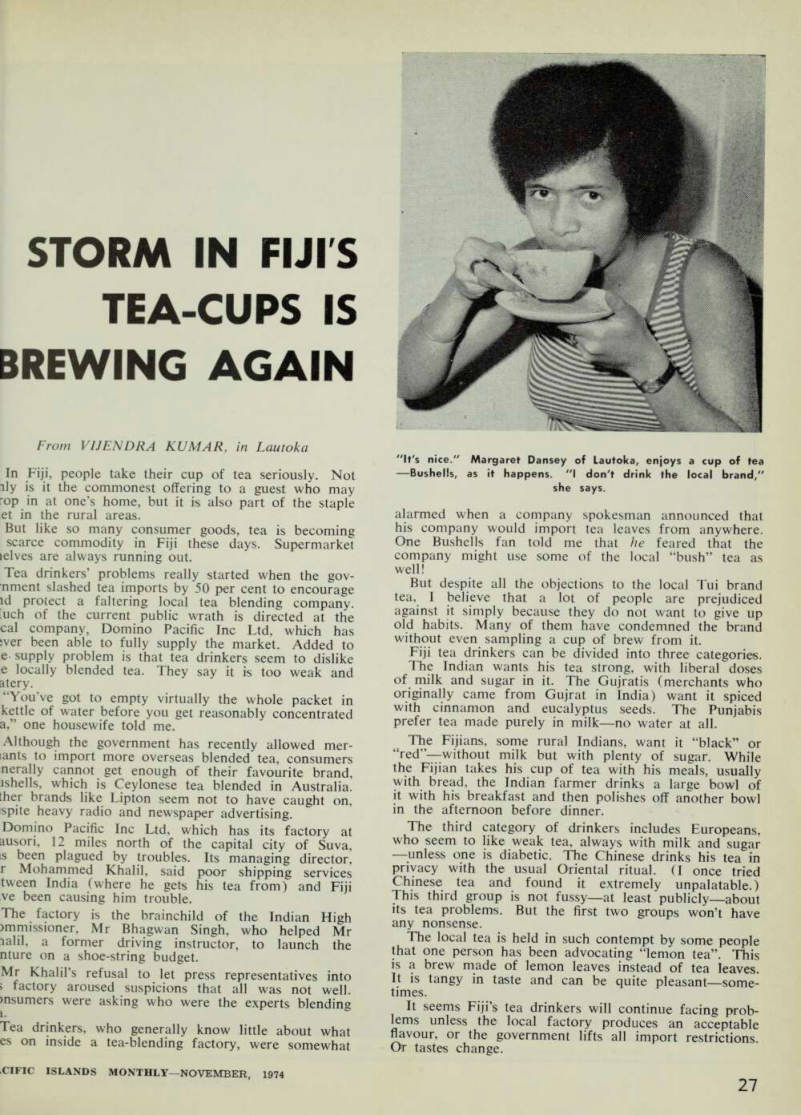
"It's nice." Margaret Dansey of Lautoka, enjoys a cup of tea —Bushells, as it happens. "I don't drink the local brand," she says.