Unhappier
pp. 26-28 · Read in the full issue
face of Friendly Fiji
From SUE WENDT in Suva Tourism in Fiji isn’t the flourishing healthy plant it used to be. The in cipient rot has corroded quite sign nificantly the traditional “friendly Fiji” image. (It’s certainly time for a new image!) Fiji Visitors Bureau offices, the Consumer Council and the Depart ment of Communications, Works and Tourism all have fat files of com plaints from angry visitors with grievances to air.
Causes range from undelivered souvenirs to over-charging by dud free dealers, from surliness of staff to cockroaches in the food.
An irate Auckland woman in Sep tember demonstrated a new weapon in the fight against what she con sidered unfair dealing. She picketed a Suva duty free shop and after at tracting the Press, the police and an interested crowd, she succeeded in getting her money back.
Mrs Renata Stempher contended that the duty free dealer quoted her a price of $175 for a stereo set. But when she gave the shopkeeper $2OO in New Zealand travellers’ cheques (5F224) she received only $23 change instead of $49.
The shopkeeper said he quoted the price in New Zealand currency, but Mrs Stempher said she understood he quoted Fiji currency.
Although the manager declared at first that a sale was a sale, after Mrs Stempher stood outside the shop tell ing would-be customers of her ex perience, he finally agreed to the re turn of the set.
The “persuasion” can only be blufl or veiled threats, for the FVB and the Consumer Council have no legal authority to enforce a settlement. The police, too, keep out of it if it’s a straightforward argument between tourist and shopkeeper over prices Shop around! is the obvious message Price isn’t the only complaint Numerous letters tell of obsolete goods being substituted for new, dur ing packing. Other goods are paid for, but not delivered.
Complaints against duty free dealers are numerous, but if it’s simply a case of a tourist buying in one shop and finding he could have
jought the goods elsewhere for less, here’s little the Fiji Visitors Bureau >r any other agency can do.
The bureau’s policy is to try to latisfy the customer. In this respect, aid an FVB spokesman, “it is often lelpful to persuade the merchant that n the interests of good publicity >verseas, the complaining customer hould be satisfied even if it does put hem out of pocket for a few dollars.”
In the case of duty free dealers, it s often a matter of the unscrupulous ew blackening the name of the whole ndustry. As the Consumer Council loints out: “We are very much aware if the customer who behaves rudely; he people who use dishonest tactics nd take up shopkeepers’ time when hey have no intention of buying; of he bouncing cheques . . .”
And over recent years, it hasn’t Iways been true that taxi drivers ave charged unrealistic, inflated rices, as is often believed. In follow ig up these complaints last year the Consumer Council discovered that the overnment-published schedule being uoted in some tourist publications r as 20 years old! Obviously, taxi rivers were not following it or dis laying it. Taxi meters—to be intro uced soon—will solve that problem.
Of major concern are the street )uts. Under the heading “Sword filing Touts”, a local travel agent rote of numerous complaints re vived concerning the “tactics and lanners of the numerous touts selling )-cal!ed Fijian swords on Suva reels”.
“Their favourite approach is to irround in twos, threes or fours, derly tourists or young women tour ts and then almost belligerently Ter to carve the person’s name on ie sword at a cost ranging from The agent cited cases where young omen have been in tears after this pe of approach and one elderly mple terrified by the whole incident.
“Such standover tactics, with be ildered visitors surrounded by big, irly, in most cases unshaven, dirty agleted Fijian males, conveys an dremely bad impression of Fijian
)spitality and friendliness”, the
;ent declared.
A visitor wrote describing one of iva’s less expensive guest houses: “Meals—no choice; waitress didn’t eak or understand much English.
Dinner—poor soup, meat, one een veg, 1 potato.
Breakfast—poor tea (bad taste), ied egg and bacon badly cooked id greasy, boiled egg put on big ate, no egg cup or spoon.
Pool—not usable—dirty sur undings—bad access to pool with
wire netting crushed down to step over.
Bedroom —sheets patched down middle and torn on two beds”.
Discontent isn’t confined to the smaller, cheaper establishments. A hotel long considered Fiji’s most ex pensive and luxurious is attracting an increasing amount of criticism. The setting is magnificent. But the surly attitude of staff and management’s indifference to complaints alienates guests. There is a general air too of “you tip—or no service”.
Bad service is so widespread in Fiji hotels that good service is received with surprise and delight. After a week at a luxury hotel on the Coral Coast, an Australian couple said they’d become used to receiving their wine at the same time as their coffee.
In Suva, the wine arrived with the first course—to their surprise.
At the same international standard Suva hotel however, when the visitors and their guests had ordered, the waitress loudly demanded: “Cash or charge?” The supermarket approach might be efficient, but it hardly makes for gracious dining in the city’s most expensive restaurant.
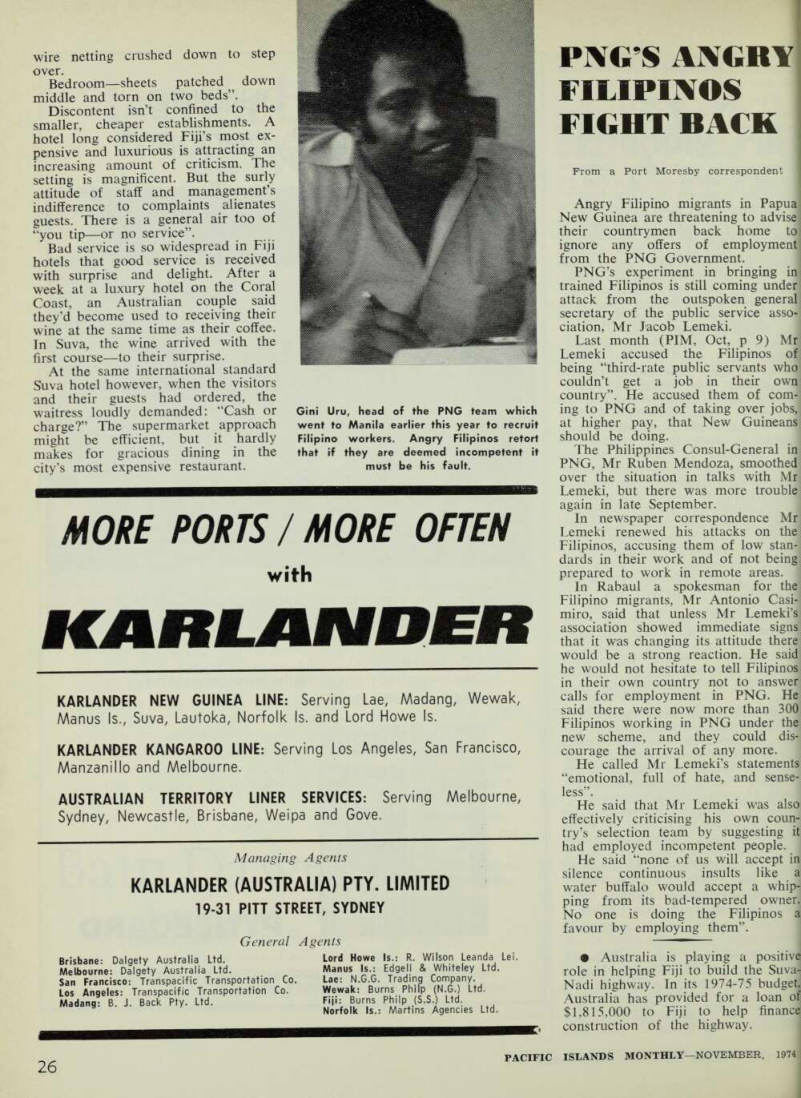
Gini Uru, head of the PNG team which went to Manila earlier this year to recruit Filipino workers. Angry Filipinos retort that if they are deemed incompetent it must be his fault.