diversity’
pp. 17-18 · Read in the full issue
'Dazzling diversity’ of PNG tradition
From Kirsty Powell,
in Port Moresby.
The Fourth Niugini Arts Festival is over. For three weeks, 50 (roups from various parts of Papua New Guinea, and from other have performed in varying combinations, on 50 different occasions, in 30 different locations around Port Moresby
In market places, sports fields, mools, colleges, the stadium, the ►pen Air Theatre, and the cultural mtre, people have danced, and sung, id acted plays, and played musical istruments before the biggest and
lost far-flung audience ever.
It was the most ambitious festival Jt. Perhaps too ambitious: for the rge number of participating groups ere uneven in quality, and the omentum and excitement of the "st week were not maintained. The ogadala dancers (from Balimo in e Western District), performed on e last Saturday night before a mere •nnkling of people on the grass of e cultural centre. On the Sunday, iwever, the final night of the festi il, they danced to a crowd of over thousand packed into the Open Air icatre.
And the crowd was rapt. The ogadala dancers have never before en seen outside Western District. their grass and leaf skirts, with eir highly elaborate painted and athered masks, and their bobbing il pieces they danced to the com lling rhythm of kundu drums (two them eight feet long—the longest ndus I’ve seen), gourd rattles, per ssive “walking sticks” of split mboo, conch shells, and haunting ng.
They moved on stage like seasoned rformers, following the patterns olved for performing in their great ighouses. The performance is
splendid in itself. But it is also the expression of a remarkable cultural revival, for these dances and their superb costumes, apparently lost after 40 years of disuse and disapproval, have been revived in the last three years.
Such a cultural revival not un naturally strives for authenticity to tradition and authentic tradition rep resents one strand in the festival per formances. The dazzling diversity of Papua New Guinean tradition was once again demonstrated.
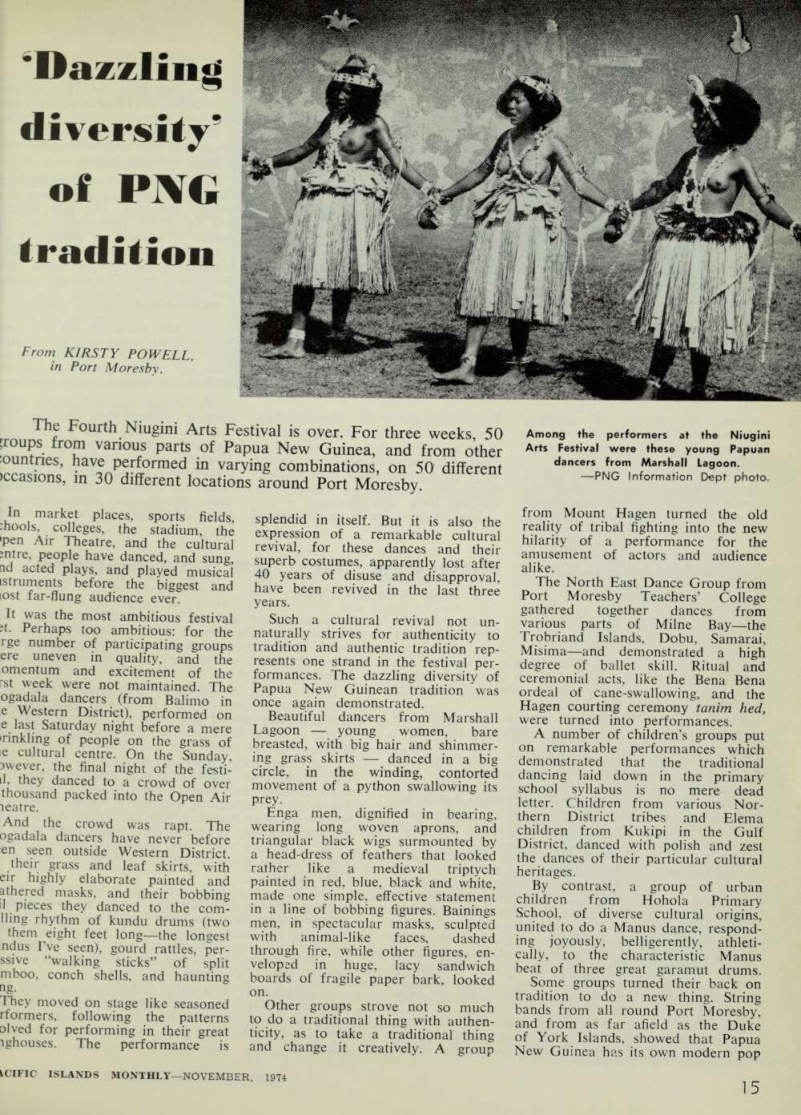
Beautiful dancers from Marshall Lagoon young women, bare breasted, with big hair and shimmer ing grass skirts danced in a big circle, in the winding, contorted movement of a python swallowing its prey.
Enga men, dignified in bearing, wearing long woven aprons, and triangular black wigs surmounted by a head-dress of feathers that looked rather like a medieval triptych painted in red, blue, black and white, made one simple, effective statement in a line of bobbing figures. Bainings men, in spectacular masks, sculpted with animal-like faces, dashed through fire, while other figures, en veloped in huge, lacy sandwich boards of fragile paper bark, looked on.
Other groups strove not so much to do a traditional thing with authen ticity, as to take a traditional thing and change it creatively. A group
from Mount Hagen turned the old reality of tribal fighting into the new hilarity of a performance for the amusement of actors and audience alike.
The North East Dance Group from Port Moresby Teachers’ College gathered together dances from various parts of Milne Bay—the Trobriand Islands, Dobu, Samarai, Misima—and demonstrated a high degree of ballet skill. Ritual and ceremonial acts, like the Bena Bena ordeal of cane-swallowing, and the Hagen courting ceremony tanim hed, were turned into performances.
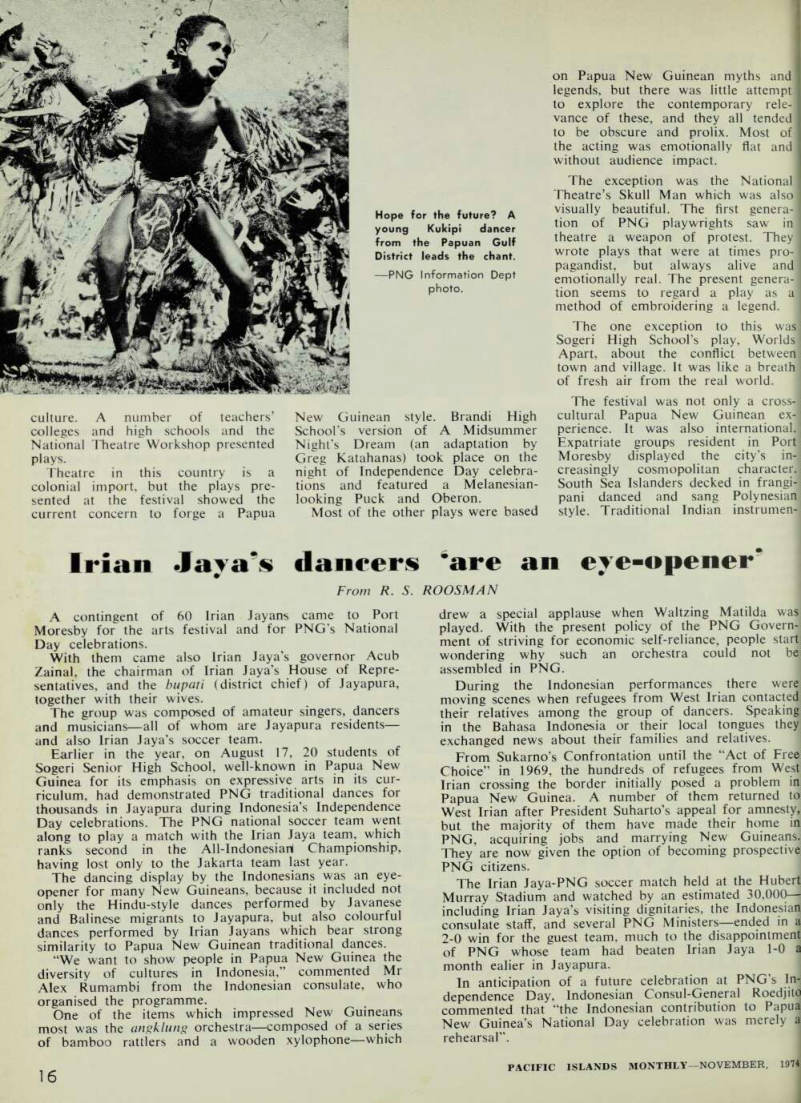
A number of children’s groups put on remarkable performances which demonstrated that the traditional dancing laid down in the primary school syllabus is no mere dead letter. Children from various Nor thern District tribes and Elema children from Kukipi in the Gulf District, danced with polish and zest the dances of their particular cultural heritages.
By contrast, a group of urban children from Hohola Primary School, of diverse cultural origins, united to do a Manus dance, respond ing joyously, belligerently, athleti cally, to the characteristic Manus beat of three great garamut drums.
Some groups turned their back on tradition to do a new thing. String bands from all round Port Moresby, and from as far afield as the Duke of York Islands, showed that Papua New Guinea has its own modern pop
Among the performers at the Niugini Arts Festival were these young Papuan dancers from Marshall Lagoon. —PNG Information Dept photo.
culture. A number of teachers’ colleges and high schools and the National Theatre Workshop presented plays.
Theatre in this country is a colonial import, but the plays pre sented at the festival showed the current concern to forge a Papua
New Guinean style. Brandi High School's version of A Midsummer Night’s Dream (an adaptation by Greg Katahanas) took place on the night of Independence Day celebra tions and featured a Melanesian looking Puck and Oberon.
Most of the other plays were based
on Papua New Guinean myths and] legends, but there was little attempt! to explore the contemporary rele vance of these, and they all tended! to be obscure and prolix. Most of I the acting was emotionally flat and without audience impact.
The exception was the National Theatre’s Skull Man which was also visually beautiful. The first genera-j tion of PNG playwrights saw in theatre a weapon of protest. They wrote plays that were at times pro- i pagandist, but always alive and ! emotionally real. The present genera-j tion seems to regard a play as a method of embroidering a legend.
The one exception to this was Sogeri High School’s play, Worlds Apart, about the conflict between town and village. It was like a breath of fresh air from the real world.
The festival was not only a cross-j cultural Papua New Guinean ex perience. It was also international.
Expatriate groups resident in Port Moresby displayed the city’s in creasingly cosmopolitan character.
South Sea Islanders decked in frangi pani danced and sang Polynesian style. Traditional Indian instrumen-
Hope for the future? A young Kukipi dancer from the Papuan Gulf District leads the chant. —PNG Information Dept
photo.