New Chief
Minister
Plays It Cool
From a Honiara correspondent
Swinging straight into action
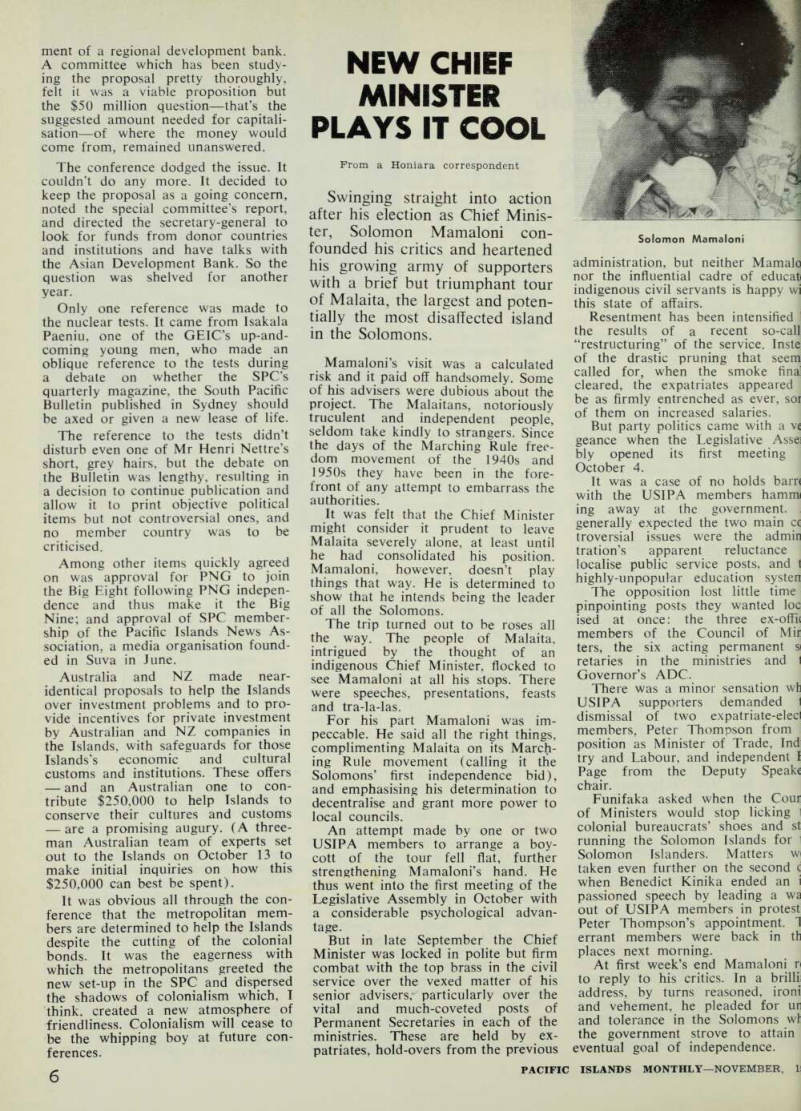
after his election as Chief Minis ter, Solomon Mamaloni con founded his critics and heartened his growing army of supporters with a brief but triumphant tour of Malaita, the largest and poten tially the most disaffected island in the Solomons.
Mamaloni’s visit was a calculated risk and it paid off handsomely. Some of his advisers were dubious about the project. The Malaitans, notoriously truculent and independent people, seldom take kindly to strangers. Since the days of the Marching Rule free dom movement of the 1940 s and 1950 s they have been in the fore front of any attempt to embarrass the authorities.
It was felt that the Chief Minister might consider it prudent to leave Malaita severely alone, at least until he had consolidated his position.
Mamaloni, however, doesn’t play things that way. He is determined to show that he intends being the leader of all the Solomons.
The trip turned out to be roses all the way. The people of Malaita, intrigued by the thought of an indigenous Chief Minister, flocked to see Mamaloni at all his stops. There were speeches, presentations, feasts and tra-la-las.
For his part Mamaloni was im peccable. He said all the right things, complimenting Malaita on its March ing Rule movement (calling it the Solomons’ first independence bid), and emphasising his determination to decentralise and grant more power to local councils.
An attempt made by one or two USIPA members to arrange a boy cott of the tour fell flat, further strengthening Mamaloni’s hand. He thus went into the first meeting of the Legislative Assembly in October with a considerable psychological advan tage.
But in late September the Chief Minister was locked in polite but firm combat with the top brass in the civil service over the vexed matter of his senior advisers,' particularly over the vital and much-coveted posts of Permanent Secretaries in each of the ministries. These are held by ex patriates, hold-overs from the previous
administration, but neither Mamalo nor the influential cadre of educat indigenous civil servants is happy wi this state of affairs.
Resentment has been intensified 1 the results of a recent so-call “restructuring” of the service. Inste of the drastic pruning that seem called for, when the smoke final cleared, the expatriates appeared be as firmly entrenched as ever, soi of them on increased salaries.
But party politics came with a ve geance when the Legislative Assei bly opened its first meeting October 4.
It was a case of no holds barn with the USIPA members hamrru ing away at the government, generally expected the two main cc troversial issues were the admin tration’s apparent reluctance localise public service posts, and t highly-unpopular education systen The opposition lost little time pinpointing posts they wanted loc ised at once: the three ex-offi( members of the Council of Mir ters, the six acting permanent si retaries in the ministries and 1 Governor’s ADC.
There was a minor sensation wh USIPA supporters demanded 1 dismissal of two expatriate-eled members, Peter Thompson from position as Minister of Trade, Ind try and Labour, and independent I Page from the Deputy Speake chair.
Funifaka asked when the Cour of Ministers would stop licking i colonial bureaucrats’ shoes and st running the Solomon Islands for i Solomon Islanders. Matters wi taken even further on the second c when Benedict Kinika ended an i passioned speech by leading a wa out of USIPA members in protest Peter Thompson’s appointment. 1 errant members were back in th places next morning.
At first week’s end Mamaloni r< to reply to his critics. In a brillii address, by turns reasoned, ironi and vehement, he pleaded for ur and tolerance in the Solomons wt the government strove to attain eventual goal of independence.
Solomon Mamaloni