Pacific Islands Monthly
pp. 6-8 · Read in the full issue
A Pen Stroke And The Pacific
Becomes An Islands Co-Operative
Colonialism’s shadow seems to have lifted from the South Pacific Commission and Conference. With sweet reason permeating the atmosphere like at no other conference in SPC history, the 14th conference, which lasted here for eight working days from September 25, approved without amendment the Memorandum of Understand ing agreed at the Wellington meeting of the eight member govern ments of the SPC.
From John Carter
PIAA's man in Rarotonga
At long last the Islands have an equal say with their former colonial masters in the doings of the SPC.
The memorandum was ceremoniously signed by the Big Eight and the oc casion was regarded as so important that, for the first time in the history of the commission and conference, four prime ministers attended —New Zealand’s new Prime Minister Mr Bill Rowling, Australian Prime Minister Gough Whitlam, Fiji’s Ratu Sir Kamisese Mara and Western Samoa’s Fiame Mataafa.
Three of them put their names to the document which bears such an obscure title that history will have to add a footnote everytime it’s trotted out for inspection. Australia’s Science Minister Bill Morrison added his name because Prime Minister Whitlam had been and gone, an overnight stop on the way to the United Nations. The brief visit gave Mr Whitlam one of those firsts he likes to collect—the first Australian prime minister to visit the Cook Islands and the first prime minister from anywhere to attend the South Pacific Conference.
Little time was taken over such an historic occasion. The irrepressible Premier of the Cooks, Sir Albert Henry, allowed no one or anything much time. With a rod of iron en cased in suave geniality he ran that conference like a schoolmaster.
I’m sure that it was the memoran dum which brought a subtle change to the atmosphere. At other con ferences there have been flashes of anger; sneers at colonial masters and a definite cleavage of opinions; the metropolitan governments on one side, the Islands on the other. But now the Islands have got rid of the chip on their shoulder. They are masters in their own house.
It’s not that perfect, of course. The Big Eight are still there, as the Com mittee of Representatives of Participat ing Governments. They’ve only one vote like the rest, but that committee is charged with various duties which make it stand out from the remainder.
The metropolitans contribute most and so call the tune. But even this
distinction is on its way out. T 1 Islands expect, and will get, equali in everything.
Now, they’re calling for “localis tion” of secretariat posts, arguii that Islanders know better than an one else what Islanders want. Th will come.
The memorandum seeks to repla the Canberra Agreement of 194 which established the SPC. It w assented to by all eight participati governments and thus has the foi of law, but it’s really a short c they’d sooner not put the searchli§ on. Hence, when one delegi questioned a rule which was direct contradiction to the Canbei Agreement he was asked to wait ur after the tea-break to pursue his poi During tea-break, things were ( plained to him. He withdrew query immediately on the resumpti< He’d got the message—let the chan] over be smooth and don’t start r picking over details.
After the memorandum was sigr (see box for main points), came 1 question: “Where do we go fn here?” Australia provided part the answer in a speech by Bill M rison who asked whether the Pac would continue to need both South Pacific Forum and the SPC.
He continued: “I don’t believe this stage in rushing in with s gestions. We should consider h best the Forum with SPEC and SPC can develop in the next cou of vears.
“The 30th anniversary of 1 organisation in 1977 may be the propriate time to review the functi* of the organisation and consi whether a whole new agreem should be formulated and a new s cessor organisation brought i being.”
He offered to host a conference
Lame-Change Coming
icuss his suggestion and said Aus ilia would table his proposal at the 75 conference which will be held xt September on Nauru.
In any case a change of name for 5 SPC is coming, and on the Cooks’ ggestion, a region-wide contest will held to choose a name which will feet the new look, and will also lect the US-held territories above i equator.
Here are some unofficial suggest is: Pacific Commission, Society of cific Countries (which allows the C to keep its badge), League of cific Islands, Pacific Islands Union d the United Countries of the cific.
This gentle zephyr of change—Bill orison called it a gentle bloodless 'olution —could have a great impact the South Pacific, particularly if, I believe it must, the SPC seeks a ser union with the Forum, but le can be done without a big ancial shot in the arm.
Which brings us to the only dark :ch in the conference—the erosion greatly-increased dollar contribu ns by inflation and the devaluation the Australian and NZ dollars, r the first time, with the 15 per it increased contributions of the ; Eight—UK, USA, NZ, Australia, mce, Fiji, Nauru and Western noa —and voluntary contributions hiding $A250,000 each from Aus lia and New Zealand, the budget sed the $2 million mark, everyone rejoiced until Secretary aeral Fred Betham—who was re >ointed, but says he’ll only do one re year—told them that they uld have to tighten their belts, j increase was 15 per cent; world ation was 20 per cent, and 70 per t of the devalued dollars from dralia and New Zealand would be nt in currency areas which haven’t alued.
Tiat was a real jolt and added ency to the conference’s directive, gested by the US, that the sec iry-general finds more money in from governments outside the on or from agencies, t was a good point. For too long, agencies, UNDP, UNDAT, WHO, universities. Foundation for the pies of the South Pacific and -rs, have been on the outside dng in. As the SPC will undergo e change, some method should Found to give the agencies, which e the money, some active part in organisation. he SPC will never amount to
much more than it is until it has more money to spend. So many times has come the cry at conferences—you give us schemes on paper but not the money to finance them.
Perhaps, because of the money shortage, and also because chairman Sir Albert got through the agenda like a whirlwind, the works pro gramme for 1975, which lists prio rities in the SPC’s budgeted pro gramme, was disposed of in two hours. Past conferences have taken at least a week.
Maybe the process was too hurried.
Some delegates would have liked to have spoken on it; to have pleaded for priority for some item way down the list. They didn’t get the chance.
This is part of the new look. The Planning Committee, whose delibera tions can be attended by all the Islands and agencies too, now does the job of compiling the programme and listing priorities. Therefore, the theory goes, there’s no need for lengthy debate at the conference.
Which many delegates agreed with, but some will ask what is the use of attending the conference if the main job is already done?
In two hours the conference ap proved expenditure of $A2,371,624, which is $157,412 more than the SPC has got. Mr Betham also warned that
four specialist posts may have to be jettisoned.
The Big Eight gave the following sums towards the budget, on an agreed percentage basis; Australia (31 per cent) $475,837, plus $250,000 voluntary contribution for special projects; Fiji (1 pc) $15,349; France (14 pc) $214,895 plus voluntary $50,000; Nauru (1 pc) $15,349 plus $1,500 voluntary; New Zealand (16 pc) $245,594 plus $250,000 volun tary; United Kingdom (16 pc) $245,594; US (20 pc) $306,991; Western Samoa (1 pc) $15,349. The Island territories including Fiji ($3,400) contributed $36,393 between them.
The item which took the longest time was one which will no longer appear on the agenda—addresses by territorial delegations on their special needs and problems. PNG’s Tony Siaguru argued for abolishing the addresses, which have been a feature of all conferences. So out they go, but there’s nothing to stop any member from circulating a paper setting out his country’s problems and needs.
One subject, which it was pro phesied would take some time and cause some argument, took little time and produced no argument. It was the three-year-old topic of the establish
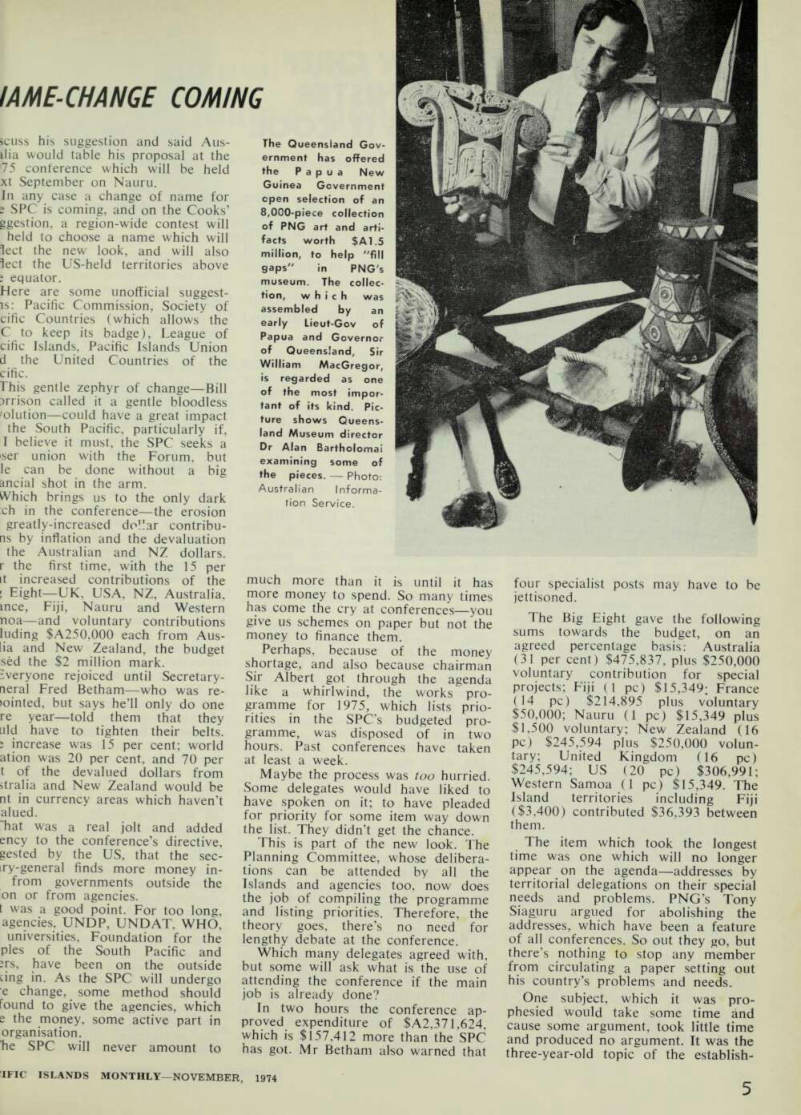
The Queensland Gov ernment has offered the Papua New Guinea Government open selection of an 8,000-piece collection of PNG art and arti facts worth SAI.S million, to help "fill gaps" in PNG's museum. The collec tion, which was assembled by an early Lieut-Gov of Papua and Governor of Queensland, Sir William MacGregor, is regarded as one of the most impor tant of its kind. Pic ture shows Queens land Museum director Dr Alan Bartholomai examining some of the pieces. Photo; Australian Informa tion Service.
ment of a regional development bank.
A committee which has been study ing the proposal pretty thoroughly, felt it was a viable proposition but the $5O million question—that’s the suggested amount needed for capitali sation—of where the money would come from, remained unanswered.
The conference dodged the issue. It couldn’t do any more. It decided to keep the proposal as a going concern, noted the special committee’s report, and directed the secretary-general to look for funds from donor countries and institutions and have talks with the Asian Development Bank. So the question was shelved for another year.
Only one reference was made to the nuclear tests. It came from Isakala Paeniu, one of the GEIC’s up-and coming young men, who made an oblique reference to the tests during a debate on whether the SPC’s quarterly magazine, the South Pacific Bulletin published in Sydney should be axed or given a new lease of life.
The reference to the tests didn’t disturb even one of Mr Henri Nettre’s short, grey hairs, but the debate on the Bulletin was lengthy, resulting in a decision to continue publication and allow it to print objective political items but not controversial ones, and no member country was to be criticised.
Among other items quickly agreed on was approval for PNG to join the Big Eight following PNG indepen dence and thus make it the Big Nine; and approval of SPC member ship of the Pacific Islands News As sociation, a media organisation found ed in Suva in June.
Australia and NZ made near identical proposals to help the Islands over investment problems and to pro vide incentives for private investment by Australian and NZ companies in the Islands, with safeguards for those Islands’s economic and cultural customs and institutions. These offers and an Australian one to con tribute $250,000 to help Islands to conserve their cultures and customs are a promising augury. (A three man Australian team of experts set out to the Islands on October 13 to make initial inquiries on how this $250,000 can best be spent).
It was obvious all through the con ference that the metropolitan mem bers are determined to help the Islands despite the cutting of the colonial bonds. It was the eagerness with which the metropolitans greeted the new set-up in the SPC and dispersed the shadows of colonialism which, I think, created a new atmosphere of friendliness. Colonialism will cease to be the whipping boy at future con ferences.