A Place By Any Other Name . . .
pp. 90-91 · Read in the full issue
Would Lose A Lot Of Charm
By James Davie
BATH; a utensil of tin, porcelain, iron or plastic used for ablutions; a town in Avon. The most volup tuously beautiful of English cities bears a name associated with scouring powder and dripping taps. Meanwhile great centres of industry have names like “Wolverhampton” and “Sunder land” (say them slowly and sooth ingly) from a twilit Wagnerian world.
But there are no wolves at Wolver hampton (though not a little to won der at in Sunderland). Both these names—and Bath too —were given by Anglo Saxons; and Anglo Saxon names are basically identity tags.
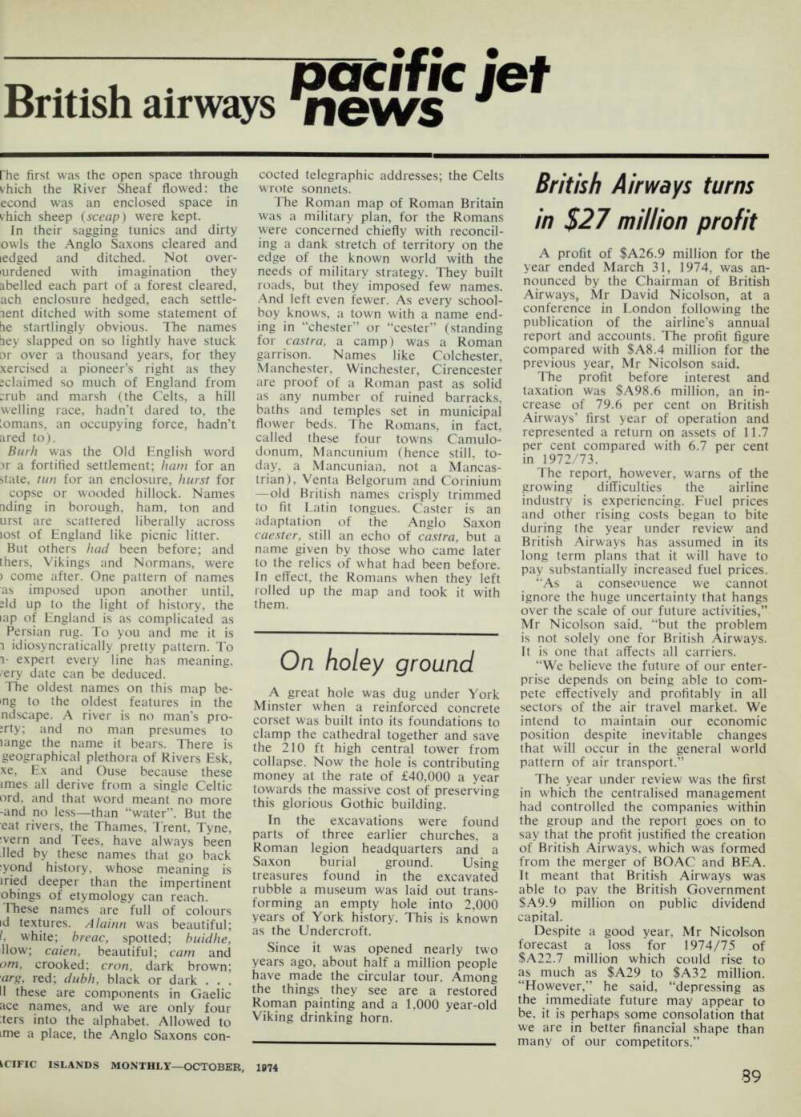
When the Angles, the Saxons or some tribe of that ilk stumbled upon the opulent baths the Romans had left behind in Aquae Sulis they called the place Hat Bathu (“a hot spring”).
Wolverhampton is “the home farm of Wulfrun”, a lady of whom only her name is remembered, though it can be deduced that her nature was pious, for the place got its name when, in 985, she gave the land to the church.
Sunderland was “Sonderland”, which is just an Anglo Saxon word for part of an estate separated from the rest.
A very literal mind, the Anglo Saxon mind. If your goats (gat) grazed in a valley (cumb) you called the place Gatcombe. If you kept pigs (swin) on a hill (dun) you called it Swindon. And what the Anglo Saxons called these places we still call them today, however the spellings have changed. Mousley in Worcestershire (mus, “a mouse” and leak, “a forest clearing”) was doubtless first settled by some mute, inglorious Beatrix Potter.
One generation has adopted the names of another to its own forms.
A scribe drowsing over some monas
tic inventory may have dropped a letter or two, added a letter or two to give an ordinary name a Latinised respectability.
The accents of an area may have shaped its place names (all those Cornish names beginning with Z); the spellings of later gentility quite dis torted them (Heathfield and Hatfield both come from the same origin, “open country covered with heather” —nothing to do with hats). In such
ways plain statements of the obvious have grown into eccentric anti quarianisms.
Even the Anglo Saxon words were changing in meaning all the Anglo Saxon time. Field, the Old English word for an open space was trans mogrified into the Old English word for an enclosed space. Thus industrial Sheffield in Yorkshire and ostenta tiously rural Sheffield in Sussex have even less in common than a name.
Bath, the Romans' Aquae Sulis. When the Anglo Saxons discovered the Roman baths, they called the place Hat Bathu ('hot springs').
fhe first was the open space through vhich the River Sheaf flowed; the econd was an enclosed space in vhich sheep ( sceap ) were kept.
In their sagging tunics and dirty owls the Anglo Saxons cleared and icdged and ditched. Not over mrdened with imagination they abelled each part of a forest cleared, ach enclosure hedged, each settle icnt ditched with some statement of lie startlingly obvious. The names hey slapped on so lightly have stuck ar over a thousand years, for they xercised a pioneer’s right as they so much of England from :rub and marsh (the Celts, a hill welling race, hadn’t dared to, the Romans, an occupying force, hadn’t ared to), Burh was the Old English word ar a fortified settlement; ham for an state, tun for an enclosure, hurst for copse or wooded hillock. Names tiding in borough, ham, ton and urst are scattered liberally across lost of England like picnic litter.
But others had been before; and thers, Vikings and Normans, were ) come after. One pattern of names as imposed upon another until, -Id up to the light of history, the tap of England is as complicated as Persian rug. To you and me it is i idiosyncratically pretty pattern. To i- expert every line has meaning, date can be deduced.
The oldest names on this map be ing to the oldest features in the ndscape. A river is no man’s pre tty; and no man presumes to lange the name it bears. There is geographical plethora of Rivers Esk, xe, Ex and Ouse because these imes all derive from a single Celtic ord, and that word meant no more -and no less—than “water”. But the eat rivers, the Thames, Trent, Tyne, :vern and Tees, have always been lied by these names that go back :yond history, whose meaning is iried deeper than the impertinent obings of etymology can reach.
These names are full of colours id textures. Alainn was beautiful; I, white; breac, spotted; buidhe, How; caien, beautiful; cam and om, crooked; cron, dark brown; arg, red; dubh, black or dark . . . 11 these are components in Gaelic ace names, and we are only four :ters into the alphabet. Allowed to ime a place, the Anglo Saxons con
cocted telegraphic addresses; the Celts wrote sonnets.
The Roman map of Roman Britain was a military plan, for the Romans were concerned chiefly with reconcil ing a dank stretch of territory on the edge of the known world with the needs of military strategy. They built roads, but they imposed few names.
And left even fewer. As every school boy knows, a town with a name end ing in “Chester” or “cester” (standing for castra, a camp) was a Roman garrison. Names like Colchester, Manchester, Winchester, Cirencester are proof of a Roman past as solid as any number of ruined barracks, baths and temples set in municipal flower beds. The Romans, in fact, called these four towns Camulo donum, Mancunium (hence still, to day, a Mancunian, not a Mancas trian), Venta Belgorum and Corinium —old British names crisply trimmed to fit Latin tongues. Caster is an adaptation of the Anglo Saxon caester, still an echo of castra, but a name given by those who came later to the relics of what had been before.
In effect, the Romans when they left rolled up the map and took it with them.