Salutes
p. 39 · Read in the full issue
New Hebrides
Cook Bicentenary
Sailing on his second voyage of discovery, Captain James Cook, on July 17, 1774, sighted the island of Aurora, now named Maewo, and re discovered the archipelago which he named the New Hebrides.
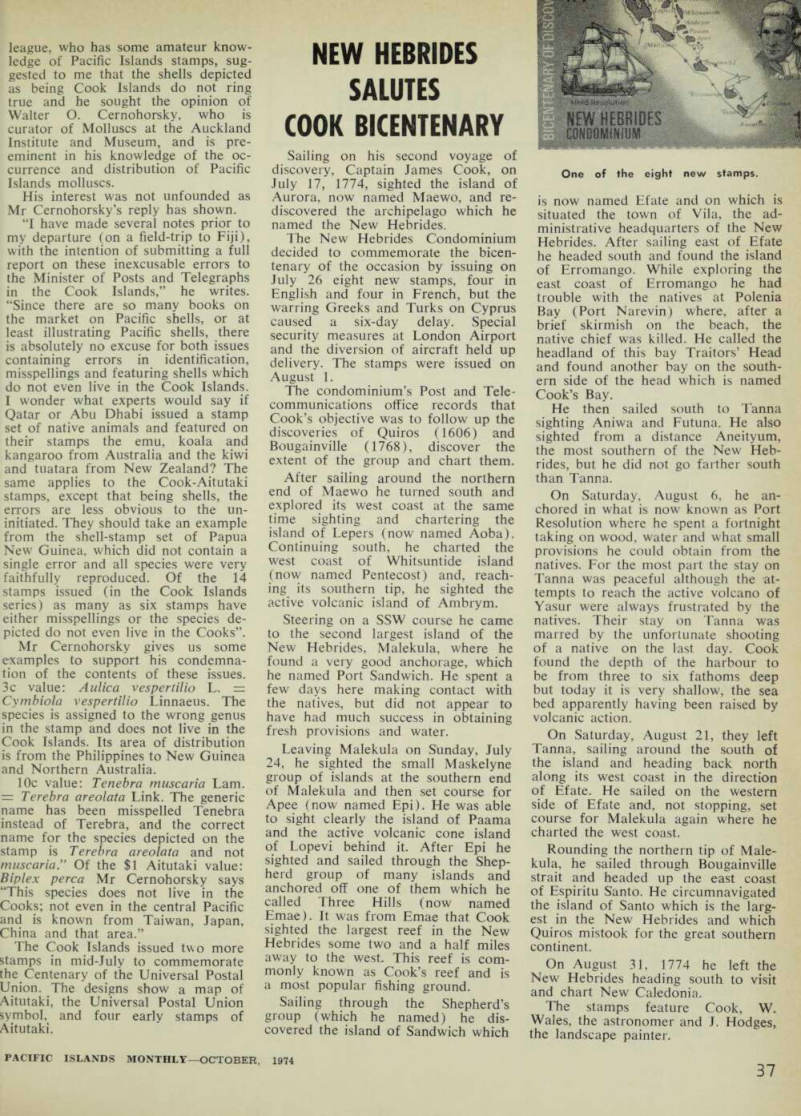
The New Hebrides Condominium decided to commemorate the bicen tenary of the occasion by issuing on July 26 eight new stamps, four in English and four in French, but the warring Greeks and Turks on Cyprus caused a six-day delay. Special security measures at London Airport and the diversion of aircraft held up delivery. The stamps were issued on August 1.
The condominium’s Post and Tele communications office records that Cook’s objective was to follow up the discoveries of Quiros (1606) and Bougainville (1768), discover the extent of the group and chart them.
After sailing around the northern end of Maewo he turned south and explored its west coast at the same time sighting and chartering the island of Lepers (now named Aoba).
Continuing south, he charted the west coast of Whitsuntide island (now named Pentecost) and, reach ing its southern tip, he sighted the active volcanic island of Ambrym.
Steering on a SSW course he came to the second largest island of the New Hebrides, Malekula, where he found a very good anchorage, which he named Port Sandwich. He spent a few days here making contact with the natives, but did not appear to have had much success in obtaining fresh provisions and water.
Leaving Malekula on Sunday, July 24, he sighted the small Maskelyne group of islands at the southern end of Malekula and then set course for Apee (now named Epi). He was able to sight clearly the island of Paama and the active volcanic cone island of Lopevi behind it. After Epi he sighted and sailed through the Shep herd group of many islands and anchored off one of them which he called Three Hills (now named Emae). It was from Emae that Cook sighted the largest reef in the New Hebrides some two and a half miles away to the west. This reef is com monly known as Cook’s reef and is a most popular fishing ground.
Sailing through the Shepherd’s group (which he named) he dis covered the island of Sandwich which
is now named Efate and on which is situated the town of Vila, the ad ministrative headquarters of the New Hebrides. After sailing east of Efate he headed south and found the island of Erromango. While exploring the east coast of Erromango he had trouble with the natives at Polenia Bay (Port Narevin) where, after a brief skirmish on the beach, the native chief was killed. He called the headland of this bay Traitors’ Head and found another bay on the south ern side of the head which is named Cook’s Bay.
He then sailed south to Tanna sighting Aniwa and Futuna. He also sighted from a distance Aneityum, the most southern of the New Heb rides, but he did not go farther south than Tanna.
On Saturday. August 6, he an chored in what is now known as Port Resolution where he spent a fortnight taking on wood, water and what small provisions he could obtain from the natives. For the most part the stay on Tanna was peaceful although the at tempts to reach the active volcano of Yasur were always frustrated by the natives. Their stay on Tanna was marred by the unfortunate shooting of a native on the last day. Cook found the depth of the harbour to be from three to six fathoms deep but today it is very shallow, the sea bed apparently having been raised by volcanic action.
On Saturday, August 21, they left Tanna, sailing around the south of the island and heading back north along its west coast in the direction of Efate. He sailed on the western side of Efate and, not stopping, set course for Malekula again where he charted the west coast.
Rounding the northern tip of Male kula, he sailed through Bougainville strait and headed up the east coast of Espiritu Santo. He circumnavigated the island of Santo which is the larg est in the New Hebrides and which Quiros mistook for the great southern continent.
On August 31, 1774 he left the New Hebrides heading south to visit and chart New Caledonia.
The stamps feature Cook, W.
Wales, the astronomer and J. Hodges, the landscape painter.
One of the eight new stamps.