East Irian Or Ng? What Indonesia
pp. 25-31 · Read in the full issue


Thinks Of Its Emerging Neighbour
In the days of Bung Sukarno when Australia and Papua New Guinea pondered over the Indonesian strong nan's plans for his newly-acquired territory of West New Guinea (Irian Jaya), there was a story in Jakarta hat Sukarno had a map of the whole of the region and on that map East New Guinea, like West New Guinea, was depicted as part of Indonesia. But with Sukarno's downfall, confrontation ceased and today >apua New Guinea and Indonesia are exchanging messages of friendship. How does the Indonesian view >apua New Guinea's changing status? Below, Dr R. S. Roosman, senior lecturer in the Political Studies Depart nent of the University of Papua New Guinea, samples current Indonesian thought through the pages of its ewspapers.
By R. S. Roosman
It is in the light of Papua New luinea gaining its self-government ist year and ultimately its indepen ence, that so much publicity has sen given by the newspapers in idonesia’s capital city Jakarta. The iiara Karya Dec 1, 1973 announced lat “This day, Saturday Dec 1 repre :nts the birthday of a new Republic: apua New Guinea”, appearing as a ib-title to Michael Somare’s picture sside the New Guinean flag.
Apparently furnished by the same mrce and author, three newspapers iblished the same article under fferent titles and dates: “Papua ew Guinea, newly emerging under ie leadership of a former journalist” 2ahaya Kita Dec 2); “Papua New uinea, a newly emerging nation”
Vlerdeka Dec 3); and “Papua New uinea; The last unknown territory” >inar Harapan, Dec 3).
The Jakarta Times (Dec 3) pub hing in English, wrote: “Papua ew Guinea assumes self-government iring a quiet ceremony . . . The r -year-old Chief Minister Michael >mare took formal responsibility for s 2i million people from the for er Australian Administrator Leslie hnson. Although it will take time r PNG to achieve its independence, 'erseas countries have already own interest in establishing closer lations with the young nation; eanwhile, the UK and Indonesia ive established their diplomatic presentation to PNG, and it can be pected that before long New Zea ad, the USA and Japan will simi rly have their diplomatic represent ives sent there. Papua New Guinea 11 become the biggest nation in the ►uth Pacific after Australia and New :aland. Presently, Papua New uinea is inclined to grow closer to astralia and Indonesia, however, me observers have said that the w nation will gain prestige soon playing a role in regional affairs”.
Prior to these articles, the Kompas daily of Nov 20, 1973 published an article titled “We must welcome Papua New Guinea’s Independence” and quoted Irian Jaya’s governor Acub Zainal’s statement: “I am con vinced that PNG’s self-government which will come next month, will not have any negative effect on people in Irian Jaya. Therefore, PNG’s in dependence must be welcomed. Also, because people in Irian Jaya now feel themselves 100 per cent Indo nesian”.
On the border agreement which was signed by Adam Malik, the governor had this to say: “The agree ment has a positive result. The situ ation has improved greatly, and we have become good neighbours. Even if problems arise between people liv ing on both sides of the border, these can be solved peacefully. The socio
economic development in PNG will not have a detrimental effect on neighbouring Irian Jaya, although so far such an effect has not yet been felt”.
Malik’s 3-day visit to Port Moresby in mid-November ’73 was covered by Merdeka of Nov 20 in an article: “When Adam Malik was in PNG”.
He is pictured while inspecting the PNG guard of honour with PNG Foreign Minister Maori Kiki, and in another picture while shaking hands with Michael Somare at a state dinner given by the Chief Minister.
The article says, in part: “Many problems were discussed by Adam Malik, among them the signing of an administrative border agreement”.
The Jakarta Times (Dec 3) quoted PNG’s Chief Minister as having said that “his country’s foreign policy will be oriented less toward Australia, and more towards Indonesia and Japan, and sees his country as a bridge be tween Asia and the inland people of the Pacific Ocean”. Under the title “Reluctance to accept independence in PNG”, Suara Karya (Dec 4) quoted an article in US Newsweek by Tony Clifton, that “Kugame Kura, a PNG tribal chief, ordered his fellow-tribesmen to erect a fence around a 15 km area to protect political freedom (ie independence) from coming into his tribal territory”.
On Josephine Abaijah’s Papua Besena Movement, the article says that “they (the Papuans) feel them selves superior to the people from the north, and therefore reject be coming part of the same country”.
Indonesia Raya (Dec 15) in an article entitled, “The Tolai Political Movement in East Irian” (note: Otherwise, the author, Amri Marzali, used the term Papua New Guinea throughout his article) wrote: “In early 1971, the former head of the Indonesian delegation in the West New Guinea dispute with the Nether-
Kiki's visit
lands, the late Soedjarwo Tjondro negoro, was invited to observe from close by the preparations of the Australian Government to give PNG self-government. Not long thereafter, prominent PNG-ans visited Indonesia.
First, the leader of the PNG Parlia ment with five of its members, fol lowed by a visit by the (late) PNG Minister of Information Paulus Arek in late 1971. Chief Minister Michael Somare visited Indonesia at the end of 1972. Very recently, 14 PNG parliamentarians accompanied by two public servants, visited Indonesia”.
The visit was covered by four Jakarta newspapers, Suara Karya Harian Angkatan Bersenjata, Nusan tara (all three on Dec 4) and Kompas (Dec 5). Both Suara Karya and Harian Angkatan Bersenjata give exactly the same version of the article, as both newspapers speak for the military faction. The article men tioned the 14-man delegation as “representing all political parties and is headed by Stephen Tago, a mem ber of the Progressive People’s Party, one of the partners in the Coalition Government. Their 7-day visit is de signed to be a familiarisation visit during which the delegates will meet
their Indonesian counterparts in Jakarta and members of the regional assemblies in Surabaya and Bandung”.
Sinar Harapan (Dec 18) published a photograph of eight members of the delegation at “Kertamukti”, the Governor’s office in Bandung, West Java, with Deputy Governor Nasuhi, during which they were presented with souvenirs in the form of the Seal of West Java and a three dimensional wooden puppet represent ing the mythological hero Gatotkacha and—according to Mr Nasuhi— “symbolising Independence, Law and Order”.
Under the heading, “A Papua New Guinean Department Chief attends Cultural Conference”, Harian Ang katan Bersenjata of Dec 8 reported, “The PNG Minister of Police, Cul ture and Recreation Pita Lus arrived in Jakarta for a 12-day visit in Indo nesia. The minister, accompanied by his private secretary John Haugie, will join the Australian delegation to the UNESCO Conference in Jogya karta which will be opened on Mon day Dec 10, 1973. Before returning to his country, he will meet Indo nesian government leaders to discuss problems which have some relevance to his function”.
The highlight was certainly Mr
and Mrs Albert Maori Kiki’s visit to Indonesia. Indonesia Raya (Dec 13) was the first newspaper to break the news, in an article, “The PNG De fence Minister is coming to Indo nesia”: “The Ministry of Foreign Affairs announced yesterday Mr Maori Kiki’s plan to visit Indonesia from Dec 15-20 upon invitation of Foreign Minister Adam Malik. Be sides meeting Mr Malik, Mr Maori will pay a state call to the other Indonesian leaders”.
In a special article Berita Yudha (Dec 21) published “Maori Kiki’s Life-story” in which his year and
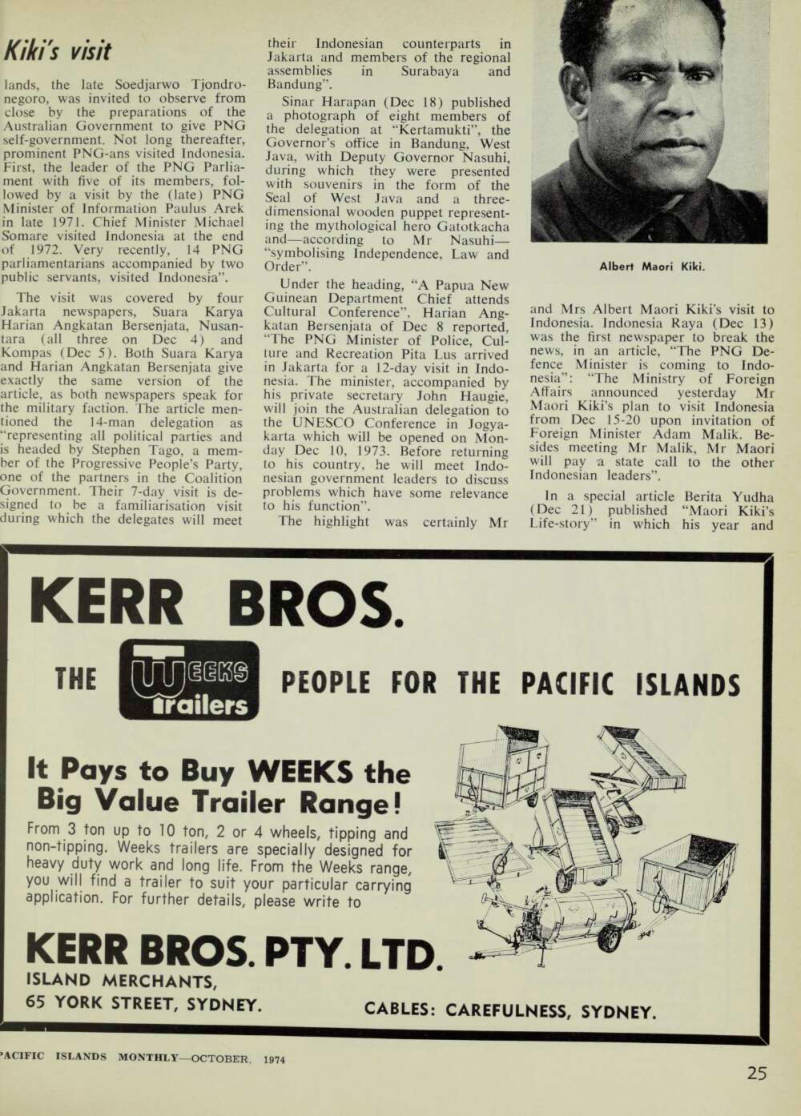
Albert Maori Kiki.
)lace of birth, education, career and eligion were elucidated in detail. In >inar Harapan (Dec 17) Mr Kiki is eferred to as “the founder and eader of the PNG labour movement, md he has a long-standing experience n the nationalist movement in his :ountry. He has the ability of speak ng several local tongues besides his mowledge of English and Pidgin”.
Berita Buana (Dec 17) reports hat the guests were received at dalik’s residence in Jakarta. In a •ress interview Kiki is quoted as aying: “New Zealand’s proposal to orm a sub-regional co-operation •ody in the South Pacific is of great ignificance for my country”. How ver, he said that he was observing urther developments until more larity was given by the proposing arties, ie Australia and New Zea and. On foreign matters PNG had till to consult the Australian govern ment. “PNG will merely follow what Australia has already done”, he said mghingly, “because PNG is still a ew boy in the group”.
Harian Angkatan Bersenjata (Dec 7) in an article, “Papua Niugini will dllow the steps of its Elder Mothers’’, said of Maori Kiki’s state ments at a press interview that “PNG dll wait and see how a wider ;gional co-operation in the Asia acific area is going to develop such s New Zealand's Prime Minister forman Kirk proposed when he isited Port Moresby en-route to In onesia”. “It would be better”, Kiki dded, “that PNG’s elder brothers .ustralia, New Zealand and Indo esia discuss the matter first, and 3me to an appropriate formulation f what their Asia-Pacific regional 3-operation consists, so that it is isy for PNG—which is still young -to join them, for PNG’s problems ;semble theirs”. Kiki was of the pinion that regional co-operation in ie Asia-Pacific area was “a good lea”.
Indonesia Raya of Dec 18 in its tide, “Sub-regional grouping of
idonesia-Aussie-New Zealand-Papua
iuGini?” reported that a joint corn unique was issued by the govern ents of Indonesia and New Zealand which it was agreed by President jharto and New Zealand Prime linister Kirk (who visited Indonesia cently) that Indonesia and New saland would approach PNG to find way to form a new sub-regional ouping. The proposed grouping, hich includes Indonesia as a parl or, would be in line with New Zea nd’s and Australia’s policy to rengthen their ties with Asia.
PNG Foreign Minister Kiki—while siting Indonesia—stated that “his mntry would not object to such a
grouping. It will emphasise PNG’s role as a bridge between Southeast Asia and the Pacific, and also as a possible way to help the backward province of Irian Jaya which shares a common border with PNG”.
At a press conference. Kiki revealed his country’s intention to open a legation in Jakarta in the middle of 1974 (Berita Buana, Dec 20).
“But” he commented, “because PNG is still under the supervision of the Australian Department of Foreign Affairs, the final decision on the matter rests with them”. Kiki further disclosed that “Australia has agreed to the opening of diplomatic representation for PNG at the consular level”.
About Maori Kiki’s meeting with President Suharto on Dec 19, at which Foreign Minister Malik was also present, Berita Yudha (Dec 20) had this to say; “There is no clarification about matters that were discussed during the meeting which was merely a visit to make the acquaintance of the Indonesian president”. However Berita Buana of Dec 20 revealed that “Kiki’s meeting with President Suharto and several Indonesian department heads was held in a friendly atmosphere. Their discussions ineluded the problem of joint border and regional co-operation and an exchange of diplomatic personnel, sports teams and cultural groups”.
Kiki revealed further that “a future exchange of PNG and Indonesian students should be viewed as part of a scheme of exchanging human beings” and he hoped that “such an exchange will also include the sending of dancers and other artists”.
Kiki met Indonesian Minister of
Communications Emil Salim in his Jakarta office for half an hour. In the article, “Maori Kiki explores co operation in the field of communi cation”, (Berita Yudha, Dec 20).
Salim said that PNG Foreign Minis ter Kiki wanted to see as much as possible of transport and communi cation in Indonesia. Both countries have similar products to export, such as timber and mining products. Indo nesia should develop its South Paci fic trade; so far, the flow of export goods is directed toward Europe, Japan and the USA which Salim re ferred to as “traditional trade”. Indo nesia’s South Pacific trade—which involves merely one or two vessels a month—can be considered minimal.
Shipping would improve by exploring which products can be exported to the South Pacific area and what methods of transportation can be im plemented on such trade. Salim said further that “he is studying the pos sibilities of directing the flow of Indonesian goods toward the South Pacific”. The Pacific countries have started to co-operate with ASEAN countries, a fact which already shows prospects of trade promotion, especially of industrial goods, In “Niugini wants to import from Indonesia” (Harian Kami Dec 21) Maori Kiki is quoted as saying that “his visit to Indonesia is to learn much from Indonesia’s experiences in various fields including the import of goods from Japan. He hopes also that PNG can import from Indonesia in the future”.
According to Harian Angkatan Bersenjata of Dec 20, Kiki said there is no Communist Party in PNG be-
Irian Jayans (or West New Guineans) passing the Cenderawasih University at Abepura.
Photo: R. S. Roosman.
Defence co-operation
cause “his government is well aware of the dangers of communism”. Con cerning the possibility of training PNG officers in Indonesia, Maori Kiki said that “this matter has been discussed with the Indonesian mili tary leaders. However, there are no plans to train PNG cadets at the Akabri, the Indonesian Military Academy, because of linguistic diffi culties: people in PNG do not speak Bahasa Indonesia; the official lan guage in PNG is English”.
The Jakarta Times (Dec 20) wrote that Minister Kiki visited the Indo nesian Foreign Office, Bureau of Education and Training, “to become more informed on the system of training diplomats in Indonesia”. Kiki who holds a teacher’s certificate did not miss the opportunity to give a lecture. He said, among others: “You are fortunate that you have Bahasa Indonesia”, furthermore, “Since we are neighbours it is important that we must know each other”.
A press conference was held at the Wisma Yani Hall in Jakarta, before Maori Kiki boarded a plane on Dec 19 on his way home via Singapore.
In an article “Papua Niugini offers training of teachers and farmers from Irian Jaya”, Sinar Harapan (Dec 20) quoted Kiki as saying that “PNG offers teachers’ training and instruc tion in the fields of agriculture and technology to West Irianese as well as other Indonesians, because PNG has the institutions of tertiary educa tion in those fields”. This was in answer to the question of whether PNG was prepared to help its closest neighbour Irian Jaya. In its develop ment, PNG is more advanced than Irian Jaya. The present (Indonesian) government is not to be blamed for it, because West Irian’s condition should be rather judged from the point of view of the former (Dutch) administration. Fortunately, the Aust ralian government has been generous enough to PNG so that PNG has achieved its present stage of develop ment, whereas the Dutch did not assist West Irian.
On co-operation in defence and security matters, the feasibility of training PNG military officers at the Military Academy in Bandung, West Java was agreed.
Considering the need for establish ing formal diplomatic relations, Kiki revealed that “PNG will open a con
sulate in Jakarta in mid-1974”. He mentioned that “problems arising from border disputes are not un common. In this connection, the possibility of establishing a joint border patrol has been discussed.
Exchange of cultural missions and university students would also be in valuable for both countries, so as to reach a mutual understanding of the ways of life in both Irian Jaya and
Png”.
An article titled, “The Papua New Guinea that I saw; the Strength of its Armed Forces” by August Pareng kuan, appearing in Kompas (Dec 6) gives figures of New Guineans parti cipating in the Pacific Islands Regi ment, the PNG Police Force and the Navy. The author added: “In its Air Force, which is really small, there are no PNG members”.
Australia’s Minister of Defence, Mr Barnard, is quoted in the article as having said in Port Moresby on Jan 25, 1973 that “the aid of SA23 million for the development of the PNG Armed Forces will be given in the form of equipment, technical and operational aid, and training facilities.
Although a threat from without is not likely, at the present, we must remain alert. We must maintain our