the long knives
p. 17 · Read in the full issue
Saru’s night of the long knives
From Vijendra Kumar
in Lautoka
IT was the night of the long knives—and steel spikes. At Mr Mohammed Ishaque’s home at Saru, on a hilly settlement four miles inland from Lautoka, a crowd of 200 waited in silent anticipation for the strangest of all ceremonies to start. A full moon shone brightly from the clear sky.
About a dozen performers, the youngest of whom was a boy of seven, sat on a stage covered with a tangerine-sheeted canopy. They wore loose-fitting, white long pants, shirts and head-dress.
Their high priest, Maulvi Abu Bakar, led them in chanting ancient prayers of which the refrain of marhaba, marhaba echoed loudly to the rhythm of small goat-skin drums some men were playing.
Thick smoke from incense burning in a large urn coiled up ward to the canopy. Its pungent smell pervaded the atmosphere.
At about 11 pm the priest received the other-wordly sign he had been expecting. Later, I learnt that he must sight the reflection of the moon and a star—the Islamic religious symbol—on the sheet before he may order his men to risk their lives.
At a nod from Maulvi Abu Bakar, one of the performers got up, took off his shirt and came up to face the priest, who, too, had risen. The priest picked up a nine inch long piano wire needle and skewered the other man’s tongue.
As blood oozed from the wound, the priest licked it with his tongue.
The bleeding stopped.
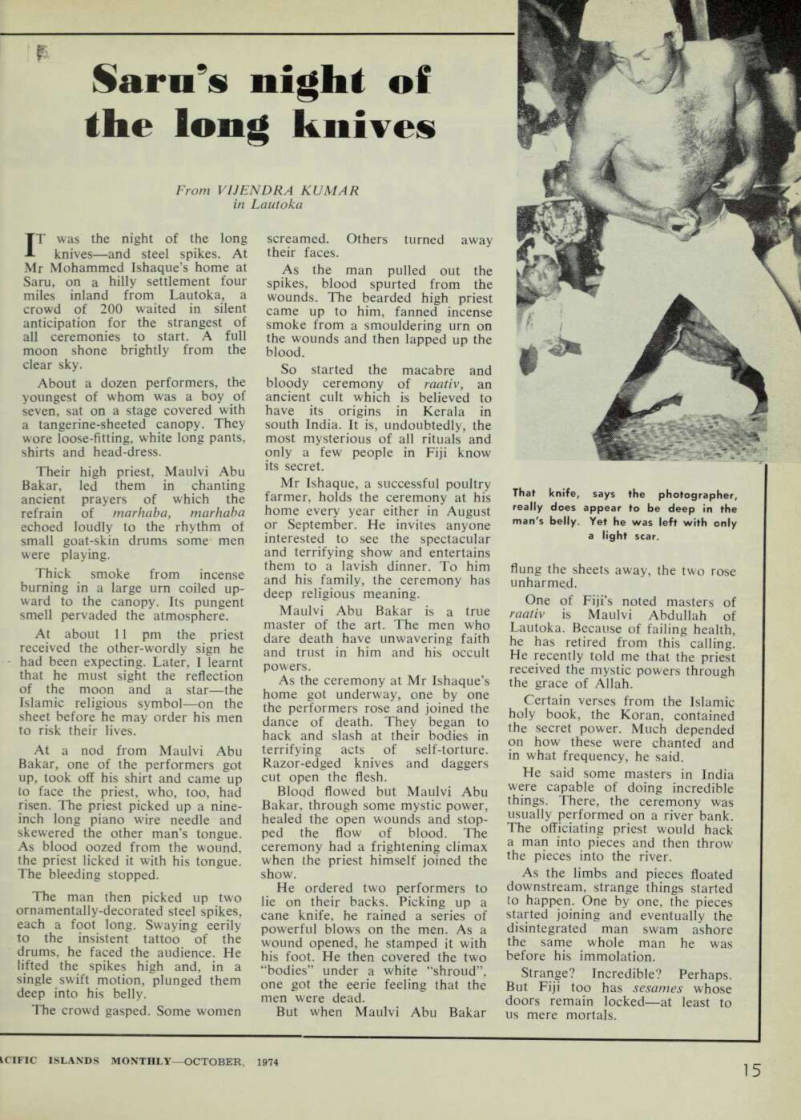
The man then picked up two ornamentally-decorated steel spikes, each a foot long. Swaying eerily to the insistent tattoo of the drums, he faced the audience. He lifted the spikes high and, in a single swift motion, plunged them deep into his belly.
The crowd gasped. Some women
screamed. Others turned away their faces.
As the man pulled out the spikes, blood spurted from the wounds. The bearded high priest came up to him, fanned incense smoke from a smouldering urn on the wounds and then lapped up the blood.
So started the macabre and bloody ceremony of raativ, an ancient cult which is believed to have its origins in Kerala in south India. It is, undoubtedly, the most mysterious of all rituals and only a few people in Fiji know its secret.
Mr Ishaque, a successful poultry farmer, holds the ceremony at his home every year either in August or September. He invites anyone interested to see the spectacular and terrifying show and entertains them to a lavish dinner. To him and his family, the ceremony has deep religious meaning.
Maulvi Abu Bakar is a true master of the art. The men who dare death have unwavering faith and trust in him and his occult powers.
As the ceremony at Mr Ishaque’s home got underway, one by one the performers rose and joined the dance of death. They began to hack and slash at their bodies in terrifying acts of self-torture.
Razor-edged knives and daggers cut open the flesh.
Bloqd flowed but Maulvi Abu Bakar, through some mystic power, healed the open wounds and stop ped the flow of blood. The ceremony had a frightening climax when the priest himself joined the show.
He ordered two performers to lie on their backs. Picking up a cane knife, he rained a series of powerful blows on the men. As a wound opened, he stamped it with his foot. He then covered the two “bodies” under a white “shroud”, one got the eerie feeling that the men were dead.
But when Maulvi Abu Bakar
flung the sheets away, the two rose unharme.d.
One of Fiji’s noted masters of raativ is Maulvi Abdullah of Lautoka. Because of failing health, he has retired from this calling.
He recently told me that the priest received the mystic powers through the grace of Allah.
Certain verses from the Islamic holy book, the Koran, contained the secret power. Much depended on how these were chanted and in what frequency, he said.
He said some masters in India were capable of doing incredible things. There, the ceremony was usually performed on a river bank.
The officiating priest would hack a man into pieces and then throw the pieces into the river.
As the limbs and pieces floated downstream, strange things started to happen. One by one, the pieces started joining and eventually the disintegrated man swam ashore the same whole man he was before his immolation.
Strange? Incredible? Perhaps.
But Fiji too has sesames whose doors remain locked—at least to us mere mortals.
That knife, says the photographer, really does appear to be deep in the man's belly. Yet he was left with only a light scar.