Triumph for
pp. 7-8 · Read in the full issue
Pacific Islands Monthly
Triumph for the Solomons' Solomon
From a Honiara correspondent Solomon Mamaloni, 32-year-old lember for West Makira, is the first 'hief Minister of the Solomon >lands. He beat off the challenge of ve other candidates after a series of jcret ballots held among the 24 lected members of the Governing Council (now the Legislative Assem ly) in Honiara on Tuesday, .ugust 27.
For the trenchant and charismatic famaloni, the election was a triumph f planning and organisation. An arly favourite for the top political ost, he was considered by many to ave peaked too soon, and had irgely been written off as a con fer for the big job. Instead atten on began to focus on some of the ther candidates, notably the quietly npressive Benedict Kinika (East lakira); the veteran David Kau mae (Are Are); and the radical hilip Solodia Funifaka (Lau and Ibaelalea).
Far from having shot his bolt, awever, Mamaloni showed that he ad merely been biding his time, and week or so before the election, imours began sweeping the capital 1 the effect that the small man with e big personality had quietly ithered an impressive array of voting rength and was going to make a rong late bid for the position. This as enough for a local businessman inning a book on the event to re state Mamaloni as 5-4 on favourite.
For a time the issue was obscured f the shifting political patterns in e Solomons. The United Solomon lands Party Association (USIPA), d by Kinika and Gideon Zoleveke, arted off with a majority of elected embers in its ranks, but as polling ly grew closer there were a number defections to Mamaloni’s People’s
Progressive Party (PPP) and to the neutrals.
The days immediately before the election were hectic in the extreme, with members of one camp nominat ing former members of the other, frantic private meetings being held and alliances being formed and broken, and no one sure who was going to vote for whom.
Then, in a shrewd pre-election move, Mamaloni arranged for his nomination to come from the highly respected Willie Betu, long regarded as one of the more moderate and level-headed elected members. A number of the undecided took this as a sign that Mamaloni, if elected, would pursue a middle-course, and this undoubtedly gained him votes.
True to local form, little of all this leaked out to the general public.
Hardly any details of the circum stances surrounding the election were released by the authorities, and as far as the vast majority of islanders were concerned, the whole affair was a marked non-event.
For the participants, on the other hand, it turned out to be a real cliff hanger, with the issue in doubt to the very end. It was ostensibly a secret
ballot held behind closed doors in Honiara’s Kalala House, with only the elected members and a few ad ministrative bigwigs present. But no one ever keeps a secret for long in the Solomons.
It took two and a half hours and six ballots before the Chief Minister was selected. From the start it be came apparent that there were only two men in it, the two Eastern Dis trict representatives, Mamaloni and Kinika, with Solodia Funifaka corn ing third in most ballots. When the Malaita man finally dropped out, Mamaloni and Kinika tied with 12 votes each on the fifth ballot. On the sixth and last poll Mamaloni surged ahead to gain the victory by 14 votes to 10.
For all his comparative youth, the new Chief Minister takes up his new
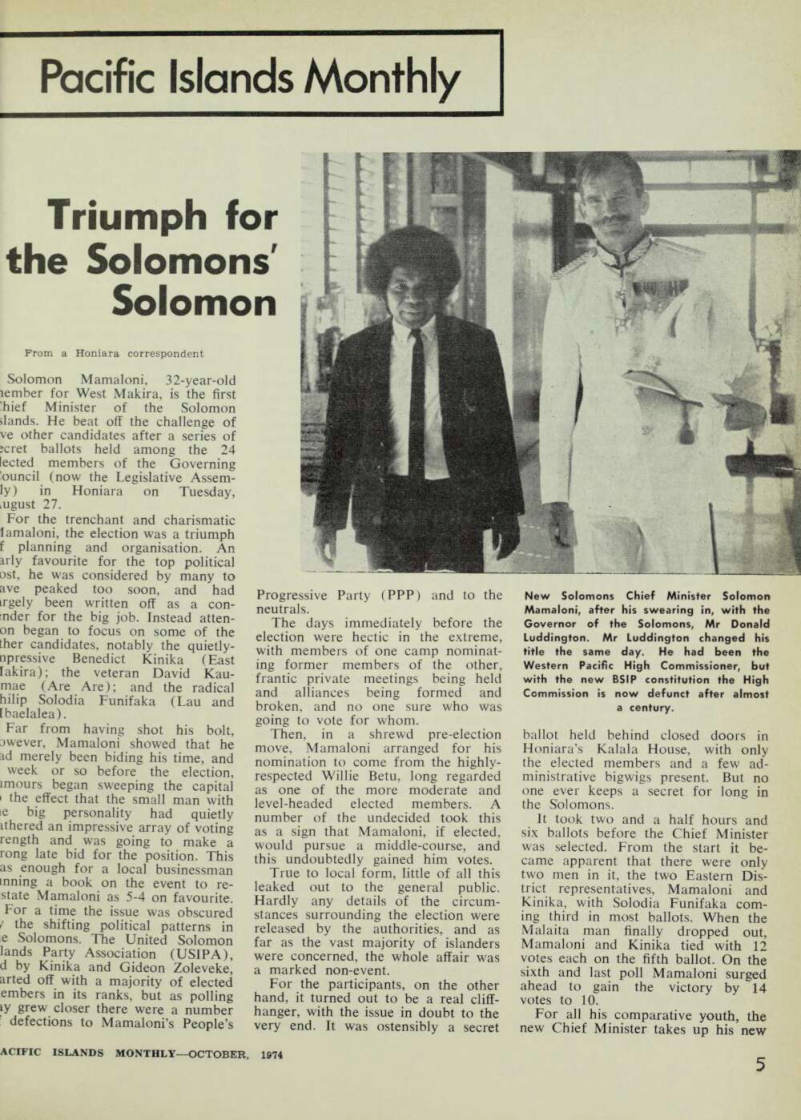
New Solomons Chief Minister Solomon Mamaloni, after his swearing in, with the Governor of the Solomons, Mr Donald Luddington. Mr Luddington changed his title the same day. He had been the Western Pacific High Commissioner, but with the new BSIP constitution the High Commission is now defunct after almost a century.
duties with a wealth of administra tive and political experience. Born in Rumahui village on Makira in the Eastern Solomons and a student of the Anglican Pawa School and King George VI Secondary School, he was educated to third form at Te- Aute Maori College, Hawkes Bay, New Zealand.
He entered government service in 1966, first as an executive officer and then as clerk to the Legislative Council which he was later to join as an elected member. He began his political career in 1970, and was one of only six sitting members who re tained their seats at the general elec tion of 1973.
The dormant and parochial poli tical situation was considerably en livened by the arrival of Mamaloni’s vigorous personality. From the begin ning, he showed himself to be an outstanding politician, honest, out spoken, an excellent debater and brilliant speaker. A forthright critic of administrative inefficiency, from his early days in the chamber, he declared himself an opponent of what he called the three unwelcome visitors of poverty, ignorance and disease.
In his public utterances he ex pressed his opinion of the expatriate administration (“a backfire of colonialism”); the local education policy (“superficial . . . shortsighted . . . miseducation”); medical services (“insufficient facilities and staff”); the salaries and living conditions of labourers in the capital (“would spark a revolution in other coun tries”).
One of Mamaloni’s preoccupations has been the divided state of the country and the poor communications between the scattered islands. He has been scathing about the inadequate panaceas introduced by the authori ties for the different districts: “In the Eastern District they inject politics; in Western they inject education; in Central they inject tourism, and in Malaita they inject birth-control”.
As the Chairman of the Local Government Committee, a position which he had held since 1973, Mama loni was an outstanding success. His major piece of legislation was the design and introduction of a wide ranging system of decentralisation, giving increased powers to the local councils. This was easily the most im portant step forward so far taken in the development of the Solomons.
Mamaloni will not be short of problems in his new job. At the moment the copra-based economy is buoyant and exports are booming, but the almost inevitable downturn in the market will once again reduce the islands to depending on the an nual grant-in-aid being paid with in
creasing reluctance from Great Britain. Like every other group in the Pacific the Solomons are in inflation’s grip. Police had to be called in re cently to restore order after fights at a Honiara market over the spiralling prices of food on sale there.
Less than 48 hours after he had been sworn in as Solomons Chief Minister, Solomon Mamaloni released the names of the five elected mem bers of his Council of Ministers. The group includes three former commit tee chairmen in Willie Betu, David Kausimae and Gideon Zoleveke. The two newcomers are NZ-born Peter Thompson, an Anglican priest, and Stephen Cheka, at 28 the youngest member of the inner circle.
It is a strong council. Betu, Kau simae and Zoleveke are experienced politicians, while Thompson, the only expatriate among the leaders, has long been a prominent back-bencher and commands enormous support in his own constituency and considerable respect among his fellow-elected members in the Legislative Assembly.
Cheka, too, for all his youth, has been one of the up-and-coming politicians.
Willie Betu, the dapper and charm ing 36 year-old Santa Isabel man, becomes Minister of Education and Cultural Affairs. Although his brief will include such varied activities as libraries, museums and film censor ship, undoubtedly most of his energy will go into sorting out the much maligned education system. To help him, however, is his newly-appointed Chief Education Officer, Francis Bugotu, an educationist of distinction and a man with a Pacific-wide repu tation.
In his capacity as Minister of Trade, Industry and Labour, the 42 year-old Peter Thompson will need all his considerable store of energy.
He will also require a certain amount of luck as so much of the economic future of the Solomons depends upon external forces which the government can do little to control.
Thompson has set his face against excess feather-bedding—“people start with what they have got and build from that”—but has always been concerned to see that islanders share in any profits made by overseas firms out of local resources. He holds that the basic principles of development are communications and marketing, and has joked that he would some times like to cut the revenues of government departments by half and
spend the surplus on building more
roads in the districts.
As the Minister of Works and Pub lic Utilities, the 52 year-old Choiseul man, Gideon Zoleveke should have few problems. He has already shown himself to be a capable and un
obtrusive administrator. The Marine I Department, another of Zoleveke’s I responsibilities, has come in for pub-1 lie criticism in the past, but the in-1 creasing use of commercial vessels ini the Solomons seas should take some I of the strain off government vessels. I David Kausimae’s main interests! will be in the rural areas. He is the I new Minister of Agriculture and!
Rural Economy. A few years ago! agriculture in the Solomons was I something of a sick joke, but it has! taken enormous strides in the last! year or so and the 44 year-old Are!
Are representative should be able to I build on sound foundations.
Stephen Cheka, 28, Minister of I Health and Welfare, inherits a con-| troversial medical service and one! which is always battling against! shortages of staff and funds. His taskl will be a challenging one. He is a! former primary school teacher.
Mamaloni has decided, at least fori the time being, to retain control of!
Home Affairs, including local govem-j ment and information and broad-i casting. The new constitution allows for a sixth minister, so it is possible that at some future date Mamaloni! may relinquish all or some of these!
additional responsibilities.
There are also three ex-officio] members of the Council of Ministers:! the Financial Secretary, the Attorney-] General and the Deputy Governor,] all of them expatriates. The Chairman] of the Council is the Governor.
The United Solomon Islands Party! has announced that it has selected a shadow cabinet with its members acting as opposition spokesmen in the I
Legislative Assembly.
USIPA also has a new leader in Philip Solodia Funifaka, the 36 year-i old Malaita man from the Lauj Lagoon. It was announced that Funi faka had taken over the reins fromj Benedict Kinika. The reason given for Kinika’s stepping down was that he and Mamaloni were both Makiraj men, and that it might cause unrest on the island if they were seen to be : in contention in Honiara.
Solodia Funifaka has always ranked high in the councils of USIPA and had enough support from the rank and file Legislative Assembly members to come third to Mamaloni] and Kinika in the recent election. A former student for the priesthood, he became a schoolteacher and then a I labour inspector. Known for his in dependent and forthright views on ■ many subjects, he was expected to be something of a firebrand whenj elected to the Governing Council in 1973. Instead he impressed many people with his willingness to listen to opposing points of view.