Pacific Transport
pp. 75-82 · Read in the full issue
Slands Get To Grips With
Regional Transport Problems
By staff writers
Two conferences, which were being held—one at Suva and the other at Nukualofa—towards the nd of August, could reach decisions affecting the economies of all the Islands. The importance of both atherings is underlined by the presence of government ministers and delegates from the Australian nd New Zealand governments.
The Suva conference is thrashing ut the vital question of the future f Air Pacific, the Fiji-based regional irline, while the meeting at Nukua »fa is the inaugural meeting of the □uth Pacific Forum’s Regional Ship ing Council. There’s hard bargain ig at both meetings behind closed Dors with Fiji probably holding a istol to Tongan and Nauruan heads.
Fiji wants Air Pacific in undisputed mtrol of regional air services. Her rime Minister, Ratu Sir Kamisese lara, is adamant on this and views e airline’s future as the “real test : Pacific regional co-operation” so ,r as the Forum is concerned. Nauru id Tonga see their shipping fleets as e nucleus of a regional shipping What more natural than Fiji aging a theme song at both con rences of “You play ball with us id we’ll play ball with you—or se!”
The civil aviation conference in iva from August 19 follows a lower vel meeting in Canberra in June at hich the airline’s future was dis issed. No decision was made but in rly August there was a general eling of pessimism that the Suva inisterial conference would also not ach general agreement about Air icific. Delegations are attending om Australia, New Zealand, the UK, e Solomon Islands, the GEIC, estern Samoa, Tonga and Nauru.
The attitude of all the metropolitan ivernments and Fiji is that the gional airline should be made to ark, as the only hope for stable and ieap transport within the Pacific lands will come from a regional air le. However, there is a view that the areholders of the smaller island oups should be increased consider •ly at the expense of the metro ilitan shareholdings. The difficulty re is that the smaller countries don’t ve the financial resources. (Fiji,
Qantas, British Airways and Air New Zealand each has 22.68 per cent of the shareholding, the BSIP, the GEIC, Western Samoa, Tonga and Nauru 1.85 per cent each).
Nauru is quite determined to con tinue operating independently and has, in fact, recently ordered a third aircraft, a Boeing 737, for delivery in July, 1975. Western Samoa’s Poly nesian Airlines has now begun to run smoothly after some early difficulties, and Samoa attitudes are that Western Samoa now has no need to give away the substance for the shadow—that it is quite capable of giving the services it wants with its own airline. (Air Pacific holds 10,000 shares in Polynesian Airlines).
Tonga is more enthusiastic in its efforts to operate its own airline, although there is less substance. King Taufa’ahau Tupou IV has been negotiating with the Japanese to
provide the aircraft and crews, but the general feeling in the aviation world is that the Japanese will want trade concessions which will practi cally amount to a takeover of Tonga. (See story p 77).
However, the Tongans do seem determined to have an airline of their own, irrespective of where it comes from, because they feel they want direct access to the outside world rather than through Fiji. They feel they can make arrangements for reciprocal rights, and should be able to fly direct to New Zealand, New Caledonia, Tahiti, Honolulu and Japan. In this respect the Tongans, like the Western Samoans —and as the Nauruans have already shown themselves —are nationalists.
They also believe that too much of Air Pacific’s income goes into the hands of the metropolitan govern ments and that the airline is not run for the benefit of the islanders.
Among Nauru, Tonga, Fiji and Western Samoa there is a mutual feeling of suspicion, although these un fortunate attitudes have been eased in recent months following the appoint ment of Fiji’s Deputy Prime Minister, Ralu Sir Penaia Ganilau, to the Air Pacific board. Ratu Sir Penaia has been active in negotiations and efforts to keep Air Pacific as a regional airline. He is a man of charm, with a wise head and is widely respected in the Pacific, and if there is any way the Islands’ aviation aims can be drawn together, then Ratu Sir Penaia is the man to do it.
The Suva meeting is expected to be the final meeting before a firm decision is made by the various governments on whether Air Pacific continues in its present fashion. If this meeting fails then Air Pacific is dead as a regional airline. It might become a largely internal airline, a Fiji-owned instrumentality, with Fiji
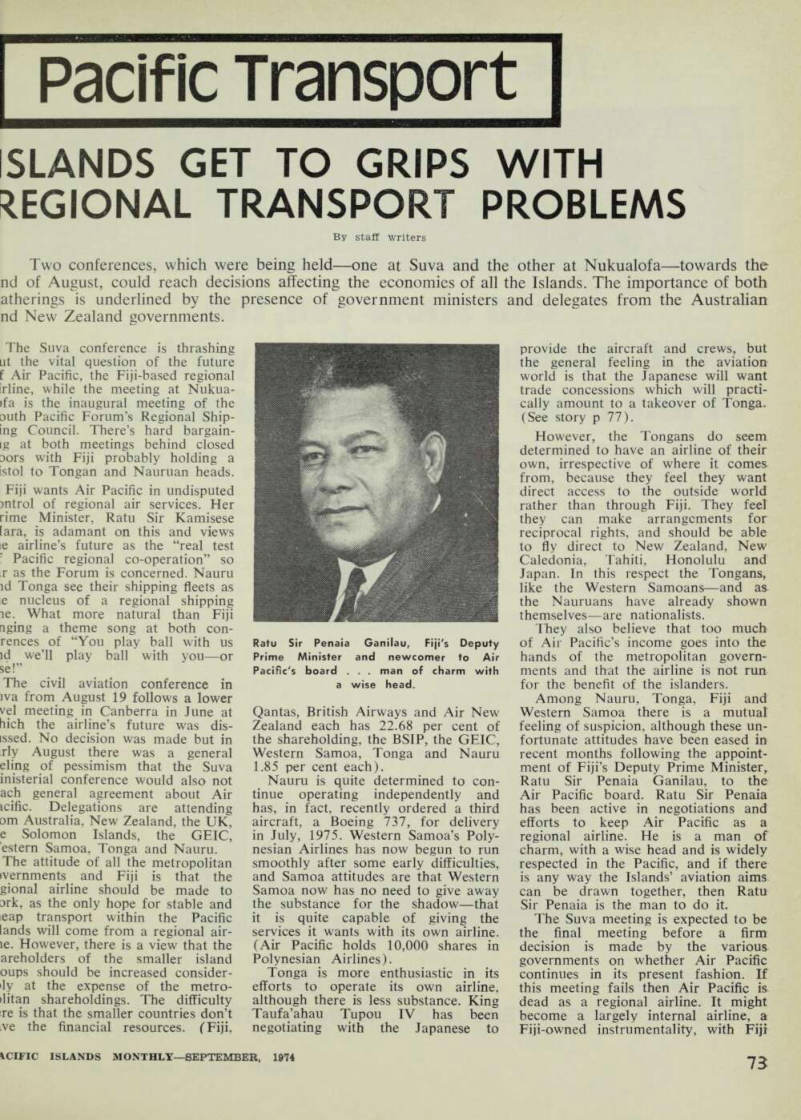
Ratu Sir Penaia Ganilau, Fiji's Deputy Prime Minister and newcomer to Air Pacific's board . . . man of charm with a wise head.
igotiating separate rights outside the iuntry.
Air Pacific operates a fleet of two ACIII jet aircraft (one is at present i charter to Malawi), three turbo op HS74Bs, and four piston-engined erons. The airline operates internally am Nausori Airport, near Suva, to adi, Labasa, Savusavu and Matei faveuni). In the GEIC it operates gular services covering Tarawa, itaritari, North Tabiteuea and bemama.
On regional services, Air Pacific >erates twice a fortnight between ji and the GEIC, once a fortnight tween the GEIC and Nauru, once week between Fiji and Western moa, three times a week between ji and Tonga, three times a week Dm Fiji to the New Hebrides and e BSIP with one of those flights tending to Port Moresby, and once week between Nadi and Brisbane, a the New Hebrides and the BSIP.
For other developments on Air icific, see story in col. two.
Members of the South Pacific )rum were expected to take a major ;p towards creating a regional ship rig line at the Nukualofa three-day nference beginning on August 27. [location of three days to the meet g suggested that ministers and their visers would come up with a final cision although both the Australian id New Zealand governments are >s than lukewarm on the idea.
The need for a regional shipping le has been aired off and on for veral years, and was thoroughly bated at the South Pacific Forum at arotonga in March, The forum rected the South Pacific Bureau for :onomic Co-operation (SPEC) to ke steps to form the council, and en take any further steps necessary fore the forum makes a decision on e form of a regional shipping cor iration.
The area already has a strong base i which to build a shipping line—auru Pacific Line and Pacific Naviga )n Co, of Tonga. Nauru and Tonga >erate regional services now, but ey are not co-ordinated. A full-scale gional line covering all forum mem :rs could lead to a rationalisation of rvices, and subsequent economics.
Paa Interested
In Air Pacific
The Fiji veto on Pan American Airways flying through Nadi could be resolved through PAA becoming a shareholder in Air Pacific. Fiji cut the number of services PAA operated through Nadi from three to one a week by the end of July, and intended then that all PAA services through Fiji should be eliminated. However, late in July, Fiji decided to allow the airline to operate one flight in the first week in August.
Fiji wants rights at Pago Pago and Majuro in return for PAA rights in Fiji, but the US Government has refused to let Air Pacific start ex clusive regional services to US island territories.
The US Civil Aeronautics Board is dealing with an application by Air Pacific for a licence to fly to Pago Pago and Majuro. A judge heard the case and reported to the CAB. It was in anticipation of an early decision from the CAB that Fiji gave PAA the early August reprieve.
If PAA became a shareholder in Air Pacific a different light could be thrown on the issue. The Fiji Prime Minister, Ratu Sir Kamisese Mara, said a proposal to admit PAA as a shareholder was made before the dispute over air rights came to a head. As PAA flew into the area from which Air Pacific drew its traffic, and as a shareholder, it would be in its interests to bring more people to the South Pacific.
Meanwhile, Air Pacific continues to draw a lot of criticism. In the Senate recently. Senator Shiromaniam Madhavan said the people of Vanua Levu referred to Air Pacific as Air Pathetic because of its pathetically poor service. The government should withdraw from Air Pacific and form a wholly-owned Fiji airline.
In Tonga in July, a man who was
to fly to New Zealand complained that only half-an-hour before an Air Pacific aircraft was to leave, he and 14 others were told they could not go. The man, however, blamed the agent in Tonga, rather than the airline.
There was an interesting develop ment in Fiji Air Services in July when the Fiji Government proposed to buy 21,000 $1 shares. The Fiji Air Services board decided to recommend acceptance of the offer, which would give the government a four to five per cent interest.
Fiji Air Services, with Britten- Norman Islanders and Beech Barons, operates scheduled local services and unscheduled local and overseas services. The general manager, Mr Bryan O’Loan, said it is maintaining a 50 per cent growth rate, and is now carrying more than 2,000 passengers a month. About half that number travels on the Nausori-Ovalau service.
On August 1, the airline stepped up to 15 the number of weekly services on the Nausori-Ovalau route. The Nausori-Lakeba service went up to three a week, and the Nausori-Vatu koula service was doubled to four a week. Services to several outer islands will be started when airstrips are laid.
The Fiji Government’s move could lead to Fiji Air Services taking over all internal flights, and leaving Air Pacific to concentrate on regional services—if it survives.
Tonga's Hopes For
Fleet Expansion
Some of Tonga’s hopes and aspira tions for its merchant fleet were out lined recently by Captain C. Hill- Willis, general manager of the Pacific Navigation Co. High on the list is the acquisition of a third ship for the Tonga-New Zealand service, to augment those already provided by the Frysna and Aoniu.
And the Tauloto looks like being withdrawn from the Tonga-Sydney service for time-charter work else where. However, this will not happen till another ship is available to re place the Tauloto, which also services Suva, Lautoka and Apia on return trips from Sydney.
Captain Hill-Willis said finance and a long-term charter were available for a 65,000-ton bulk ore carrier, which Pacific Navigation Co hoped to operate. It was hoped that as a new venture, it would lead to more ships of that type being chartered by the company.
The fleet is comprised of 11 ships on services from Nukualofa to Syd ney, Tauranga, Lyttelton, Fiji, Rotuma, Apia, the Tokelaus, Ha’apai and Vava’u, and employs 183 Tongan officers, engineers and seamen. The annual wages bill is more than
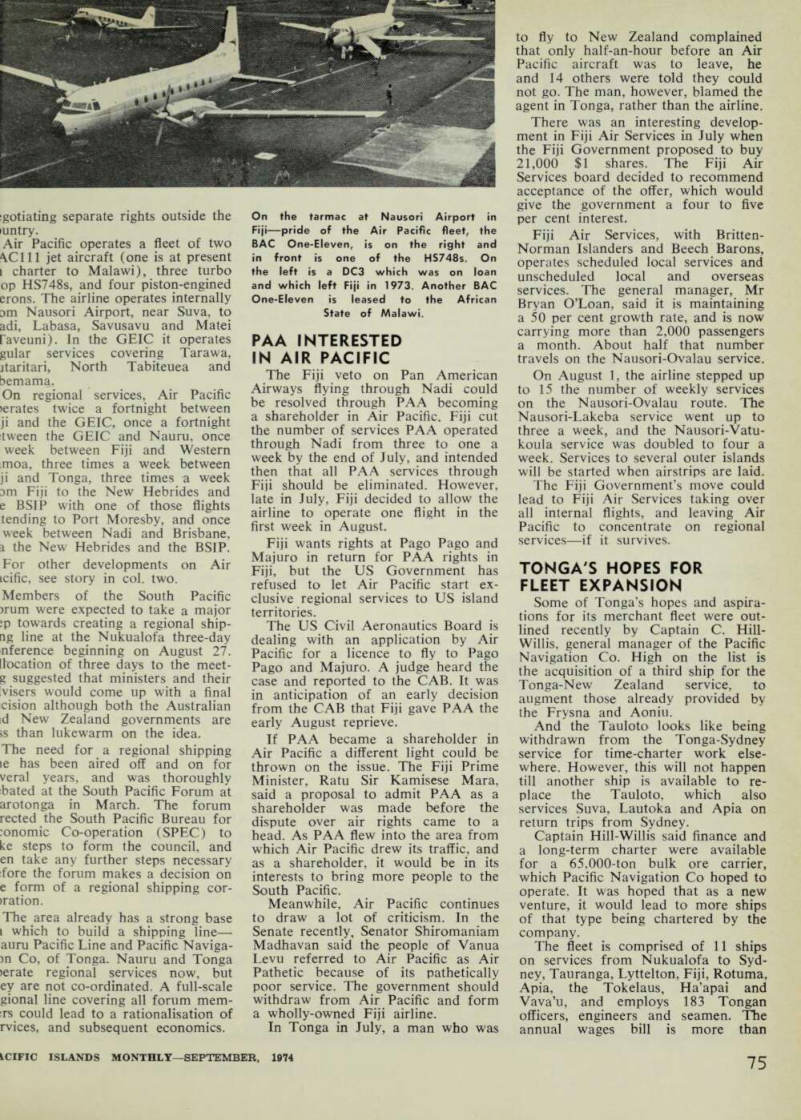
On the tarmac at Nausori Airport in Fiji—pride of the Air Pacific fleet, the BAC One-Eleven, is on the right and in front is one of the HS748s. On the left is a DC3 which was on loan and which left Fiji in 1973. Another BAC One-Eleven is leased to the African State of Malawi.
1700,000. Another 5T150,000 is ent in Tonga on stores and main nance.
Tonga also supplied crew men for her ships for which the Pacific avigation Co was agent. These eluded the Enna G, James Cook and avlur.
He said that when a marine training hool was established, Tonga would i able to supply a steady stream of amen for both Tongan and foreign ips. There was a world shortage of lined and qualified seamen.
The navigation training scheme in inga was started in October, 1973, ider the guidance of Captain Mike files, using the old tug, Hifofua, as training ship. Sixteen cadets are in fining at present. Four of them are igineer cadets and the others are ;ck cadets.
. . And Its Needs
Or An Airline
Tonga needs to attend to several iportant matters related to the >eration of a regional or inter itional air service before its first icing 737 arrives, Mr Yoichi ayashi, international managing rector of All Nippon Airways, said aen he visited the country in July, is visit was “accidental”. He and his mpany’s deputy manager of the ternational marketing section, Mr itsuo Tanaka, were in the Pacific on her matters, so he took time off go to Tonga to “look it over”.
Mr Hayashi said airport facilities iuld have to be improved, more •tel accommodation would be re ared, roads should be improved, d hotel catering requirements should assured.
All Nippon has earmarked two 7s for Tonga.
Ord Howe Flying-Boat
Ings Swan-Song Soon
The last flying-boat service con cting Sydney and Lord Howe Island scheduled for September 10. Since e passenger service was discontinued May, Airlines of NSW has main ined a link to carry mails and other sential goods. On most flights her issenger capacity has been fully ken up with officials connected with e laying of the air-strip. In some stances the flying-boat has had to ake two flights a week. She is fully •oked right up to the last flight.
The flying-boat, which was damaged Lord Howe Island on June 9 when own ashore by strong winds, was ken back to Rose Bay hangar for pairs. These were expected to be tished about the middle of August, irlines of NSW then intended to put back on the Sydney-Lord Howe n.
The other flying-boat, which was
about to be transferred to her new owners, Antilles Air Boats, in the Caribbean, was then hurriedly im pressed into the Lord Howe run. She was to be withdrawn when the damaged flying-boat was renaired and back in service, and sent to Antilles Air Boats.
The new strip had an unscheduled testing on August 4, when an RAAF Caribou transport aircraft landed to pick up a man suffering from a compound ankle fracture. The plane was to make an aerial survey of the partly completed strip, but this was changed to a mercy mission before it took off from Richmond in NSW.
It carried a doctor, a nurse and a medical orderly. After picking the man up the aircraft flew him to Brisbane for hospital treatment. The Caribou landed and took off in strong crosswinds.
All Nippon has earmarked two 737’s for Tonga.
Second Launch
For Tahiti Service
A new passenger launch will go into service between Papeete and Moorea about the end of this year.
Mr Pierre Sachet, who has been running a 50-passenger launch on this service for about 10 years, with the Keke 11, has found it necessary be cause of the demand to get a bigger launch to augment the Keke II services.
The new launch, Keke 111, designed by Sydney naval architect Warwick Hood, will be 100 ft long. It is a welded aluminium launch, capable of 23 knots, and will be able to carry 165 passengers in air-conditioned comfort. Keke 111 will be powered by two 2,500 hp MTU engines.
Sofrana To Launch
Full Container Service
Sofrana-Unilines will launch a full container service between Sydney and Noumea about the middle of October with a Tarros class container ship, similar to the Union South Pacific.
Sofrana is looking for a more econo mical operation. There will be con tinuous reception of goods at a Syd ney depot, which will avoid queueing at the wharves.
Cargo from Brisbane and Mel bourne for New Caledonia will be collected at depots, put into con tainers and railed to Sydney for loading into the ship. The ship can carry about 90 conventional con tainers of general and refrigerated cargo. Specialised containers will be available for shippers.
The container ship will be named the Captain Scott, and will replace a conventional cargo ship of that name, which Sofrana has on charter.
Another ship chartered bv Sofrana,
the Captain Magellan, at present on the Australia-New Caledonia-New Hebrides service, will be withdrawn.
No decision has yet been made about the future of the chartered ships.
A new ship, the Capitaine Wallis, expected to go into service in September, will replace the Capitaine Bougainville on the Sydney-Fiji run, and will offer more space. The Capitaine Bougainville will go to New Zealand to replace the Capitaine La Perouse on the NZ-New Guinea service. She has more cargo space than Capitaine La Perouse. The La Perouse will operate a service from Melbourne and Sydney to the New Hebrides, New Caledonia and Fiji, replacing the Capitaine Magellan.
Improved Shipping
Service For Cooks
It was announced in Rarotonga in late July that an improved shipping service from New Zealand ports to Rarotonga would begin shortly.
The recently-formed New Zealand Shipping Corporation plans to begin a fortnightly service to the Cooks using two small motor vessels the MV Lorena (1,000 tons) and the MV Toa Moana (1,600 tons). These vessels will replace the NZGV Moana Roa which has made ap proximately tri-weekly calls at Raro tonga from Auckland since November 1960.
The Lorena and Toa Moana (Sea Warrior) are both small enough to berth, discharge and load cargoes in the improved Avatiu Harbour. This should save costs, because the much larger Moana Roa had to anchor in the roadstead off Avarua and discharge and load cargoes by lighters, a costly procedure, especially when the weather was bad.
The Moana Roa will be used by the Royal New Zealand Navy as a research vessel and it is understood
Captain Drew, who was recently ap pointed captain superintendent in the Gilbert and Ellice Islands Development Authority. He went to the GEIC from England in 1967 to start the marine training school.
that most of her former crew will I join those of Lorena and Toa Moana..
The Moana Roa made its last and I 145th call at Rarotonga in late July-early August.
Captain Steve Ponsford, operational! manager for the New Zealand Ship ping Corporation, spent a week ini Rarotonga in July. He said the cor poration will provide a better ship ping service for the Cook Islands thani they have experienced before and! that his visit to the Cooks had givem him a better appreciation of what! operations are needed.
Fiji Company Buys
A Solomons Ship
The Wong Shipping Co, of Fiji hasi bought the Coral Princess from the!
BSIP Government bringing the Wong; fleet to four. The Coral Princess willi be used mainly to trade from the Laui and Lomaiviti islands to the Vanuai Levu coast. Trade along the Wainunu coast, on the south side of Vanuai Levu, has increased, and there are often complaints of irregularity of shipping services.
The Coral Princess, 138 tons, is 89 ft long and is powered by two Gardiner eight-cylinder engines. She has a wooden hull and an aluminium superstructure and is equipped with a freezer. On her BSIP register she was allowed to carry 50 passengers—six in the saloon and 44 on deck. These may be changed to suit Fiji require ments. I The Tabu Soro, bought by the Fiji Government to replace the Uluilakeba, which sank in Hurricane Lottie in December, 1973, has been delayed by engine trouble on her delivery voyage. The ship, with a Norwegian crew, left Kristiansand, Norway, in May. She put into Port of Spain, Trinidad, for repairs.
Mystery Of
The Lost Trudy
A minor sea mystery surrounds the disappearance of the inter-island trading vessel Trudy, lost with nine people aboard in New Hebridean waters between the islands of Efate and Erromango.
Even after three days of intensive searching by sea, air and land — covering a total area of more than 40,000 square miles —only two pieces of ship’s wreckage were found—-I top cabin section and a length of broken hull timber. There were no survivors, no bodies.
The popular theory is that the ship, on a routine voyage from Vila to Tanna carrying gas cylinders among its cargo, blew a hole in its bottom, and sank instantly, carrying most of the five crew and four passengers
ith it. One veteran South Pacific ilor commented grimly; “If any xlies had been hurled into the ater, the sharks would soon take re of them.”
It doesn’t leave much for the Ficial Court of Inquiry to do, except :t through evidence of the ship’s aworthiness, the master’s compe nce—neither of which is questioned ■and the formal procedure of mari ne disaster inquiry.
The Trudy, owned by Tanna busi ssman Bob Paul, was a familiar -ht among the southern islands of s New Hebrides, picking up cash rgoes for shipment to Vila and inging supplies of tinned food, tilding materials—and gas cylin rs.
As she slipped out of Vila harbour i the evening of July 26 it was just other sea-trek along an intimately own route, and the Pacific waters ;re in a kindly mood. A few miles uth of Efate, Trudy radioed her sition ... it was the last known ntact.
It was not unknown for the ship call in at Erromango on her way Tanna, but after a weekend of ence a worried Bob Paul asked the thorities in Vila for assistance, le of Air Melanesiae’s Islander air ift was sent out, and just before sk on July 29 the pilot spotted lat looked like ship’s wreckage out 15 miles north-west of Dillon’s y. In a first-light take off from tnna next day, the Islander re lated the wreckage and guided the ndominium vessel Navaka and the nerican yacht Silhouette to the spot, ey picked up the wreckage, and it s positively identified as being from > Trudy.
One result of the Court of Inquiry iy be that procedures for the re rting of passengers sailing on inter md vessels should be tightened Radio Vila, the New Hebrides sadcasting Service, reported that > handling agents for the Trudy Vila had not known that she was rying four passengers in addition the five crew members.
Trol 'Bomb'
R Suva Wharf
\ petrol leakage in July from a iker point at Kings Wharf, Suva, blighted the need to relocate tanker :harge and bunker facilities in i’s capital city. There was a heavy icentration of high octane petrol nes while a tanker was discharging, fhe fire brigade was ealled in. A trine Department spokesman said was likely that the fuel being :harged at North Point had Daked t the valves in the lines serving South Bunker point.
All cargo work was suspended at the south end of the wharf, and the gate leadmg to that wharf was closed, as a highly explosive situation had developed.
Apart ' from inconvenience and delays to shipping, the incident pointed to the dangers of fuel lines and bunkering facilities in conjunction with a commercial port, and dangerously close to the business centre of the city. The emergency underlines the need to relocate the tanker discharge and bunker facilities on a site remote from the city.
The leak was traced at the end of July and the faulty pipe removed.
Wharf activities were back to normal at the beginning of August.
Aust Talks May Bring
Better Service To Png
Another attempt is being made to cut down delays on the Australian waterfront so that shipping companies may give a more efficient, and cheaper, service to Papua New Guinea. Recently officials from PNG visited Australia to discuss the question of providing regular berthing m Sydney, Melbourne and Brisbane for ships in the Australia-PNG trade, A guarantee of regular berths would not eliminate industrial trouble, which is rife, but it would ensure that ships would not have to tie up in the harbour till space was available. At present, particularly in Sydney, there
is a glut of shipping, a result of a 25 I per cent cut in the tariff on imports. ] The shipping companies have tried time-slotting the arrival of trucks at the waterfront to eliminate the huge cost of having them queue and wait for several hours before accepting the cargo. This has helped, but it is a system subject to breakdown for various causes, often industrial, and often associated with the narrow I streets leading to the wharves, parti- 1 cularly in Sydney.
The PNG team had talks with officials of the Australian Shippers’
Council, the Chamber of Shipping, stevedoring interests, the Departments of Overseas Trade and Transport, the NSW Maritime Services Board and i the Melbourne Harbour Trust. The four main shipping lines serving PNG, are prepared to co-operate by rear ranging schedules to make the best use of the facilities should regular berths be provided. These lines are Karlander, New Guinea Australia j Line, New Guinea Express Line and I Conpac.
Big Extensions At
Port Moresby Airport
June, 1976, is the target for com pletion of reconstruction of major work at Port Moresby airport. The 1 work includes a new runway, taxi ways, parking apron and associated works. The new runway will be 2,500 metres long and will be capable of handling fully loaded Boeing 727 s and 7075. It will also be able to handle the jumbos—Boeing 7475.
The runway at present in use is 1,750 metres long, and was designed for Constellation-type aircraft. It is now becoming uneconomic to main tain this runway as a heavy duty , pavement. • The Air Niugini fleet will soon increase to 22 with the addition of two more 40-seat Fokker Friend ships. The aircraft, which cost about 1300,000 each, were bought in Japan during a recent visit by the general manager of Air Niugini, Mr R. G.
Conley, and the engineering man ager, Mr L. Cooper. The first aircraft is expected in November, and the second in January, 1975. There will be 10 Fokkers in the fleet when these two aircraft go into service. 9 Increased fuel costs have forced Polynesian Airlines to raise fares.
Recent increases have been approved by the governments of Western Samoa, Tonga and Fiji. The main new fares are Apia to Nadi or Suva, $76.15, and Apia-Tonga, $62.20 (both single). Polynesian Airlines has been appointed agents for CP Air in Western Samoa and Niue.