The Editor's Mailbag
pp. 25-33 · Read in the full issue
Sailing Backwards
David Richardson, Cairns, Queens ind comments in his letter (PIM, ily, p 43) on the use of plywood [ the canoe we are building for the [awaii-Tahiti-Hawaii trip.
We are forced to use marine ply ood for the hulls because there are iry few of the large koa trees left hich were the traditional material >r the dugout hulls, or keel-pieces, id most of these are in conserva an. Of those few trees which are atainable, signs of decay indicate lat the wood would not be suitable.
The Hawaiian Canoe Racing As •ciation requires that each club ive a koa canoe, and with the re ;nt increase in racing clubs, the few did logs still standing will be gone. really makes no difference what e canoe is made of where perform ice is not a factor. We are less terested in authentic construction an we are in authenticity of per rmance. The three factors in :rformance are hull shape and sight (which will be duplicated), sembly method (all parts will be shed with several miles of hand aided sennit), and sail rig (sails ill be of plaited pandanus, i in. save to match old sails in useums). In 10 months we should tve performance data.
The canoe Mr Richardson des ibes, is indeed a beautiful work, y favourite Maori canoe is Te ki a Tapiri in Auckland. I have en in contact with friends in New ;aland who also aspire to duplicate i ancient voyage. It’s my hope that ey will be encouraged by the corn unity, for data derived from such periments will enable science to ake better assessments of ancient fiynesian maritime capabilities.
Thank you for the exposure in M. I hope Mr Langdon is success -1 with his book! Publicity like this n help stimulate support for fur er scientific study of Pacific pre story.
Aloha pumehana.
H. K. Kane
Vice-President, Polynesian Voyaging Society, anolulu.
Education In American
Samoa
I commend PIM on excellent coverage of Pacific area news, and, in general, my respect for the pub lication allows me to read its articles with confidence and trust that the reporting is factual.
It is unfortunate that the two items on education in American Samoa (PIM, July, pp 11 and 33) could not have been checked for accuracy before publication. The author is mis informed on several points: 1 The Department of Education has recently adopted a rule to pro vide equal educational opportunities for all students. Upon implementation of the rule, (1) no public school will limit enrolment by language require ment; any eligible school-age student will attend the school nearest his residence; (2) US trained teachers will be assigned throughout the pub lic schools wherever their services will be most beneficial, instead of comprising the total teaching staff of one school, Fia Iloa. This rule, apparently the “sudden” policy change referred to in the article on page 11, does not mean the depart ment is phasing out or de-emphasising English instruction. 2 Several statements in the article convey the impression that Fia Iloa is the only school in American Samoa in which English is used or
taught. English is spoken and taught in Grades 1-12 in all 26 elementary schools and four high schools of American Samoa. There are no sepa rate “English language systems” and “Samoan language systems” of edu cation. Ninety-eight per cent of the instructional materials, including reading books, are written in the English language; and English, ac cording to DOE policy, is the official language of instruction in all the pub lic schools of American Samoa. In all schools except Fia Iloa, there are Samoan teachers in the classroom with the Samoan students, and Samoans do, naturally, speak Samoan. They also teach English, use television in teaching English, and use English in instruction in other subjects. There is no anticipated change in this. Primary level children who have had no previous instruction in English are an exception: they are instructed primarily in Samoan during the first year while they are learning English, but very soon the balance shifts and instruction by thfc third year is primarily in English. But there is no group of students in the ele mentary and secondary schools, not even the first grade children, who are taught “only in Samoan”. 3 The DOE proposes to expand and improve the existing Samoan language programme (which now consists of beginning reading in Sa moan in the first year of school; limited Samoan language arts activi ties in grades 2, 3 and 4; and one secondary course in Samoan language and culture.) Such a project should strengthen and enrich the instruc tional programme; it does not mean a phasing out or de-emphasis of English. 4 A task force to study the role of educational television in American Samoa was formed in 1971 and the recommendations of that team, to re duce the amount of television used and to use television in different ways, were adopted for the 1972- 1973 school year and for following years. Television has been and re mains a valuable resource for the classroom teacher in American Samoa, and there is no more recent plan for “far less” use of TV as sug gested by the July article. 5 Although it is true that as long as present admission requirements and present teacher-assignment prac tices continue at Fia Iloa School, the DOE is not eligible for certain
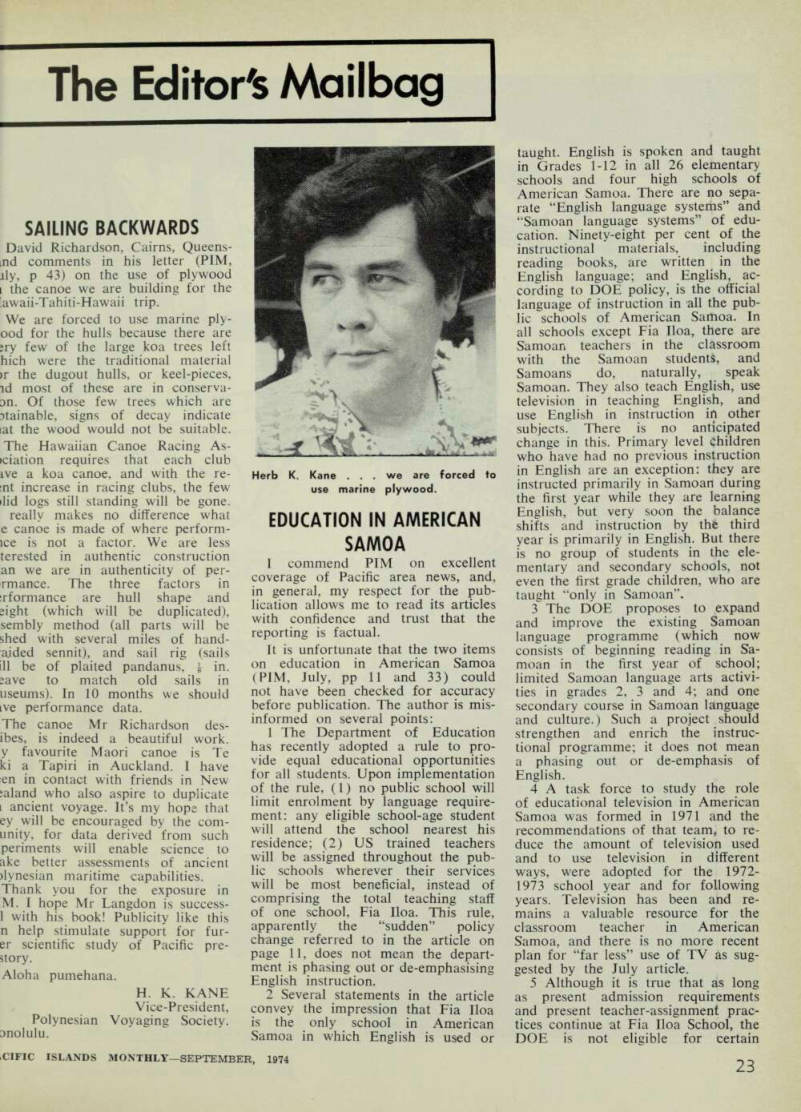
Herb K. Kane . . . we are forced to use marine plywood.
;deral funds, this has not been the ;ason for plans to change the opera on of Fia Iloa school, plans which, xording to the DOE rule, will not s fully implemented until 1975-1976. 6. The article indicates that only Dove-average students can speak 3th English and Samoan, and that i large number of students” cannot i instructed in English because they >eak Samoan. In every educational r stem, there are students who have ore facility in languages than hers, but in no way is the number I bilingual students in American unoa limited to the above-average, bviously the fact that a child speaks imoan does not preclude his speak g English and receiving instruction English. 7 The item on page 33 indicating at there will be no instructional levision programming in American imoa for the rest of the year is in durate. On May 29, 1974, the DOE mounced that instructional telecasts ere ceasing, because of power prob ms, for the remainder of the 1973-
1974 school year. The school year ended three days later on May 31, 1974. Instructional television pro gramming will begin again in Sep tember when schools reopen.
(Mrs) Marilyn Barry,
ITV Manager.
American Samoa.
New Hebrides Censorship
The film Hiroshima-Nagasaki recently caused alarm to the Censor ship Board of the Joint Administra tion of the British and French governments in Vila. It was purely a documentary (15 minutes) film, depicting the immediate effects of the atom bomb explosion that took place in Japan during World War 11.
Radio Vila announced the screen ing of the film and that it was open to the public; children under the age of 12 were not to be allowed to see it as it could terrify them and give them nightmares. The notice aroused the Board’s suspicions and it im mediately banned the screening. The reason for the ban was that the film had not been submitted to the Board, and that the Board had not granted permission for it to be screened.
The Joint Regulation on Censor ship came into force in 1973, but the publication of it was poor. The Presbyterian Church of the New
Hebrides, which occasionally imports films for its use, did not possess a copy until this dispute arose.
The regulation states that . . No person shall exhibit to the public any cinematograph film ... in the New Hebrides unless and until a permit has been granted by the Censorship Board.”
The members of the Board include the French and British district agents, who act as joint chairmen, the district education officers of each national service and two New Hebrideans ap pointed by the Resident Commis sioners by joint decision.
Fair enough! No film should be exhibited for public screening with out the approval of the Censorship Board. The film was not screened.
But a good crowd of people, many of whom had travelled several miles, many of whom had paid taxi fares especially to come over for the film, and many of whom had cancelled their meetings for that night, were disappointed at discovering that the film was cancelled. I was disappointed too by the Board’s action. I had gone to the trouble of bringing the film in from Fiji; preparing a simple explana tion to accompany the film and get ting the necessary equipment ready for the programme. But it was all to our disappointment, when just a
Cont on p 29
ew hours prior to the scheduled ime, the programme had to be ancelled.
People of the New Hebrides, like be rest of the world, hear of the aternational fuss over the develop ment of nuclear arms by the big owers —Russia and the United States alking on nuclear disarmament; India ntering into the nuclear race; China nd France carrying out nuclear test igs. New Hebrideans generally do ot appreciate why countries such as lew Zealand and Australia should go m the extent of boycotting the ships nd planes that service the New lebrides Group in their protest gainst French nuclear testing. New lebrides, as an innocent country and eople, suffers the direct consequences f such international fuss. Why should it suffer? Is all this fuss necessary? yhat is wrong with nuclear arms nd nuclear explosions? These are ome of the questions that puzzle the Jew Hebrideans. Most remain quite >norant of the reasons for the fuss nd the danger of nuclear bombs The screening of the film was itended to dispel some of this fog f ignorance. As such, it was purely ducational —to help the public of me New Hebrides to be aware of the angers of nuclear weapons. To ensure lat the screening of the film achieved mis purpose, a simple explanatory iece was prepared to accompany le film. However the purpose was ever achieved. The film was on loan ar a very short time and had to be immediately.
The film was screened before three members of the Board on the follow ig day. (Incidentally, the regulation as it that “. . . four members of the oard shall constitute a quorum”, ince things were rushed through, the oard could not form a proper uorum to see the film.) The Board ave its approval for the public :reening of the film, but only with fluctance and reservations reflected i the manner in which permission as granted. Before the film could be mown, a certificate of approval had ) be obtained from the Board. No oung person under the age of 18 mould be allowed to see it. Any ex lanation accompanying the film must e related only to the context in which me incident occurred. In other words, must say: “America dropped the ombs in Japan when the two ountries were at war with each ther during the second World War i 1945” . . . full stop! Furthermore
it was demanded that such an ex planation must be written out and shown to the Board before it was used; and again that no speeches must be made following the screen ing of the film.
Fine! But who wants to be made aware of a danger that is not an issue, and it is a danger to every living soul on the face of the earth.
If we must not bring in the current aspect of the danger, then what is the point of screening the film at all?
If education is to serve any com munity, it must deal with issues that are immediately related to the life of that community. Unless our education has something to say about our life here and now, it is not worth pursuing.
It was explained that the Board was concerned about public order. It is funny that Public Order should be the Board’s first concern. The Board is not interested in checking every film that comes into the Group.
For instance, anything on Mickey Mouse or the Wild West, which simply provide entertainment, are allowed to pass unquestioned But any film that makes New Hebrideans think and start questioning about life and the world must be examined. One wonders if this reflects political fear and suspicion on the Board’s part.
Often, when a person does some thing that he knows is unfair to the person behind whose back he does it, he is very careful that the game is not revealed to the person who is
being cheated. A lot of information that should be communicated to the New Hebrideans never gets past the! clutches of the two administrations. I The New Hebridean petitioner to the United Nations was infuriated on dis covering that the information on New Hebrides sent out by the UN never came to the knowledge of the general public.
The recent incident over the film is j another example of the way New Hebrideans have been deprived of j information on matters of importance J to them as people and as a country. I Education in the New Hebrides is very much polished by the colonial varnish of the British and the French 1 governments.
Sethy J. Regenvanu.
Vila, New Hebrides.
Aviation Lynch Law
The article by your staff writer on the development of regional air j services in the South Pacific (August, j p 75), should be disturbing to any-j one with some knowledge of the factors which make airline operation successful, and to anyone with some I affection for the Islands. Each group doing its nationalistic bit in aviation will, in my opinion, lead to com mercial success for none—just more and more subsidies, unreal balance sheets, and increasing influence from foreign interests.
Surely the core of unity in the area is Fiji—and surely Air Pacific should be the international carrier, with not a cent of Australian, New Zealand or British money in it, but rather the currencies of all the Island groups referred to in your article.
The owners of Air Pacific should then negotiate rights for the airline, using Nadi as the international pivot, to operate with high frequency into Australian and New Zealand airports, and even across the Tasman as part of a triangle, if that leg were con sidered to be commercially sound.
The days of waving an airline as a flag are over—an airline must now be a hard commercial proposition.
What has to be found in equipment should not be more than two types of aircraft, instead of the mixed bag of machines which appears to be building up now as a result of every one going off and doing their own thing; one aircraft type for inter national services into Australia and New Zealand; and the other for regional services. What you buy to a great extent is what you can get overhauled, certainly the major over hauls, in Auckland or Sydney. In other words, do not try to build up an expensive maintenance base in
Nadi. Keep down the number of
people employed.
For each Island group to pursue ts expensive and unnecessary policies, as outlined, would add up to i luxury this family of islands could lot afford, with so much else to be lone for the good of the people.
George Lynch.
Sydney.
Future Arts Festivals
That the First South Pacific Festi val of Arts 1972 was a resounding luccess, both in spontaneous joy generated and in the rehabilitation md preservation of many foundering :ultures was the unanimous opinion )f participants, editorials, spectators, he organisers and the host country, "iji. The directors of the Sydney )pera House Opening Committee vere so impressed that three hundred >r so of the participants were ogether again in Sydney for the Jpera House Opening by Her dajesty, the Queen in 1973.
New Zealand has offered to host he next South Pacific Festival. It has >een suggested that this event should >ccur every four years. But without l permanent body created to ensure ontinuity—such as the Olympic James or the Adelaide Festival of enjoy—there is grave danger of ragmentation through natural human nertia. The ideals and goals should »e decisively crystalised and set down or a permanent constitution with the •riginal enthusiasm and imagination ;ept alive.
When the South Pacific Commiss on meets, there should be a con erted effort to create through that ody which was responsible for the rst festival, an organisation which /ill be permanent, knowledgeable and edicated.
Considering the mountainous prob ;ms of such an inter-nation effort or the arts, it is hoped that the ex erience of the first South Pacific ■estival of Arts will guide the —and any such permanent ody as may be decided upon in rder to further the best display poss ible of the rich store of treasures /hich is the art forms of the Pacific copies.
Above all, the arts of the South ’acific must be encouraged. The /orld needs the joy and the beauty hey present to us all. As an antidote or some of the ills the West has
known in theatre and other art pur suits, they are invaluable.
Beth Dean.
Sydney.
A 'Biased' Reviewer!
W. G. Coppell’s book review of The New Pacific (PIM, Aug, p 69) or, to give it the correct title. The New South Pacific was biased. What is worse, Dr Coppell did not admit his bias. I wish to play by the rules.
This letter is biased.
It is biased against crass and fatuous nonsense such as that your reviewer put before us last month.
Waigani, KEITH JACKSON.
Papua New Guinea.
Great Wall Broken
Huang Sui-Lan in the Making of a Fiji Chinese (PIM, Mana, July p 64) has for me broken a Great Wall of human barrier. I have now moved from taking for granted my attitude of the stereotyped Chinese to regarding him or her as just another human being, and with other human beings I must remember that I co-exist.
I am going to be a more confident and contended man in my small capacity in our business dealings.
To Huang I say merci!
M. Tagarasi.
Vila,