change, bloody missionaries?
pp. 21-23 · Read in the full issue
Who raised those winds of change, bloody missionaries?
From the Rev JOHN GARRETT in Fiji
On a hot day in 1950 I ran into a lomon Islands planter in the airport ilding at Jakarta. He told me the d trouble in Indonesia was “the ;as these bloody missionaries are tting into people’s heads.”
Even then missions in the Pacific re getting ready for go-home signals d preparing the churches for auto my. They had followed the 1938 idras world meeting of the Inter tional Missionary Council where i tide turned from paternalism to : idea of responsible self-hood for anger churches. The Pacific seemed e to follow Asia, Africa and Latin nerica.
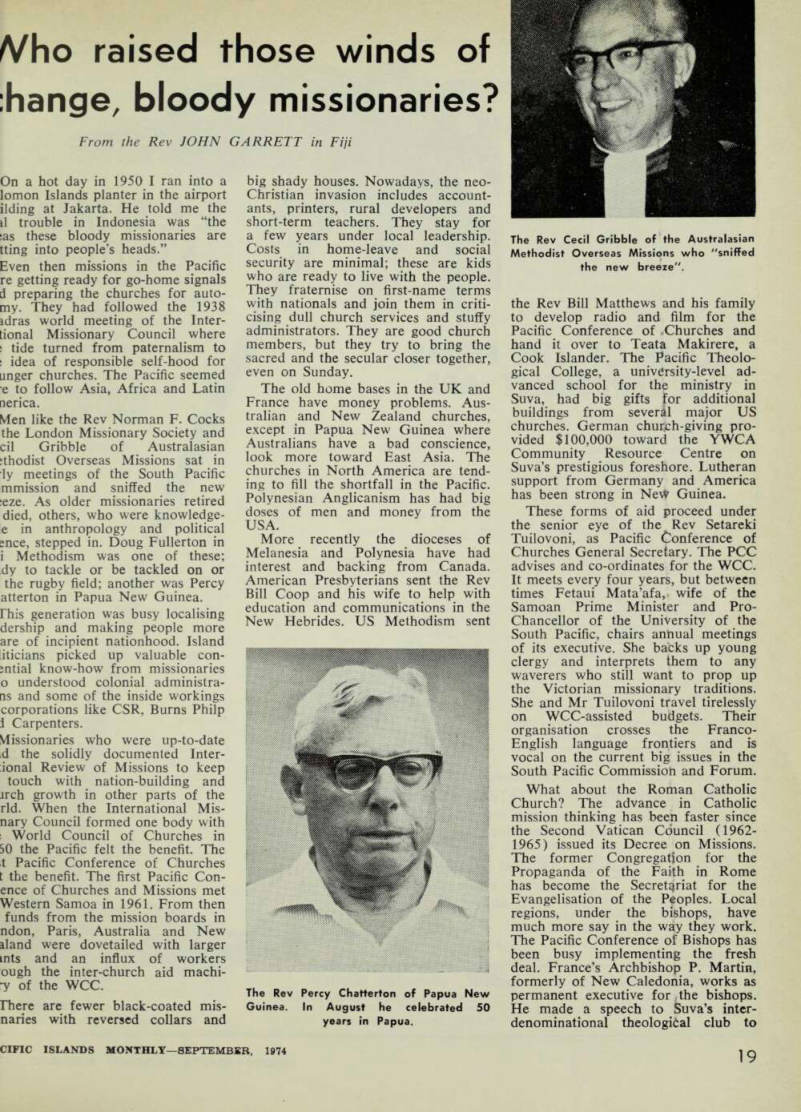
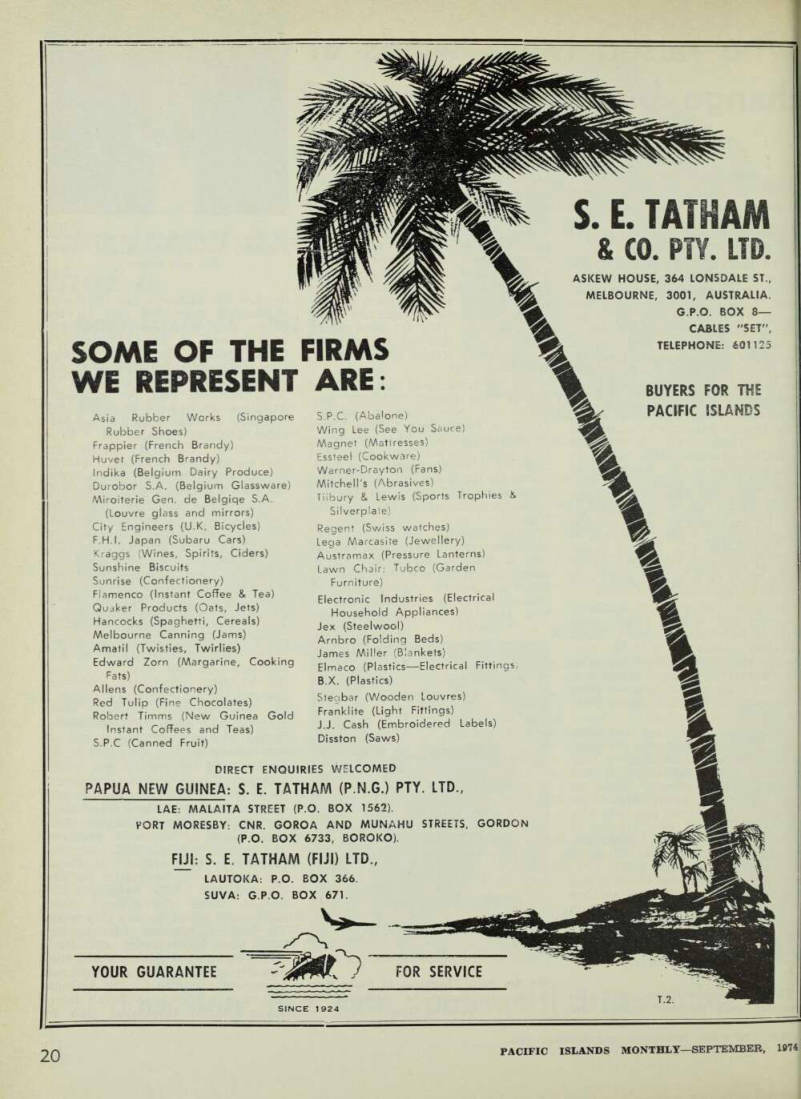
Men like the Rev Norman F. Cocks the London Missionary Society and cil Gribble of Australasian dhodist Overseas Missions sat in ly meetings of the South Pacific mmission and sniffed the new :eze. As older missionaries retired died, others, who were knowledge e in anthropology and political snee, stepped in. Doug Fullerton in i Methodism was one of these; dy to tackle or be tackled on or the rugby field; another was Percy atterton in Papua New Guinea.
Phis generation was busy localising dership and making people more are of incipient nationhood. Island iticians picked up valuable con mtial know-how from missionaries 0 understood colonial administra tis and some of the inside workings corporations like CSR, Burns Philp 1 Carpenters.
Missionaries who were up-to-date d the solidly documented Inter ional Review of Missions to keep touch with nation-building and irch growth in other parts of the rid. When the International Mis nary Council formed one body with : World Council of Churches in SO the Pacific felt the benefit. The t Pacific Conference of Churches t the benefit. The first Pacific Con ence of Churches and Missions met Western Samoa in 1961. From then funds from the mission boards in ndon, Paris, Australia and New aland were dovetailed with larger mts and an influx of workers ough the inter-church aid machi •y of the WCC.
There are fewer black-coated mis naries with reversed collars and
big shady houses. Nowadays, the neo- Christian invasion includes account ants, printers, rural developers and short-term teachers. They stay for a few years under local leadership.
Costs in home-leave and social security are minimal; these are kids who are ready to live with the people.
They fraternise on first-name terms with nationals and join them in criti cising dull church services and stuffy administrators. They are good church members, but they try to bring the sacred and the secular closer together, even on Sunday.
The old home bases in the UK and France have money problems. Aus tralian and New Zealand churches, except in Papua New Guinea where Australians have a bad conscience, look more toward East Asia. The churches in North America are tend ing to fill the shortfall in the Pacific.
Polynesian Anglicanism has had big doses of men and money from the
Usa.
More recently the dioceses of Melanesia and Polynesia have had interest and backing from Canada.
American Presbyterians sent the Rev Bill Coop and his wife to help with education and communications in the New Hebrides. US Methodism sent
the Rev Bill Matthews and his family to develop radio and film for the Pacific Conference of .Churches and hand it over to Teata Makirere, a Cook Islander. The Pacific Theolo gical College, a university-level ad vanced school for the ministry in Suva, had big gifts for additional buildings from several major US churches. German church-giving pro vided $lOO,OOO toward the YWCA Community Resource Centre on Suva’s prestigious foreshore. Lutheran support from Germany and America has been strong in Neifr Guinea.
These forms of aid proceed under the senior eye of the Rev Setareki Tuilovoni, as Pacific Conference of Churches General Secretary. The PCC advises and co-ordinates for the WCC.
It meets every four years, but between times Fetaui Mata’afa, wife of the Samoan Prime Minister and Pro- Chancellor of the University of the South Pacific, chairs annual meetings of its executive. She backs up young clergy and interprets them to any waverers who still want to prop up the Victorian missionary traditions.
She and Mr Tuilovoni travel tirelessly on WCC-assisted budgets. Their organisation crosses the Franco- English language frontiers and is vocal on the current big issues in the South Pacific Commission and Forum.
What about the Roman Catholic Church? The advance in Catholic mission thinking has been faster since the Second Vatican Council (1962- 1965) issued its Decree on Missions.
The former Congregation for the Propaganda of the Faith in Rome has become the Secretariat for the Evangelisation of the Peoples. Local regions, under the bishops, have much more say in the way they work.
The Pacific Conference of Bishops has been busy implementing the fresh deal. France’s Archbishop P. Martin, formerly of New Caledonia, works as permanent executive for ,the bishops.
He made a speech to Suva’s inter denominational theological club to
The Rev Percy Chatterton of Papua New Guinea. In August he celebrated 50 years in Papua.
The Rev Cecil Gribble of the Australasian Methodist Overseas Missions who "sniffed the new breeze".
how his colours on subjects like laximum practical co-operation with ther Christians and opposition to tomic testing. Catholics and Pro ;stants have been attending one nother’s meetings freely. The Roman !atholics are in several national auncils of churches and want to >in the Pacific Conference of Churches, where they are already bservers.
The Roman Catholics have an Jvantage in total commitment be mse of the celibate religious com lunities like the Marists and Divine tord Missionaries. Many members f these groups opt for citizenship hen countries become independent, he trend is less clear among Pro stant missionary expatriates, who jntract for a term, not for life.
As a result of the changes in mis ons most churches now feel the rain of two problems: finding local oney to raise the ratio of Pacific mding to foreign help, and training cal leaders and administrators. The oman Catholics also face leakage om the ranks of the priesthood and ligious communities; there is talk the need for married clergy in iltures where lifelong celibacy causes izzlement.
All the new trends are accelerating :cause of the preponderance of ider-25s in the churches. Funerals, tirements, and resignations assist. ie churches are being dragged oaning, if not screaming, out of the >th into the late 20th century. They e listening to ideas that never tered the heads of the (bloody?) issionaries of yesterday.