Tropicalities
pp. 14-17 · Read in the full issue

A whiteman's
eargo eult
Papua New Guinea’s Investment Corporation Fund, formed in Sep tember last year as a share unit trust by the Investment Corporation of Papua New Guinea, which was two years old last February, will shortly be delivering the goods to the share holders in the shape of dividends.
And the shareholders, all indigenes, are likely to get a pleasant surprise.
The investments have prospered. The $l2 million-worth of shares are worth, at present, around $l4 million and the interest rate at least eight per cent, and, said Mr V. C. Jacob, the corporation’s managing director, to PIM, it’s likely to be “better than 10 per cent”.
“Ah, whiteman’s cargo” is likely to be the cry when the news gets around the villages. And, thereby looms a worry, and the reason why the corporation has gone into the film business with a locally-produced film, Stori Bilong Invesmen Koporesen.
As Mr Jacob explained in Sydney in August when the English version of the film was launched—the sound tracks are also in Pidgin and Motu — one of their worries is that the people may get a wrong slant on the whole thing. There’s a danger that share holding and its concomitant winnings may be regarded as a whiteman’s cargo cult. So the accent, now that the corporation and its fund are wax ing strong, is on educating the people in the business of investment. They are being given both sides, the rough —when shareholdings depreciate— and the smooth, like the present when everything is doing fine.
When the corporation’s balance sheet for the year ended June 30 is published, it will show a profit well in excess of $1 million which isn’t bad going on a government grant of about $5 million.
One seemingly small matter which is giving the corporation great satis faction is that in the first nine months of the investment fund’s life only one shareholder sold his shares.
The gambling aspect is being
ignored. The stress is on the benefits to be gained by investing, particularly by groups, in the corporation’s vari ous holdings.
The film, in colour, made by PNG based Film Niugini, and directed by Andrew Phillips. ex-Office of In formation, and freelance journalist Chris Ashton, tells the story of how a local government council discovers what the corporation does and buys shares in it. The happy ending is a substantial cheque.
That happy ending might be a worry too. The shareholders will have to be made to realise that a 10 per cent dividend one year could be halved, quartered or even flattened the following year.
One important aspect of the cor poration’s activities, buying shares as it has to date, in 20 undertakings— including a million shares in Bougain ville Copper—is that its shareholdings and consequent representation on company boards gives it, and the PNG Government, a voice in running companies in PNG.
“We carry the government’s voice into the boardrooms, a voice that hasn’t been heard before”, said Mr Jacob. “When we go in, we try to influence the board so that our as pirations are reflected in the com
pany’s performance”.
So that now the voice of Papua New Guinea, its government and its people is being heard in many places, in copper town Panguna, on chicken farms, in timber mills, ice-cream factories, the tourist industry, tile making factories and in buses.
Pitcairners will
raise the wind
The people of Pitcairn Island are not concerned with nuclear devices being exploded by the French about 500 miles away. Rather, they are interested in another type of energy, generated by wind. Their interest has deepened since fuel became more difficult to get a few months ago.
But when they checked the cost of wind generators and the banks of batteries needed to hold the power, against their average per capita in come (about SUS3O a month), they almost gave up hope. Then the Seventh-day Adventists’ Voice of Prophecy in Glendale, California,
stepped in, asking listeners to the station’s radio broadcasts to help.
The appeal raised about SUSIO,OOO, almost the exact amount required to buy two 2,000-watt wind mills and allied equipment. Two mills have been bought in Australia and are expected to be installed and operating by Christmas. One im mediate result will be a big cut in the bill for fuel.
Incidentally, with the departure of a family of three for New Zealand, the population is down to 66.
A La Perouse
relie goes home
A tattered reminder of the visit to American Samoa by the La Perouse expedition in 1787 —a much-worn French Navy coat, with gold braid, was presented to the Museum of American Samoa in Pago Pago by the Bishop Museum in Honolulu, which had been keeping the coat on a custodial basis since 1957.
In 1787, the La Perouse expedition landed at Aasu village, on the north shore of Tutuila and, for reasons never really understood, was engaged in a battle with the Samoans. Twelve French sailors were killed. The expedition moved on to other islands and eventually was shipwrecked.
In November, 1884, the Frenct frigate Fabert visited Aasu anc erected a small memorial to the French sailors killed there and gave proper military honours to the long dead Frenchmen.
At that time, a French officer 5 ! coat was presented to High Chiel Lualemaga of Aasu, along with a ha with white feathers, a sword will a mother-of-pearl hilt, a gun and supply of shells.
After several years the chief re quested a new coat, as the origina coat had become rather worn. H< was given a new coat by the Frencl
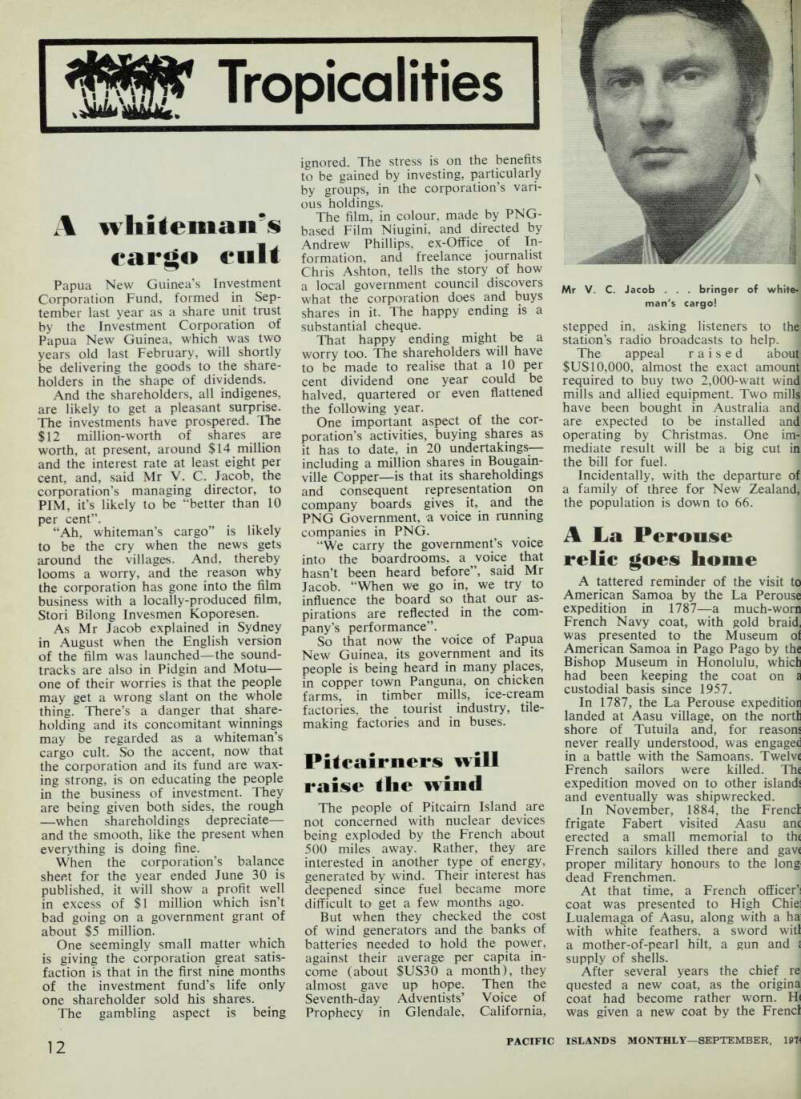
Mr V. C. Jacob . . . bringer of white man's cargo!
Javy and the original coat was put side.
However, in 1957, the original coat ras given to the Government of American Samoa and then transferred > the Bishop Museum in Honolulu. d that time American Samoa had no mseum and asked the Honolulu mseum to keep the coat until there r as a proper place for it.
The Museum of American Samoa as opened last year.
iVhen file law
yen i to pot
It is, according to a court ruling, jite legal to be in possession of arihuana and to sell it in the US rust Territory. Chief Justice Harold r . Burnett, in July, removed restric ts on the sale or possession of arihuana when he issued his judg ent in a case the Trust Territory overnment brought against Mariano . Bermudes, who had been arrested id charged with having possessed id sold marihuana.
Mr Justice Burnett invalidated the itutes and regulations covering the issession and sale of marihuana. He 50 invalidated the laws which de led what a drug was and em iwered the Director of Health Ser ies to decide which drugs had “sub mtial potential” for abuse. He us made it impossible for the TT >vernment to prosecute individuals r the sale or possession of mari ana. But his ruling did not affect e statutes prohibiting the sale or •ssession of hard drugs, such as rpin and opium.
The judge said the law, which dele ted authority to the Director of jalth Services to determine drugs the basis of “current medical owledge”, did not provide a efficiently precise standard upon lich the director can base his de minations”.
“The medical profession is in a te of flux as to its appraisal of irihuana and is dubious about the estance’s role in drug abuse,” the lief Justice said.
Another point in question was that rmudes could have been given a [fer sentence for the sale and ssession of marihuana under the tutes made invalid, than he could :eive for importing and selling ium or heroin. Mr Justice Burnett d he did not feel that was right, i was an important factor in his validating the marihuana statutes.
A delighted Assistant Public De ider, Mr Benjamin Abrams, who peared for Bermudes, described * Justice Burnett’s order as a
“courageous and enlightened de cision”.
“The effects highlight the fallacy of so-called victimless crimes, since any self-respecting doctor knows that marihuana presents no threat to the user or the community,” Mr Abrams said. “There is no victim.”
He said he hoped the Congress of Micronesia and the Trust Territory Government would use the oppor tunity to observe the results of the decision before any laws affecting the use of marihuana were enacted.
However, the whole issue went to pot again later when High Commis sioner Edward Johnston announced that the possession of the happy weed remained an offence because the United States Federal Controlled Sub stances Act, which made possession of the drug an offence, applied fully to the Trust Territory.
Warning—don’t eat
European food
Expose a Pacific Islander to Euro pean food and it is not long before he has a dental problem. Dental authorities say this is particularly so in Tahiti. Now, in the Solomon Islands, a New Zealand dentist. Dr Ron Whatmough, has given another warning that children who eat Euro pean food are more likely to have tooth decay than those who don’t.
He quoted the Reef Islands chil dren as being good examples—their teeth were healthier than those of some of the children he had seen on Makira. He blamed the state of the Makira teeth on European food, saying more of it had probably been included in diets than Melanesian food. The Reef Islands children had some of the best teeth he had ever seen. He felt that was because the people of the outer islands were far away from urban area, where the diet was more “Europeanised”.
There were very few Reef Islands children with dental decay. Usually there was only one tooth to be filled for every 30 children. But in Makira there was one filling for every child.
Creating a new
elite in Fiji
Fiji could follow the House of Lords with a system of “life peer ages”, but instead of dukes, earls, lords, etc, could use the traditional title of ratu or some new title. That is the view of Ratu David Togani valu, Minister without Portfolio.
Speaking at an open day at the Fulton Missionary College, he ques tioned whether people should slavishly cling to custom unsuited for advancing times. Rather, they should hold on to what was good, and dis card the outworn, the indefensible and superficial.
At some time in the past a man became a Fijian chief because of his qualities of leadership. At some stage the title became hereditary. Natur ally, there would have been heredi tary titleholders who would never have achieved the title on their own merits.
“I wonder if, in these days, when Fiji is coming to grips with the reali ties of life as an independent nation, we might not have a look at our system of titles,” he said. “Might not we introduce our own system of life peerages, bestowing the title of ratu, or perhaps some new title, on meri-
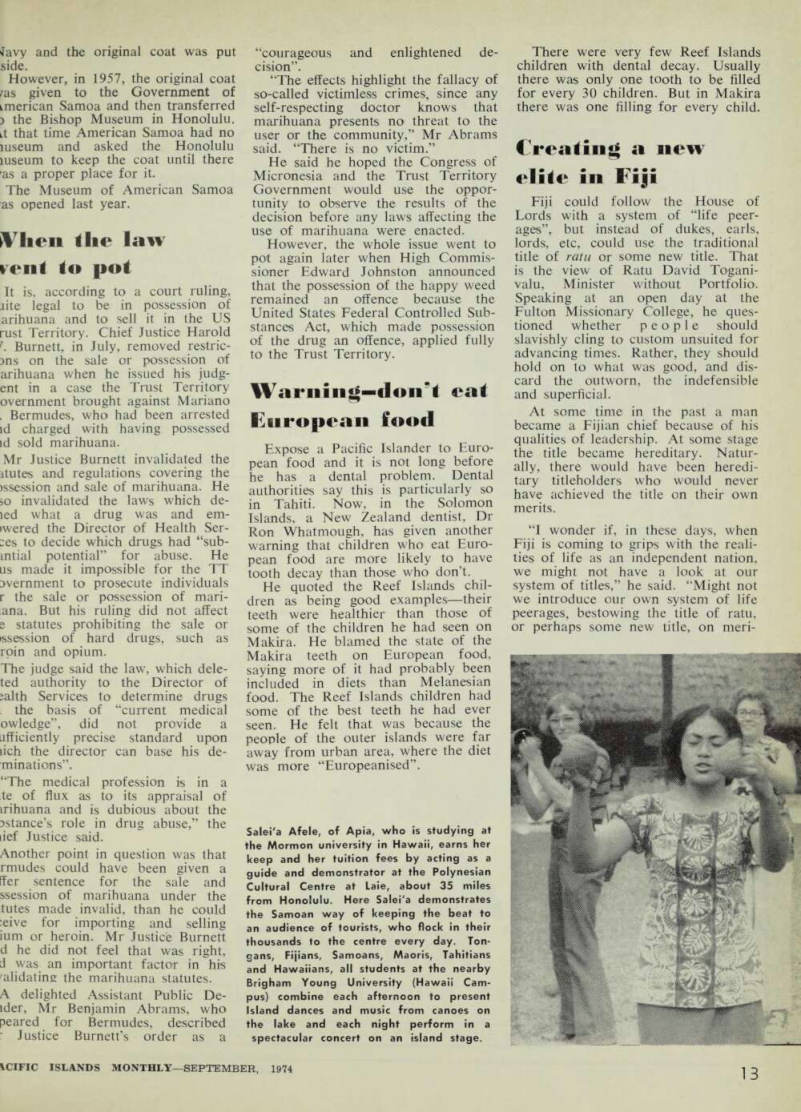
Salei'a Afele, of Apia, who is studying at the Mormon university in Hawaii, earns her keep and her tuition fees by acting as a guide and demonstrator at the Polynesian Cultural Centre at Laie, about 35 miles from Honolulu. Here Salei'a demonstrates the Samoan way of keeping the beat to an audience of tourists, who flock in their thousands to the centre every day. Ton gans, Fijians, Samoans, Maoris, Tahitians and Hawaiians, all students at the nearby Brigham Young University (Hawaii Cam pus) combine each afternoon to present Island dances and music from canoes on the lake and each night perform in a spectacular concert on an island stage.
>rious personages, to be held for leir lifetime only.”
Can roil hear
lie mother? 9
Students at the University of the mth Pacific, Suva, are “going home” rough their voices. A casual exer se in educational broadcasting has :come a way of preparing other )ung people for the kind of univers / life they will experience.
The idea started when the director the USP language laboratory and cording studio, Mr Mike O’Brien, icouraged four of them to talk into icrophones about themselves, how ey felt while away from their fami ;s, what it was like in the university id so on.
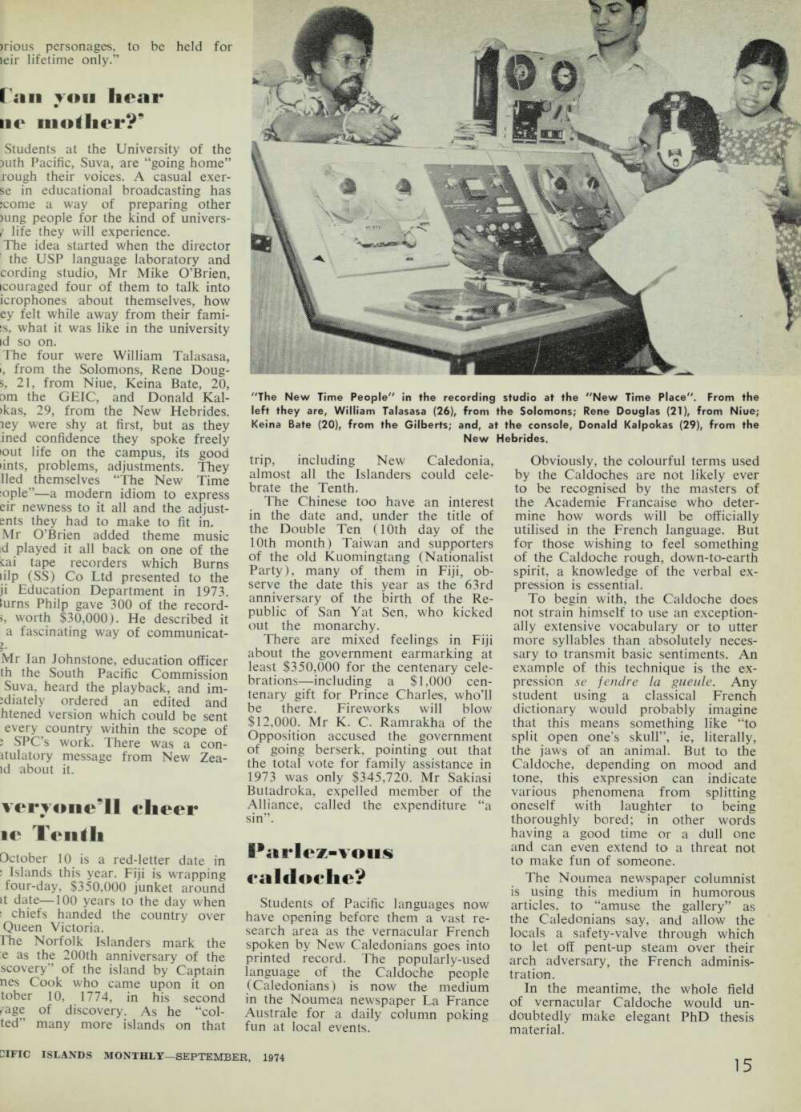
The four were William Talasasa, i, from the Solomons, Rene Doug s, 21, from Niue, Keina Bate, 20, om the GEIC, and Donald Kal >kas, 29, from the New Hebrides, icy were shy at first, but as they ined confidence they spoke freely •out life on the campus, its good >ints, problems, adjustments. They lied themselves “The New Time :ople”—a modern idiom to express eir newness to it all and the adjust ers they had to make to fit in.
Mr O’Brien added theme music d played it all back on one of the £ai tape recorders which Burns dip (SS) Co Ltd presented to the ji Education Department in 1973. turns Philp gave 300 of the record 5, worth $30,000). He described it a fascinating way of communicat y 5* Mr lan Johnstone, education officer th the South Pacific Commission Suva, heard the playback, and im idiately ordered an edited and htened version which could be sent every country within the scope of j SPC’s work. There was a con itulatory message from New Zea id about it.
veryone’ll chccr
ic Tenth
October 10 is a red-letter date in ; Islands this year. Fiji is wrapping four-day, $350,000 junket around it date—loo years to the day when ; chiefs handed the country over Queen Victoria.
The Norfolk Islanders mark the :e as the 200th anniversary of the scovery” of the island by Captain nes Cook who came upon it on tober 10, 1774, in his second /age of discovery. As he “col ted” many more islands on that
trip, including New Caledonia, almost all the Islanders could cele brate the Tenth.
The Chinese too have an interest in the date and, under the title of the Double Ten (10th day of the 10th month) Taiwan and supporters of the old Kuomingtang (Nationalist Party), many of them in Fiji, ob serve the date this year as the 63rd anniversary of the birth of the Re public of San Yat Sen, who kicked out the monarchy.
There are mixed feelings in Fiji about the government earmarking at least $350,000 for the centenary cele brations—including a $l,OOO cen tenary gift for Prince Charles, who’ll be there. Fireworks will blow $12,000. Mr K. C. Ramrakha of the Opposition accused the government of going berserk, pointing out that the total vote for family assistance in 1973 was only $345,720. Mr Sakiasi Butadroka, expelled member of the Alliance, called the expenditure “a sin”.
i’arlcz-vous
caldoche?
Students of Pacific languages now have opening before them a vast re search area as the vernacular French spoken by New Caledonians goes into printed record. The popularly-used language of the Caldoche people (Caledonians) is now the medium in the Noumea newspaper La France Australe for a daily column poking fun at local events.
Obviously, the colourful terms used by the Caldoches are not likely ever to be recognised by the masters of the Academic Francaise who deter mine how words will be officially utilised in the French language. But for those wishing to feel something of the Caldoche rough, down-to-earth spirit, a knowledge of the verbal ex pression is essential.
To begin with, the Caldoche does not strain himself to use an exception ally extensive vocabulary or to utter more syllables than absolutely neces sary to transmit basic sentiments. An example of this technique is the ex pression se fendre la gueule. Any student using a classical French dictionary would probably imagine that this means something like “to split open one’s skull”, ie, literally, the jaws of an animal. But to the Caldoche, depending on mood and tone, this expression can indicate various phenomena from splitting oneself with laughter to being thoroughly bored; in other words having a good time or a dull one and can even extend to a threat not to make fun of someone.
The Noumea newspaper columnist is using this medium in humorous articles, to “amuse the gallery” as the Caledonians say, and allow the locals a safety-valve through which to let off pent-up steam over their arch adversary, the French adminis tration.
In the meantime, the whole field of vernacular Caldoche would un doubtedly make elegant PhD thesis material.
"The New Time People" in the recording studio at the "New Time Place". From the left they are, William Talasasa (26), from the Solomons; Rene Douglas (21), from Niue; Keina Bate (20), from the Gilberts; and, at the console, Donald Kalpokas (29), from the New Hebrides.