long time a'coming
pp. 10-11 · Read in the full issue
BSIP Chief Minister a long time a'coming
From a Honiara correspondent
Although the election of the Solo mon Islands first chief minister is scheduled for August 27, and it is now August 12, the mists wreathing the protectorate’s political situation show little signs of clearing.
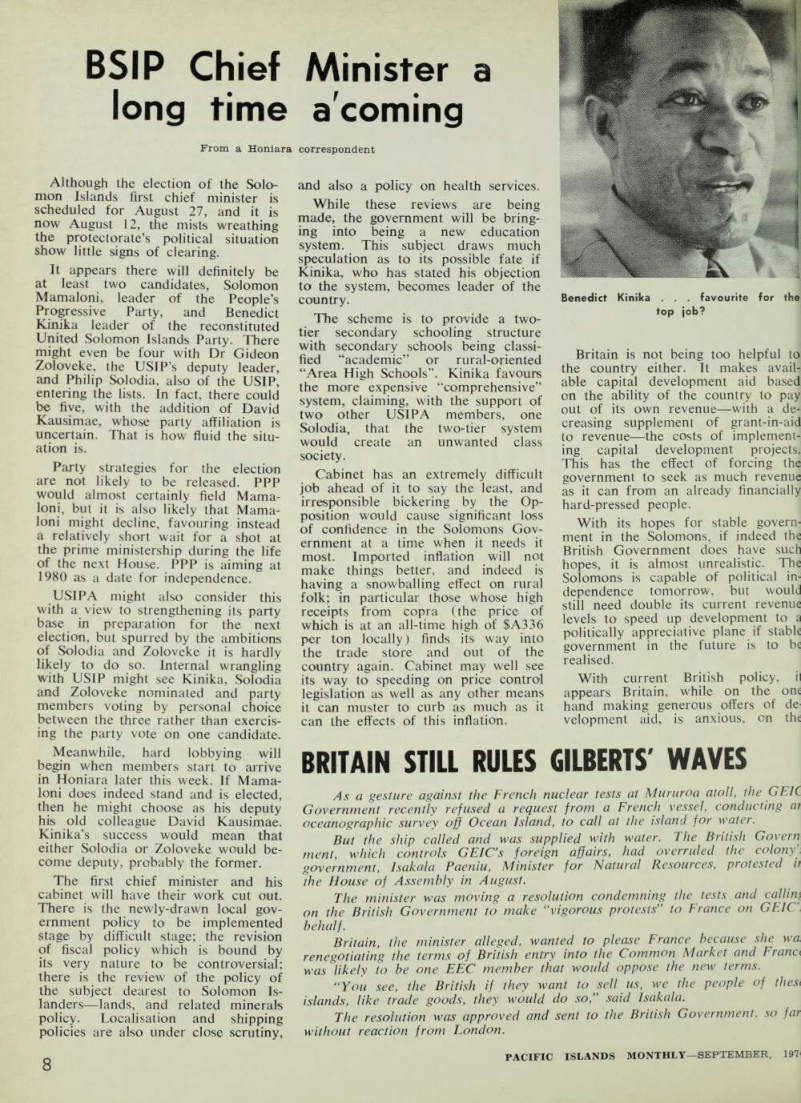
It appears there will definitely be at least two candidates, Solomon Mamaloni, leader of the People’s Progressive Party, and Benedict Kinika leader of the reconstituted United Solomon Islands Party. There might even be four with Dr Gideon Zoloveke, the USIP’s deputy leader, and Philip Solodia, also of the USIP, entering the lists. In fact, there could be five, with the addition of David Kausimae, whose party affiliation is uncertain. That is how fluid the situ ation is.
Party strategies for the election are not likely to be released. PPP would almost certainly field Mama loni, but it is also likely that Mama loni might decline, favouring instead a relatively short wait for a shot at the prime ministership during the life of the next House. PPP is aiming at 1980 as a date for independence.
USIPA might also consider this with a view to strengthening its party base in preparation for the next election, but spurred by the ambitions of Solodia and Zoloveke it is hardly likely to do so. Internal wrangling with USIP might see Kinika, Solodia and Zoloveke nominated and party members voting by personal choice between the three rather than exercis ing the party vote on one candidate.
Meanwhile, hard lobbying will begin when members start to arrive in Honiara later this week. If Mama loni does indeed stand and is elected, then he might choose as his deputy his old colleague David Kausimae.
Kinika’s success would mean that either Solodia or Zoloveke would be come deputy, probably the former.
The first chief minister and his cabinet will have their work cut out.
There is the newly-drawn local gov ernment policy to be implemented stage by difficult stage; the revision of fiscal policy which is bound by its very nature to be controversial; there is the review of the policy of the subject dearest to Solomon Is landers—lands, and related minerals policy. Localisation and shipping policies are also under close scrutiny,
and also a policy on health services.
While these reviews are being made, the government will be bring ing into being a new education system. This subject draws much speculation as to its possible fate if Kinika, who has stated his objection to the system, becomes leader of the country.
The scheme is to provide a two tier secondary schooling structure with secondary schools being classi fied “academic” or rural-oriented “Area High Schools”. Kinika favours the more expensive “comprehensive” system, claiming, with the support of two other USIPA members, one Solodia, that the two-tier system would create an unwanted class society.
Cabinet has an extremely difficult job ahead of it to say the least, and irresponsible bickering by the Op position would cause significant loss of confidence in the Solomons Gov ernment at a time when it needs it most. Imported inflation will not make things better, and indeed is having a snowballing effect on rural folk; in particular those whose high receipts from copra (the price of which is at an all-time high of $A336 per ton locally) finds its way into the trade store and out of the country again. Cabinet may well see its way to speeding on price control legislation as well as any other means it can muster to curb as much as it can the effects of this inflation.
Britain is not being too helpful to the country either. It makes avail able capital development aid based on the ability of the country to pay out of its own revenue —with a de creasing supplement of grant-in-aid to revenue —the costs of implement ing capital development projects.
This has the effect of forcing the government to seek as much revenue as it can from an already financially hard-pressed people.
With its hopes for stable govern ment in the Solomons, if indeed the British Government does have such hopes, it is almost unrealistic. The Solomons is capable of political in dependence tomorrow, but would still need double its current revenue levels to speed up development to a politically appreciative plane if stable government in the future is to be realised.
With current British policy, it appears Britain, while on the one hand making generous offers of de velopment aid, is anxious, on the
Benedict Kinika . . . favourite for the top job?
>ther hand, to be fast done with an ther dependency, by cutting back on tie very element of aid that will en ure future stability in this country.
Britain’s criterion for independence ar the Solomons—or so it has been p until now—is a balancing of pay lents. This year the country may 'ell have a surplus in its trade figures ut almost solely because of high 'orld copra prices.
The chief minister and cabinet can e expected to make their first moves i establishing high level contacts ith the Solomon’s immediate neigh our, Papua New Guinea, and also lauru. He would probably also an ounce the country’s support for ationalistic independent movements i the New Hebrides.