Pacific Transport
pp. 85-91 · Read in the full issue


Tonga Bid For World-Wide Wings
Casts A Shadow Over Fiji
By a staff writer
Tonga is aiming high in civil aviation. A number of moves are in train which could see the extension of Nukualofa’s runway to 12,000 feet, capable of taking any jet aircraft, with a lot to spare. Tonga could be come a serious rival to Fiji’s Nadi, known since World War II as the hub of South Pacific aviation.
Tonga’s High Commissioner in London has been instructed to ap proach the head offices of airlines operating out of Europe for money to help extend the runway. Ap proaches will be made to the head offices of other airlines interested in Pacific routes also.
King Taufa’ahau Tupou said early in July he wanted Tonga to become the key in a new service across the Pacific linking Australia with South America and Europe. Airlines to be approached include JAL, Alitalia, Lufthansa, KLM, SAAA, SAS, and Varig. Sydney offices of airlines have been advised of Tonga’s plans.
These moves must worry Air Pacific, and also cast a cloud over the meeting in Suva this month of South Pacific civil aviation ministers, who will decide the future of Air Pacific as a co-operatively-owned air line.
On his way back to Tonga recently, King Taufa’ahau, speaking in Fiji, uttered soothing words about Friendly Islands Air not offering a serious threat to Air Pacific. He said the only route the two airlines would have in common would be that between Nadi and Tonga.
But should Tonga become a rival for Nadi, Pacific air routes would really be in the melting pot. The Pacific would no longer be the close preserve of a few carriers operating from Australia and New Zealand to the US, or from the US to those two countries.
King Taufa’ahau Tupou did not mention Qantas, Air New Zealand and British Airways in the initial list of people asked for money. Those are the three airlines with a major interest in Air Pacific. But he said he would not exclude them.
“We would expect to negotiate reciprocal rights with Qantas, Air NZ and our own airline,” he said. “As far as the Commonwealth carriers are concerned, it would be very useful for them to have an alternative to Nadi as a hedge against the continuing industrial troubles in Fiji.
“Australia-Tonga-Easter Island-Rio de Janiero is a possible route. Most of the airlines approached already fly to Australia and South America from Europe. We are offering a link across the Pacific.”
Tonga has offered Polynesian Airlines a 20 per cent cross-shareholding in its airline, for which All Nippon Airlines will supply a Boeing 737- 200, crews, technical and other staff.
But the hostesses will be Tongan. The aircraft is expected to arrive in Tonga in October. Tonga may take delivery of a second Boeing early in 1975, and a third later in 1975, if required.
The king expects the airline will operate first of all to Fiji and Samoa.
He would like to see later extensions of services to Auckland, Norfolk
Island and, possibly, New Caledonia, Extensions to the runway at Nukua lofa are expected to cost at least $4 million. By the time all other require ments are taken into consideration the cost would be much higher. The cost of localising the operation will take time, and a lot of money.
Tonga’s moves into at least regional carrier services, do not end there, There is also talk in the kingdom of upgrading the strip in Vavau to take HS74B turbo prop aircraft, All this adds up to a situation fraught with peril for the South Pacific Forum for Fiji’s Prime Minister. Ratu Sir Kamisese Mara, has made it plain that he sees con tinuing co-operation in civil aviation —meaning, of course, co-operation in Air Pacific—as the real test of Pacific
regional co-operation,
There are those in the Islands who see Tonga as a pawn and Japan’s offer of aid to establish an international airline as the carrot dangling before the king when, in reality, Japan is using Tonga as another stepping
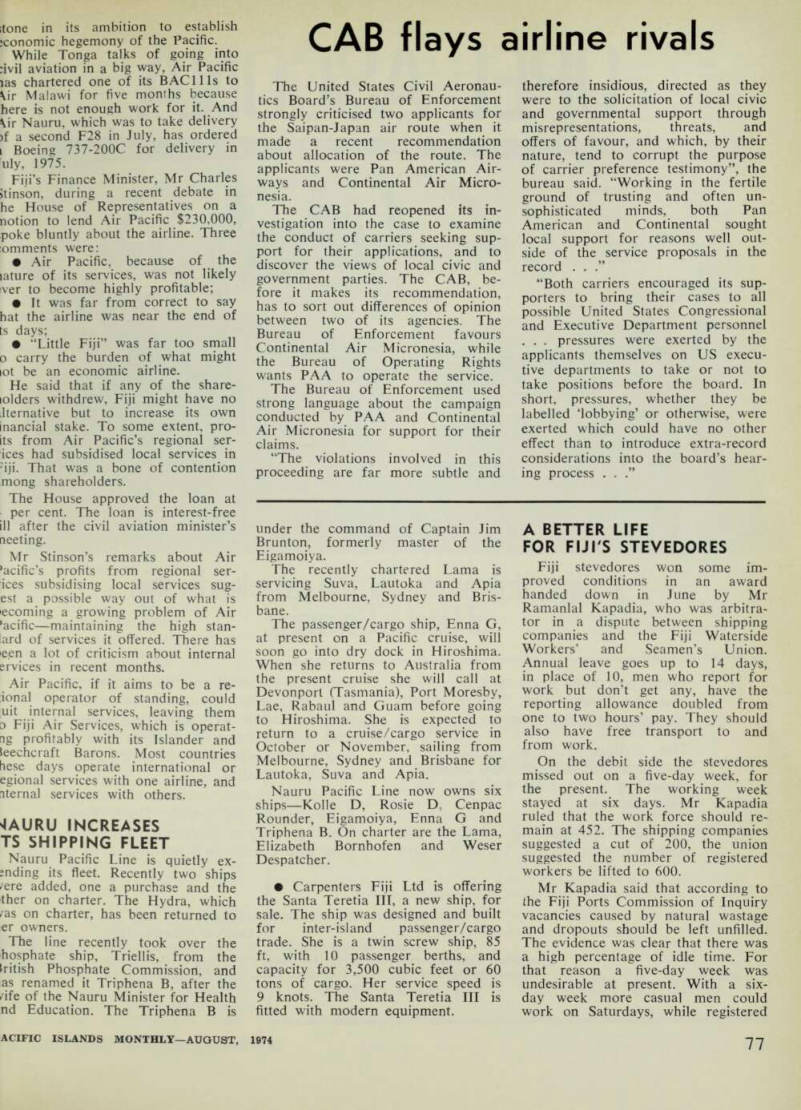
The Tarros class container ship, Union South Pacific, which was damaged during a storm north of Auckland early in June. The ship started to take in water, and returned to Auckland instead of continuing her run to Fiji and Western Samoa. She off-loaded in Auckland and then sailed to Sydney for repairs, which could not be carried out in New Zealand. Damage was minor generally, with the crane the worst affected. The ship is expected to return soon to Auckland with a full load of con tainers and then resume the Pacific Islands run. In the meantime the Union Steam Ship Co Ltd, which operates the Union South Pacific on charter, has an option to charter another Tarros container ship from Sea Containers Charters Ltd, UK.
itone in its ambition to establish ;conomic hegemony of the Pacific.
While Tonga talks of going into :ivil aviation in a big way, Air Pacific las chartered one of its BACH Is to \ir Malawi for five months because here is not enough work for it. And \ir Nauru, which was to take delivery )f a second F2B in July, has ordered i Boeing 737-200 C for delivery in uly, 1975, Fiji’s Finance Minister, Mr Charles Stinson, during a recent debate in he House of Representatives on a notion to lend Air Pacific $230,000, poke bluntly about the airline. Three ;omments were: • Air Pacific, because of the lature of its services, was not likely ver to become highly profitable; • It was far from correct to say hat the airline was near the end of ts days; • “Little Fiji” was far too small o carry the burden of what might lot be an economic airline.
He said that if any of the share lolders withdrew, Fiji might have no Iternative but to increase its own inancial stake. To some extent, pro its from Air Pacific’s regional ser ices had subsidised local services in 'iji. That was a bone of contention mong shareholders.
The House approved the loan at per cent. The loan is interest-free ill after the civil aviation minister’s aeeting.
Mr Stinson’s remarks about Air •acific’s profits from regional ser ices subsidising local services sug est a possible way out of what is •ecoming a growing problem of Air ’acific —maintaining the high stan !ard of services it offered. There has een a lot of criticism about internal ervices in recent months.
Air Pacific, if it aims to be a re ional operator of standing, could uit internal services, leaving them o Fiji Air Services, which is operat ing profitably with its Islander and leechcraft Barons. Most countries hese days operate international or egional services with one airline, and internal services with others.
Muru Increases
Ts Shipping Fleet
Nauru Pacific Line is quietly ex ending its fleet. Recently two ships /ere added, one a purchase and the ther on charter. The Hydra, which /as on charter, has been returned to er owners.
The line recently took over the hosphate ship, Triellis, from the British Phosphate Commission, and as renamed it Triphena B, after the /ife of the Nauru Minister for Health nd Education. The Triphena B is
under the command of Captain Jim Brunton, formerly master of the Eigamoiya.
The recently chartered Lama is servicing Suva, Lautoka and Apia from Melbourne, Sydney and Bris bane.
The passenger/cargo ship, Enna G, at present on a Pacific cruise, will soon go into dry dock in Hiroshima, When she returns to Australia from the present cruise she will call at Devonporl (Tasmania), Port Moresby, Lae, Rabaul and Guam before going to Hiroshima. She is expected to return to a cruise/cargo service in October or November, sailing from Melbourne, Sydney and Brisbane for Lautoka, Suva and Apia.
Nauru Pacific Line now owns six ships—Kolle D, Rosie D, Cenpac Rounder, Eigamoiya, Enna G and Triphena B. On charter are the Lama, Elizabeth Bornhofen and Weser Despatcher. • Carpenters Fiji Ltd is offering the Santa Teretia 111, a new ship, for sale. The ship was designed and built for inter-island passenger/cargo trade. She is a twin screw ship, 85 ft, with 10 passenger berths, and capacity for 3,500 cubic feet or 60 tons of cargo. Her service speed is 9 knots. The Santa Teretia 111 is fitted with modern equipment.
A Better Life
For Fiji's Stevedores
Fiji stevedores won some im proved conditions in an award handed down in June by Mr Ramanlal Kapadia, who was arbitra tor in a dispute between shipping companies and the Fiji Waterside Workers’ and Seamen’s Union.
Annual leave goes up to 14 days, in place of 10, men who report for work but don’t get any, have the reporting allowance doubled from one to two hours’ pay. They should also have free transport to and from work.
On the debit side the stevedores missed out on a five-day week, for the present. The working week stayed at six days. Mr Kapadia ruled that the work force should re main at 452. The shipping companies suggested a cut of 200, the union suggested the number of registered workers be lifted to 600.
Mr Kapadia said that according to the Fiji Ports Commission of Inquiry vacancies caused by natural wastage and dropouts should be left unfilled.
The evidence was clear that there was a high percentage of idle time. For that reason a five-day week was undesirable at present. With a six day week more casual men could work on Saturdays, while registered
vorkers still received a minimum of 10 hours’ pay.
Mr Kapadia ruled a fixed retiring ige was undesirable, without giving airly long notice to the men affected. 4en of retiring age now would get ittle from the national provident und because they had not been nembers for long. They should be dlowed to continue working till they etired of their own accord. The ilternative would be for employers to >ay “reasonable compensation”.
Mr Kapadia said there was a need or better rest, recreation and refresh nent facilities at Suva wharf. Also, a raining programme was needed to ipgrade dockers’ skills.
Fine No Deterrent
: Or Reef Poachers
A Taiwanese ship released by the Micronesian couris after the owners >aid substantial fines for poaching ap >arently returned immediately to the )lace where it had been “arrested” md repeated the offence. This was evealed in a report from the Palau District Attorney’s office on the arrest >f 12 Taiwan fishermen at Helen Reef.
It was reported that the men went ishore in a small dory while the nother ship remained outside the eef. When the Hafa Adai arrived on he scene on a field trip the mother ship sailed away, leaving the 12 men branded. The men were taken aboard ;he Hafa Adai to be charged with illegally taking marine resources from the reef.
Confiscated were nine bags of trochus, two birds and many eggs, three clams and other items.
The report from the Palau District Attorney’s office suggested that the boat involved was the Nob Tei Sheng Gen No 6, which had recently been released.
Tonga's King Hopes To
Add Big Ship To Fleet
The Tongan flag could be flying on a 76,000-ton bulk carrier in about a year. King Taufa’ahau Tupou sug gested that after a recent visit to the UK and the Middle East. He expects the ship to carry minerals from the South Pacific round the Cape of Good Hope to Europe, and then re turn to the South Pacific via the Mediterranean, the reopened Suez Canal and the Red Sea.
He called at Saudi Arabia on his tour and discussed with the authori ties there the question of picking up bulk fuel. He hopes to come to an arrangement under which Tonga will be guaranteed supplies of fuel in the event of any further embargoes.
Tonga wanted to remain independent of the large oil companies, which
were themselves dependent on Arab fuel.
The king’s hopes depend on estab
lishing diplomatic relations between
Saudi Arabia and Tonga. He expects Saudi Arabia to set up an embassy in Canberra. If that happened the am bassador could be accredited to Tonga as well as Australia.
It’s understood that nothing firm has been arranged about the bulk carrier, and that the idea was con ceived as a result of the need for an ore carrier to operate out of South Australia. King Taufa’ahau feels that Tonga could charter and operate such a vessel if there was steady work for it.
Captain Williams
Leaves The Cooks
After 18 months of trading in the Cook Islands with his 500 tons MV Moana Captain Hugh Williams has sold out and decided to go home to Sydney.
“The Cook Islands are not as happy a place as they were 10 years ago,” he told PIM. “There are too many controls and not enough cargo.”
The reason for the decline in cargo, he thought, was the mass exodus of Cook Islanders to New Zealand since Rarotonga’s international airport was opened last December.
Captain Williams sold Moana to fellow Australian Mr R. Mellor who said if business prospects in the Cooks were not good enough he would take her to New Guinea. Hugh Williams plans to return to Sydney and may buy a 1,000 ton ship with the idea of chartering it to New Guinea or Far Eastern ports.
Cooks Govt To Take
Over The Stevedores
Maritime circles in the Cook Islands are dismayed at a decision of the government to use its powers under the recently-passed Waterfront Industry Act to control stevedoring.
The act also gives the government power to control wharves.
The two stevedoring companies, the Union Steam Ship Co of NZ Ltd and Silk and Boyd Ltd, have been told their services are no longer required.
The repercussions from this are serious, as those companies will have to dismiss their stevedoring staffs, or the government will have to absorb them.
While the industry has been subject to criticism in the past, it has been run ning smoothly recently. The govern ment has been advised by Mr Jim Gatt, a New Zealander, about wharf and stevedoring matters, and Mr Gatt is expected to be appointed to take charge of the waterfront controlling authority as general manager.
Png Upgrades
Its Seamen's Standards
All seamen working in Papua New Guinea vessels over 10 metres, ex cept traditional fishing boats, will be required to undergo training. As well as this seamen will have to have one year’s service at sea before they are considered qualified.
The Minister for Transport and Civil Aviation, Mr lambakey Okuk, outlining the proposed enabling legislation, said every vessel would be required to have a minimum number of qualified seamen. The
imber would be governed by the it of the vessel.
The scheme was aimed at improv g safety and efficiency standards i local vessels where there had eviously been inadequate training navigation, emergency procedures id lifesaving appliances.
The government plans to re-equip 5 fleet over the next three years ith about 50 ships. The cost would ; more than $3.5 million.
The courses will be at Madang autical School. Initially, the intake ill be about 100 men a year and ich course will last about eight eeks.
Experienced seamen now serving on lips will be considered qualified.
Reight Rates
Oom Again
Another setback to Fiji, Tonga id Western Samoa in their battle ith inflation was a heavy rise in eight rates for cargo from Sydney om July 1. The Sydney-Suva rate >se by a whopping 32.32 per cent, onga and Western Samoa did even orse. Cargo for Tonga will have lother 6.43 and Western Samoa an ther 7.5 per cent added to the new ydney-Suva rates.
The new rates for general cargo om Sydney to Suva and Lautoka re $52.60 a tonne (up $l2) and 47 a cubic metre (up $10). The in rease has been applied by all lines ;rvicing the three countries. But the unkering surcharge has been re uced from 8.02 per cent to 6.08 per ;nt.
Constantly rising costs are blamed ir the latest round of increases. In fficient systems on the waterfront, i spite of the efforts of shipping □mpanies to streamline ways of andling cargo, weather, port con estion, and shortage of labour are 11 adding to costs.
The Pacific Navigation Co’s Tau 3to on its last trip to Sydney was in ort for 28 days. The turn-round for . ship of that class only a few aonths ago was less than eight days, t does not require much imagin ,tion to guess what that sort of hing can do to wharf charges.
There was a grain of comfort for *apua New Guinea importers after he July 1 hike in the freight rates >n cargo from Australia to PNG >orts. This was a reduction in the >unker surcharge from 8.02 per cent o 6.48 per cent. The freight rates vent up by 18 per cent, plus an ad litional $lO a tonne on refrigerated :argo.
The new rates from Sydney and
Brisbane for general cargo are (old rates in brackets): Port Moresby-Samarai $40.20 a cubic metre ($34.05); $44.80 a tonne ($37.95).
Lae-Rabaul-Madang $41.50 a cubic metre ($35.15); $46.20 a tonne ($39 15) Kavieng-Kieta $46.65 a cubic metre ($39.55); $52 a tonne ($44.05).
Honiara-Gizo $49.25 a cubic metre ($41.75); $54.95 a tonne ($46.55).
Refrigerated cargo for Honiara- Gizo costs $77.20 a cubic metre ($56.95), while for the other destina tions it is $72 a cubic metre ($52.55).
But Rate Cut For
Png Coastal Trade
Papua New Guinea introduced a completely new freight tariff for coastal vessels on July 1. One of the major effects is a cut in the rates for carrying staple items. The reduc tion, of 10 per cent, applied to such items as flour, sugar, rice, tinned meat and fish, wheatmeal and similar products.
To pay for those concessions, to
recover cost increases and to allow a start to be made on introducing more reliable coastal vessels, freight rates on other commodities will rise by varying amounts. However, the rates on produce—copra, cocoa, cof fee, etc —remain unaltered.
The Minister for Transport and Civil Aviation, Mr lambakey Okuk, said the standard flat general cargo rate covering most commodities, irrespective of value, was abolished.
Rates would be charged in a com pletely flexible manner in proportion to value, sensitivity or characteris tics of each individual commodity.
A new committee, the Coastal Freight Rates Committee, will advise the minister on all matters related to coastal freight rates.
The Union Steam Ship Co of NZ Ltd has increased freight rates on the Auckland-Pacific Islands service by 7 per cent, plus a 3.33 per cent bunker surcharge. The increase is an interim one as the company has applied for a further rise. The in crease became effective with the first voyage of the Union South Pacific after June 21.