Footlights Shine On
pp. 51-53 · Read in the full issue
The Village Green
From KIRSTY POWELL in Port Moresby
Papua New Guinea now has its
irst professional theatre company,
he National Theatre Workshop "'ompany and the company has mounted ’ its first production, and »one on tour for the first time.
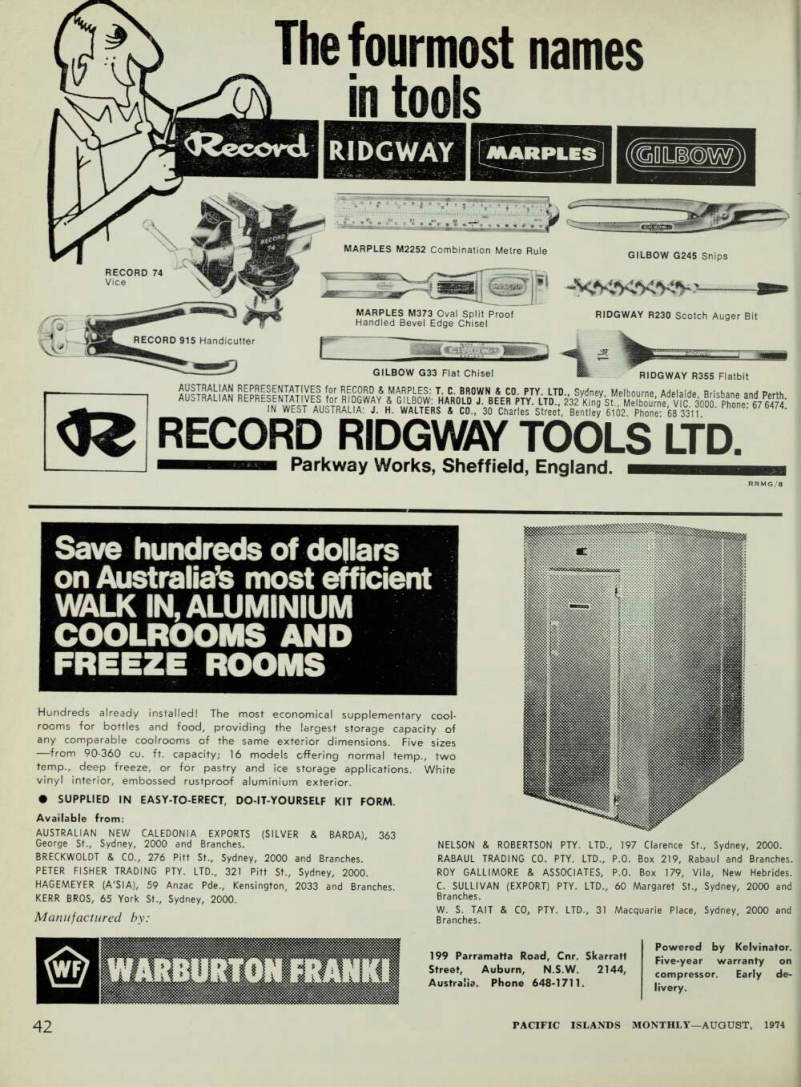
The truck in which the company ravels has been a familiar sight iround Port Moresby for some time. [t is flamboyantly decorated with a /ariety of PNG designs, and looks iomething like a 20th century mofile bans tambaram. Lately it has 3 een rattling its way to 20 villages in Central District, and to schools and colleges and even a pub, Bluff Inn, a few miles out of Port Moresby.
Theatre in Papua New Guinea has so far been rather an elitist affair, mostly in English, and largely for expatriate, university, college, and school audiences. The National Theatre Workshop, however, is setting out to create a people’s theatre.
The two plays in this first production have been workshopped by the whole company, working on very slender scripts. Drawing freely on PNG and Western traditions of mime and dance, costume and mask, legend and humour, they have created two contrasting plays with village audiences mainly in mind: a serious
dance mime and a light-hearted slap stick comedy.
The season opened in the soptus ticated setting of Port Moresby s new Waigani Arts Centre Theatre, where all mod cons in the way of movable stage, lights, sound equipment, tiered and padded seats, and so on, are laid on. Both plays went over well in this very Western setting, but 1 for one enjoyed them more the night I spent sitting on the sand in the open space of the Motuan village of Papa.
The truck had become a diessing room, and the plays were acted in front of a painted backdrop sug gestive of falling leaves, forest and new growth. The village ? was m darkness, but the company’s gener ator with two floodlights brilliantly illuminated the patch of sand that had become a stage in an open-air theatre.
First on the programme, The Old Leaves Fall, is based on a Northern District creation myth. In the be ginning, there was a man and a woman. Then the woman cut her finger, and from two blood-stained leaves which she threw on a pile of leaves, came two children who ven tured forth in the world to struggle with the spirits, and to win from
them the knowledge of gardening, and hunting, and fishing, and magic.
The dance mime which the group achieves after wrestling with this story, is visually and musically beautiful, evocative, and at times baffling: too baffling, I felt, for those not familiar with the story.
And perhaps too eclectic; for the mixture of traditional Papua New Guinean costume and freely imagined creations is not entirely satisfying. Nevertheless, there is no doubt about the sympathetic response of a village audience to the attempt to visualise and dramatise the Mela nesian perception of a world in which spirit and human beings mingle.
The second play, The Evil Firefly, by Alois Jerowai is riotous, but rather long-drawn out fun. It would make a good children’s play for Broadway or the West End, complete with foolish school teacher, masked figures, cassowary, crocodile, giant leech, owl and others, though it is a pity that these eye-catching creatures are exposed so briefly in a crowded and somewhat ill-explained episode at the end of the play.
The play tells the story of some village boys frightened of spirits, who, being forced to spend the night
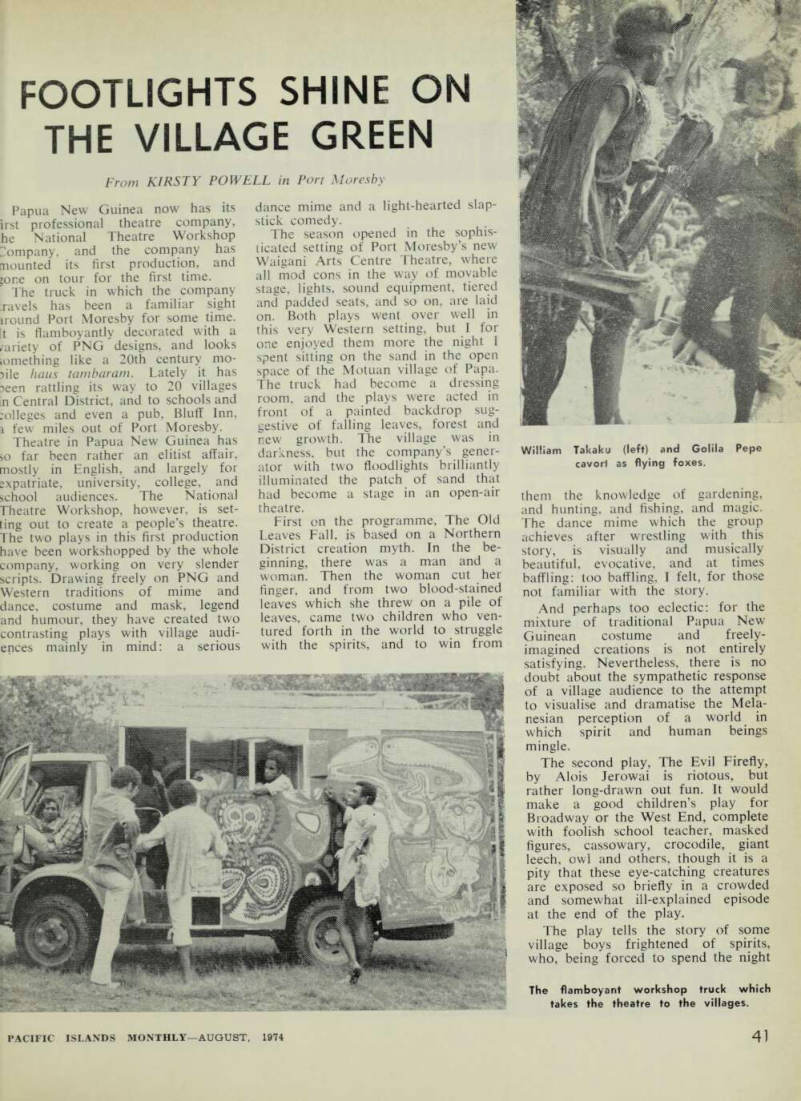
William Takaku (left) and Golila Pepe cavort as flying foxes.
The flamboyant workshop truck which takes the theatre to the villages.
n the bush, have terrifying experi ences with flying foxes, a firefly, and ;wo sorcerers. The actors who play ;he parts of the sorcerers provide the comic centre of the play. They are i study in contrast. William Takaku Is an ex-university student, a Bou gainvillean, tall, slim, black. Golila Pepe began as the driver of the com aany’s truck until someone dis covered his gift for comedy. He is Dlder than most of the rest of the actors, a light-skinned, plump Papuan. He speaks in Motu, to the delight of the Papa audience, while ;he rest of the actors speak English, ivith an occasional fragment of pidgin thrown in. Multi-lingual theatre is certainly a possibility in a multi-lingual society.
Papua New Guinea is also a so ciety in ferment, and one may ask what other possibilities there are for theatre here. Recently, we have seen tillage women storming the gates of government in serious political pro test. A people’s theatre that mirrors the concerns of the people will ex plore not only timeless questions but also the questions of the times. It will seek to generate not only laugh ter but ideas. Perhaps in its next production the National Theatre Workshop Company should attempt some topical plays.