'Democracy'
p. 16 · Read in the full issue
Prevails
In Tonga
From a Nukualofa correspondent Tonga’s Legislative Assembly “took on” the government in June and refused to pass the estimates for 1974-75. No one could remember such a thing happening before. The 8-4 vote against accepting the estimates was a protest against the government ignoring a parliamentary resolution of 1973 over a review of salaries for the civil service and members of the assembly.
The 1973 resolution was that any salary increase recommended by the review should take effect from July 1, 1973. The Privy Council, however, directed that there should be a cost of-living allowance of 20 per cent, effective from April 1, 1974.
Masao Passi, No 1 People’s Representative from Vavau, said the government had no right to violate a House resolution. It was not the fault of the House that the govern ment took so long to decide the cost of-living allowance.
Next day, the Acting Prime Minister and Minister of Lands and Survey, S. L. Tuita, asked the House to reconsider its resolution. If members were adamant he would introduce an alternative—that the House approve only half the stipulated amount as a token vote, to which could be added a special warrant should there be approval of the requested revision of the cost-of living allowance to be back-dated to July 1, 1973.
Siosiua H. Fonua, editor of the Tonga Chronicle, commenting on the House resolution, said: “The year 1974 will probably go down in the history of Tonga’s parliamentary ses sions as being one of the most significant insofar as the power of the Legislative Assembly is concerned.
In my own opinion, it took a lot of courage and perseverance on the part of the people’s representatives and the nobles to attempt what seemed an impossible task, ie, to have the Privy Council amend their original decision for the Cost of Living Allowance (COLA) payable from April 1, 1974, to be backdated to July 1, 1973, for the parliamentarians. This, indeed, is not a small undertaking for the Privy Council, . . .
“They, (the MPs) felt that the government had ignored the authority of the House, and hence weakened the status of the Legislative As-
sembly, . . . The issue in question was therefore of paramount im portance for the benefit of maintain ing the democratic principles of the Tongan system of government.
“True, Tonga’s is not a wholly democratic government, but a con stitutional monarchy, but the prin ciples adopted by a Tonga Legislative Assembly involve a certain amount of democracy. This victory must mean therefore that the government do respect the resolutions of the House and its deliberations and the amendment of their original decision is by no means a sign of a prejudiced government, but a realisation of the power of democracy and the willing ness to maintain the harmonious relationships that exist between the people and the government, . . .”
The Legislative Assembly, on June 28, approved a record $T6.57 million for 1974-75.
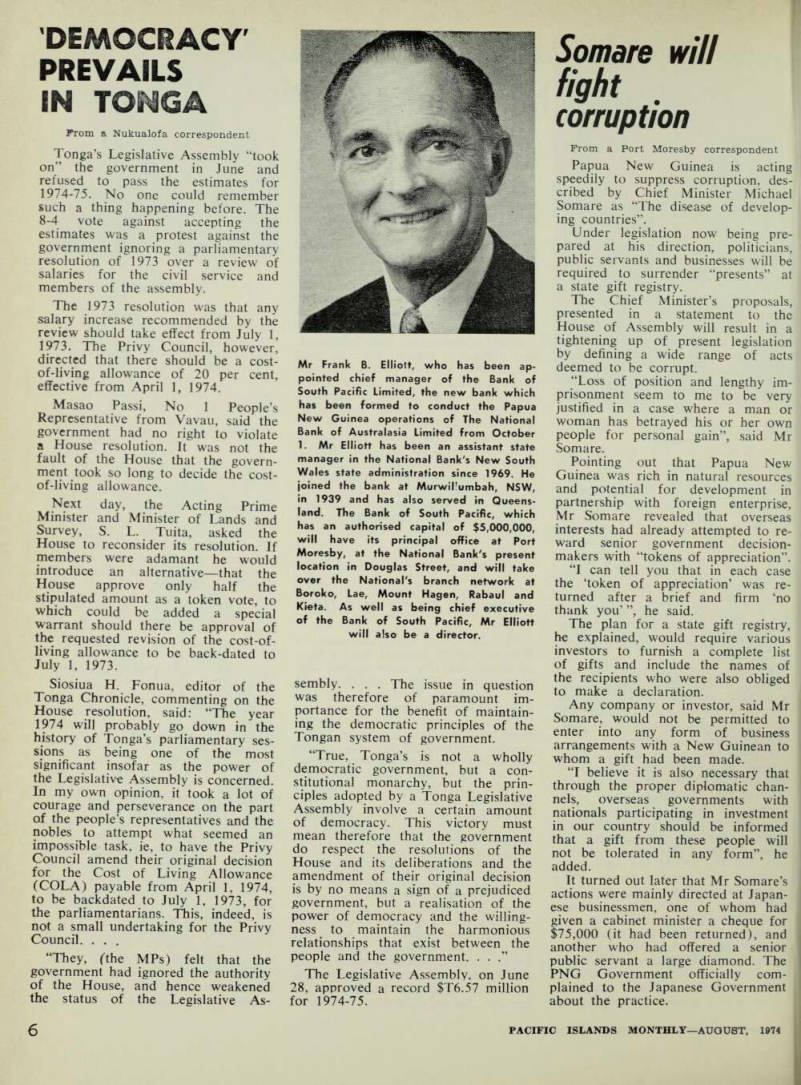
Mr Frank B. Elliott, who has been ap pointed chief manager of the Bank of South Pacific Limited, the new bank which has been formed to conduct the Papua New Guinea operations of The National Bank of Australasia Limited from October 1. Mr Elliott has been an assistant state manager in the National Bank's New South Wales state administration since 1969. He joined the bank at Murwillumbah, NSW, in 1939 and has also served in Queens land. The Bank of South Pacific, which has an authorised capital of $5,000,000, will have its principal office at Port Moresby, at the National Bank's present location in Douglas Street, and will take over the National's branch network at Boroko, Lae, Mount Hagen, Rabaul and Kieta. As well as being chief executive of the Bank of South Pacific, Mr Elliott will also be a director.