Fiji's political pot boils
p. 14 · Read in the full issue
as land lights the fire
From a Suva correspondent
Fiji MPs may brandish nooses and daggers in parliament, according to a ruling by the Speaker of the House of Representatives, Mr R. D. Patel, during a turbulent session late in June.
Since then he has had second thoughts, following a plea by the Deputy Speaker, Mr Vijay R. Singh, and is reconsidering the matter.
Tempers really boiled. These were some incidents: • The Leader of the Opposition, Mr S. M. Koya, brandished two nooses and invited two Indian mem bers, Mr Vijay R. Singh, and Mr Krishna Reddy, both Government members, to hang themselves; • Mr Maleli Raibe, a Govern ment member, asked if it would be in order to produce two daggers and ask opposition members to make use of them on themselves; • The chairman of the Native Land Trust Broad, Ratu William Toganivalu, who is also Minister for Fijian Affairs, said that while he was in office, he would refuse leases of Fijian land to any more Indian ap plicants; • Mr Koya withdrew from the House of Representatives after the Speaker told him to leave. (The Speaker and Mr Koya are both mem bers of the National Federation Party). • The Opposition Whip, Mr Karam Ramrakha, faced the pos sibility of a criminal charge for allegedly having served subpoenas in the House of Representatives while it met.
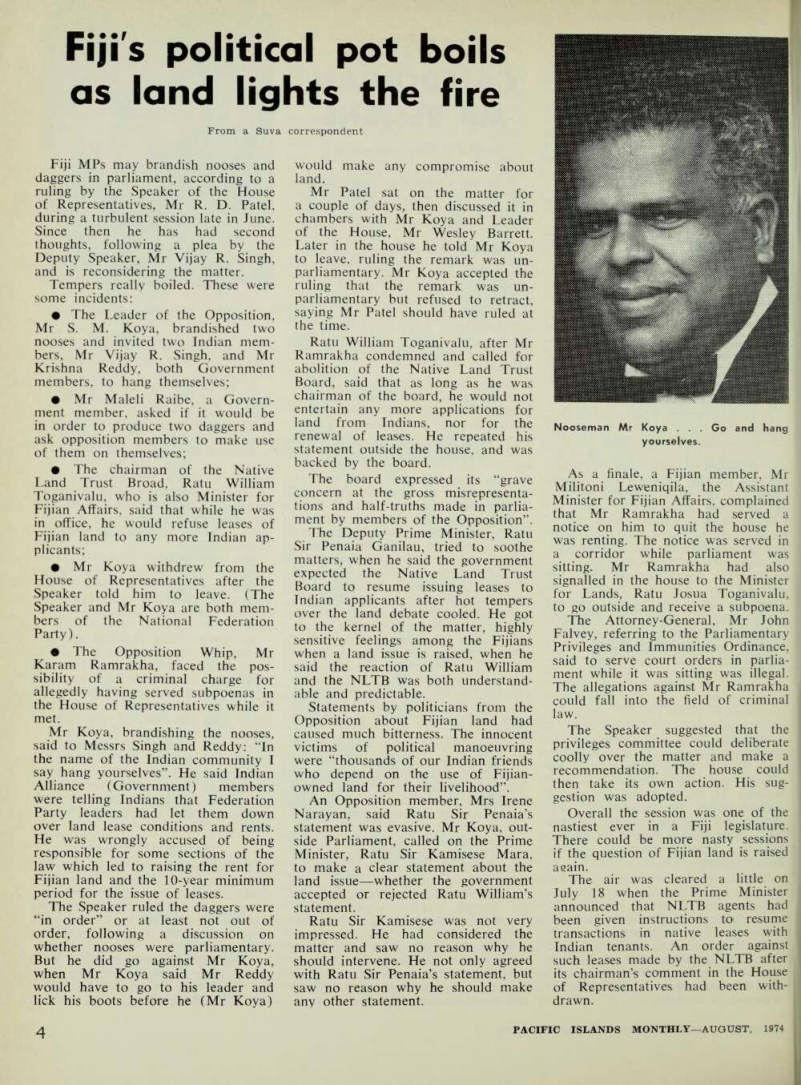
Mr Koya, brandishing the nooses, said to Messrs Singh and Reddy: “In the name of the Indian community I say hang yourselves”. He said Indian Alliance (Government) members were telling Indians that Federation Party leaders had let them down over land lease conditions and rents.
He was wrongly accused of being responsible for some sections of the law which led to raising the rent for Fijian land and the 10-year minimum period for the issue of leases.
The Speaker ruled the daggers were “in order” or at least not out of order, following a discussion on whether nooses were parliamentary.
But he did go against Mr Koya, when Mr Koya said Mr Reddy would have to go to his leader and lick his boots before he (Mr Koya)
would make any compromise about land.
Mr Patel sat on the matter for a couple of days, then discussed it in chambers with Mr Koya and Leader of the House, Mr Wesley Barrett.
Later in the house he told Mr Koya to leave, ruling the remark was un parliamentary. Mr Koya accepted the ruling that the remark was un parliamentary but refused to retract, saying Mr Patel should have ruled at the time.
Ratu William Toganivalu, after Mr Ramrakha condemned and called for abolition of the Native Land Trust Board, said that as long as he was chairman of the board, he would not entertain any more applications for land from Indians, nor for the renewal of leases. He repeated his statement outside the house, and was backed by the board.
The board expressed its “grave concern at the gross misrepresenta tions and half-truths made in parlia ment by members of the Opposition”.
The Deputy Prime Minister, Ratu Sir Penaia Ganilau, tried to soothe matters, when he said the government expected the Native Land Trust Board to resume issuing leases to Indian applicants after hot tempers over the land debate cooled. He got to the kernel of the matter, highly sensitive feelings among the Fijians when a land issue is raised, when he said the reaction of Ratu William and the NLTB was both understand able and predictable.
Statements by politicians from the Opposition about Fijian land had caused much bitterness. The innocent victims of political manoeuvring were “thousands of our Indian friends who depend on the use of Fijian owned land for their livelihood”.
An Opposition member, Mrs Irene Narayan, said Ratu Sir Penaia’s statement was evasive. Mr Koya, out side Parliament, called on the Prime Minister, Ratu Sir Kamisese Mara, to make a clear statement about the land issue—whether the government accepted or rejected Ratu William’s statement.
Ratu Sir Kamisese was not very impressed. He had considered the matter and saw no reason why he should intervene. He not only agreed with Ratu Sir Penaia’s statement, but saw no reason why he should make any other statement.
As a finale, a Fijian member, Mr Militoni Leweniqila, the Assistant Minister for Fijian Affairs, complained that Mr Ramrakha had served a notice on him to quit the house he was renting. The notice was served in a corridor while parliament was sitting. Mr Ramrakha had also signalled in the house to the Minister for Lands, Ratu Josua Toganivalu, to go outside and receive a subpoena.
The Attorney-General, Mr John Falvey, referring to the Parliamentary Privileges and Immunities Ordinance, said to serve court orders in parlia ment while it was sitting was illegal.
The allegations against Mr Ramrakha could fall into the field of criminal law.
The Speaker suggested that the privileges committee could deliberate coolly over the matter and make a recommendation. The house could then take its own action. His sug gestion was adopted.
Overall the session was one of the nastiest ever in a Fiji legislature.
There could be more nasty sessions if the question of Fijian land is raised aeain.
The air was cleared a little on July 18 when the Prime Minister announced that NLTB agents had been given instructions to resume transactions in native leases with Indian tenants. An order against such leases made by the NLTB after its chairman’s comment in the House of Representatives had been with drawn.
Nooseman Mr Koya ... Go and hang yourselves.