Niue moves to self-government
p. 12 · Read in the full issue
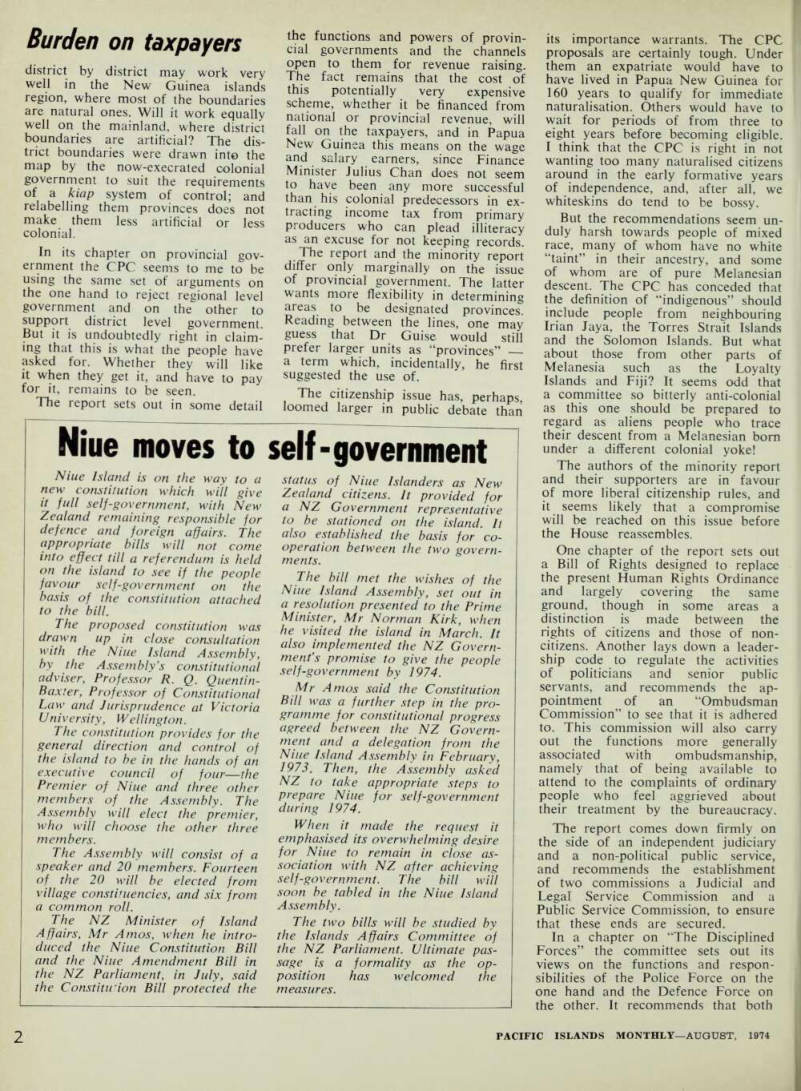
Niue Island is on the way to a new constitution which will give it full self-government, with New Zealand remaining responsible for defence and foreign affairs. The appropriate bills will not come into effect till a referendum is held on the island to see if the people favour self-government on the basis of the constitution attached to the bill.
The proposed constitution was drawn up in close consultation with the Niue Island Assembly, by the Assembly’s constitutional adviser, Professor R. Q. Quentin- Baxter, Professor of Constitutional Law and Jurisprudence at Victoria University, Wellington.
The constitution provides for the general direction and control of the island to be in the hands of an executive council of four —the Premier of Niue and three other members of the Assembly. The Assembly will elect the premier, who will choose the other three members.
The Assembly will consist of a speaker and 20 members. Fourteen of the 20 will be elected from village constituencies, and six from a common roll.
The NZ Minister of Island Affairs, Mr Amos, when he intro duced the Niue Constitution Bill and the Niue Amendment Bill in the NZ Parliament, in July, said the Constitution Bill protected the
status of Niue Islanders as New Zealand citizens. It provided for a NZ Government representative to be stationed on the island. It also established the basis for co operation between the two govern ments.
The bill met the wishes of the Niue Island Assembly, set out in a resolution presented to the Prime Minister, Mr Norman Kirk, when he visited the island in March. It also implemented the NZ Govern ment's promise to give the people self-government by 1974.
Mr Amos said the Constitution Bill was a further step in the pro gramme for constitutional progress agreed between the NZ Govern ment and a delegation from the Niue Island Assembly in February, 1973. Then, the Assembly asked NZ to take appropriate steps to prepare Niue for self-government during 1974.
When it made the request it emphasised its overwhelming desire for Niue to remain in close as sociation with NZ after achieving self-government. The bill will soon be tabled in the Niue Island Assembly.
The two bills will be studied by the Islands Affairs Committee of the NZ Parliament. Ultimate pas sage is a formality as the op position has welcomed the measures.