tor grabs
pp. 100-101 · Read in the full issue

Fortune up tor grabs
From W. H. Percival
in Rarotonga A large and highly-concentrated field of manganese nodules was dis covered on the ocean floor near Rarotonga in mid-May by Dr G. P.
Glasby, a scientist leading an oceanic nodule-searching expedition through the south-west Pacific.
The most highly concentrated areas lie between 120 and 400 miles south-west of Rarotonga and the 100 per cent manganese concentration lies at a depth of 5,400 metres. Be yond these limits the nodule con centration drops to 50 per cent, then 25 per cent, and finally nil.
Dr Glasby, of New Zealand’s Oceanographic Institute, with Dr H.
Backer of West Germany and Mr M. A. Meylan, MSc of the Hawaii Department of Oceanography had arrived with the NZRV Tangaroa on May 15. The research voyage is being made under the auspices of the NZ Department of Scientific and Industrial Research.
Dr Glasby said there are three
main areas in the Pacific where these nodules are found—off Hawaii, in the Antarctic and south of the Cook Islands.
Manganese nodules are potentially valuable for the manganese and copper they contain. Sometimes traces of cobalt can be found in them and it is thought that some could contain minute percentages of uranium.
However, it is unlikely that the Cook Islands will “get rich quick” because of this spectacular find.
Reasons? It takes a lot of time and a lot of money to develop a find of this nature.
Dr Glasby pointed out that once the densities are located, it has to be determined if the metal has been worked out of the nodules, and if it has not, the problem of raising them from three miles below has to be overcome. The setting up of a processing plant alone could take more than 15 years.
The nodule samples taken from the ocean floor measured about two inches in diameter and were of a dark-blue to black appearance. Their economic value depends on density and a viable proposition would be a million tons a year. Forty thousand tons a square mile were discovered in the area south of the Cooks, and this is within the economic require ments, said Dr Glasby.
To obtain samples, devices fitted with automatic grabs were lowered to the sea bed; the grabs were trig gered and the samples caught.
Photographs of the nodule beds were taken by an ingenious camera de veloped by a member of the scienti fic party. It was sent down and upon •eaching the bed automatically flash it the area and took the pictures—
then it released itself and slowly surfaced. Once afloat, it relayed its position by a system of radio signals, a waving flag and light signals.
The Cook Islands oceanic survey had earlier been requested by Cooks Premier, Sir Albert Henry. When told of the discovery, Sir Albert commented: “If further investiga tions prove that the extent of the metal warrants mining, I will support a joint venture arrangement with New Zealand”.
Many years ago the late David Mcßirney, an old Cook Islands’ resi dent, discovered manganese nodules on Mangaia Island, 110 miles south east of Rarotonga, but subsequent investigations proved that they were not present in commercial quantities.
Permanent home
for the SPEC bureau
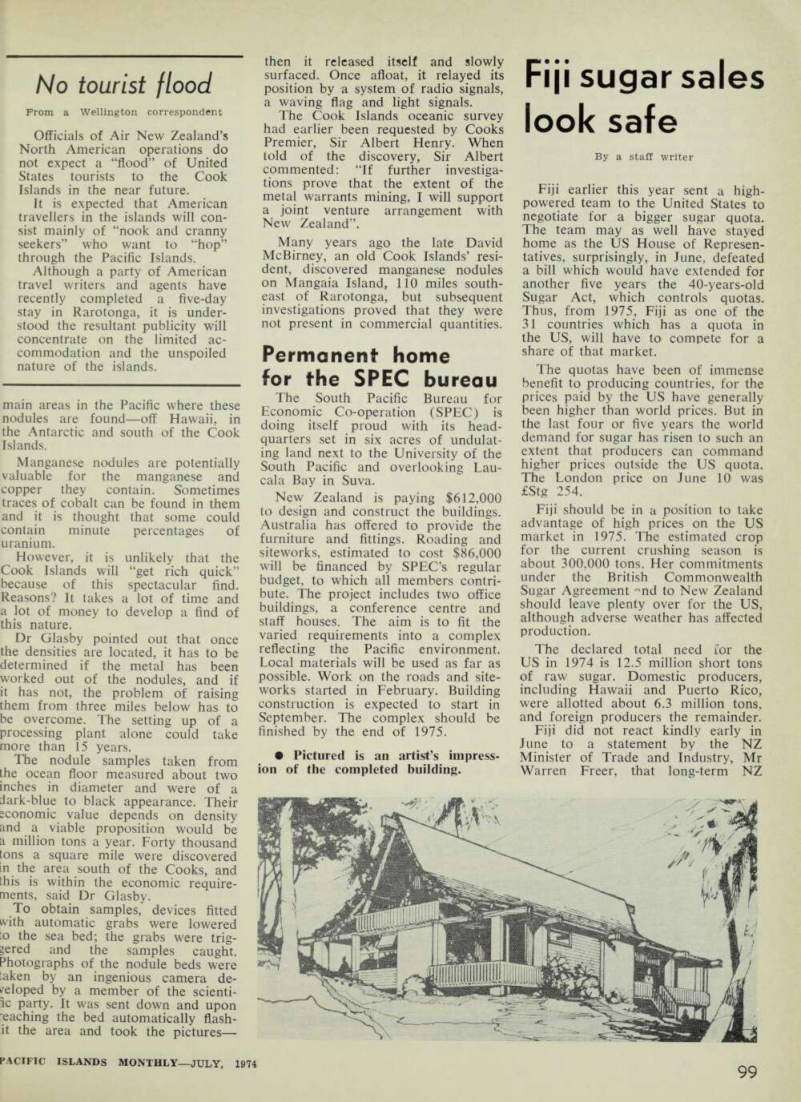
The South Pacific Bureau for Economic Co-operation (SPEC) is doing itself proud with its head quarters set in six acres of undulat ing land next to the University of the South Pacific and overlooking Lau cala Bay in Suva.
New Zealand is paying $612,000 to design and construct the buildings.
Australia has offered to provide the furniture and fittings. Reading and siteworks, estimated to cost $86,000 will be financed by SPEC’s regular budget, to which all members contri bute. The project includes two office buildings, a conference centre and staff houses. The aim is to fit the varied requirements into a complex reflecting the Pacific environment.
Local materials will be used as far as possible. Work on the roads and site works started in February. Building construction is expected to start in September. The complex should be finished by the end of 1975.