British pacifi cjet
pp. 91-92 · Read in the full issue
airways news
Britain's Invisible Resources
Published By British Airways
A Pim Advertising Supplement
By Philip Parrish
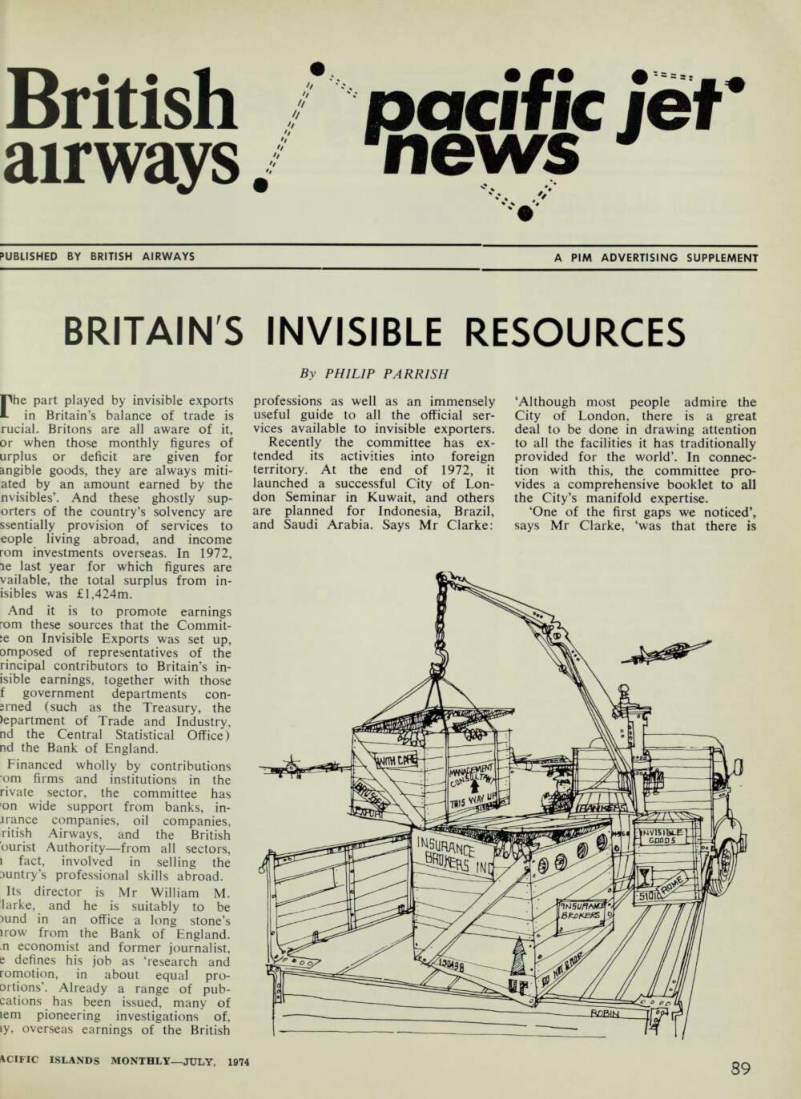
rhe part played by invisible exports in Britain’s balance of trade is rucial. Britons are all aware of it, or when those monthly figures of urplus or deficit are given for angible goods, they are always initi ated by an amount earned by the nvisibles’. And these ghostly sup orters of the country’s solvency are ssentially provision of services to eople living abroad, and income rom investments overseas. In 1972, le last year for which figures are vailable, the total surplus from in isibles was £ 1,424 m.
And it is to promote earnings rom these sources that the Commit je on Invisible Exports was set up, omposed of representatives of the rincipal contributors to Britain’s in isible earnings, together with those f government departments con ;rned (such as the Treasury, the fepartment of Trade and Industry, nd the Central Statistical Office) nd the Bank of England.
Financed wholly by contributions •om firms and institutions in the rivate sector, the committee has r on wide support from banks, in irance companies, oil companies, ritish Airways, and the British ourist Authority—from all sectors, i fact, involved in selling the Duntry’s professional skills abroad.
Its director is Mr William M. larke, and he is suitably to be )und in an office a long stone’s irow from the Bank of England, n economist and former journalist, e defines his job as ‘research and romotion, in about equal pro ortions’. Already a range of pub cations has been issued, many of lem pioneering investigations of, ly, overseas earnings of the British
professions as well as an immensely useful guide to all the official ser vices available to invisible exporters.
Recently the committee has ex tended its activities into foreign territory. At the end of 1972, it launched a successful City of Lon don Seminar in Kuwait, and others are planned for Indonesia, Brazil, and Saudi Arabia. Says Mr Clarke:
‘Although most people admire the City of London, there is a great deal to be done in drawing attention to all the facilities it has traditionally provided for the world’. In connec tion with this, the committee pro vides a comprehensive booklet to all the City’s manifold expertise. ‘One of the first gaps we noticed’, says Mr Clarke, ‘was that there is
inadequate information about the overseas earnings of the leading pro fessions’, So an inquiry was begun, and its results published last year.
Nine groups were studied in it—ac countants, chartered surveyors and architects, consulting engineers, in dependent schools, management con sultants, the medical professions, patent agents, advertising practition ers, and solicitors. The collated figures showed that these professions earned around £ll3m in 1971. In this area, the committee’s chairman, banker Cyril Kleinworth, finds hope and encouragement for the future. ‘These overseas earnings’, he de clares, ‘are important not only to the balance of payments. To the pro fessions themselves the extension of their markets to include overseas clients may be beneficial in terms of the size and security of their busi ness. To some extent the professions can offset a recession at home by selling more services overseas. More over, these markets are spread throughout the world, and are not always in the same phase of the business cycle’.
Mr Clarke points out that, although the professions have been active mainly in the Commonwealth, they have never been confined to it.
And he sees a period of expansion in Europe particularly for the younger professions. Management consultants and consultant engineers are enlarging their practices both in Europe and North America. Aware of the importance of Europe, the committee has established its own representative in Brussels, to obtain quick information about any policy initiatives in the European Economic Community that will bear on the interests of Britain’s invisible ex porters and to establish a liaison with the European Commission staff.
A glance down the winners of Britain’s Queen’s Award for Industry in 1973 gives some idea of the spread and variety of invisible exports. No fewer than 10 awards went to firms engaged in them. One for example, went to Dick James Music, involved in artist management, music publish ing, and recording, and a firm that has increased its overseas earnings six-fold over a period of three years.
Another went to British Aviation In
surance, which earns the major part of its premium income from overseas.
There was the Mermaid Hotel at Rye, Sussex, with only 30 bedrooms bu * ™ ltb an . a , ctl .™ marke ‘‘ n S which brought it more than 3 000 lators from overseas in 1971/72.
There were two firms of consulting engineers one, Sir Bruce White.
Wolfe Barry, and Partners having one contract worth £l2m in six countries from the Middle East to Asia. There were, of course, insurance brokers, and a systems engineering and management consultancy company, Easams, that specialises in things like avionic systems for combat aircraft.
So the earnings pour in—from tourism, which has more than doubled, to £s3Bm, in six years, from the City itself, from growth areas
like British construction work over seas, earnings for which rose from £som in 1967 to £B7m in 1971.
For cen turies, Britain's invis ible earnings have p roduced a net surplus, William Clarke considers t[ J h skill educat ion and accumu ,ated experi^ nce of these exporters . j Bri j; in a decided advan , a g e in these services to fo B rei tpi .
It seems that the ‘invisibles’ will be increasingly important in earning the currency with which Britain can pay for its imports—and Mr Klem wort considers that ‘the discovery of oil in the North Sea has provided the necessary stimulus to British banks, insurance companies and other in visible exporters to set up specialist departments which are now seeking business abroad’.