Yesterday
p. 73 · Read in the full issue
Nine years after World War 11, Rabaul was still littered with Japanese pillboxes, gun emplacements and bomb shelters.
A particular bomb shelter, next to the court house (pictured in PIM in July, 1954), was right in the centre of Rabaul's commercial and business quarter.
Like a hermit crab seeking a home in a new shell, some enterprising local set up house there. The place showed every sign of prospective long occupancy, and was complete with bush bed, blankets, cooking tins—the lot.
Built on one end of it was a lean-to made of scraps of paper and tin.
Nobody could say who lived there, but one European resident remarked: "Probably an employee of the Adminis tration—no private employer would be allowed to provide that sort of accommodation for his native labour".
Port Moresby shivering. It sounds almost impossible, but residents of the town put on more blankets at night on June 23, 1954, complaining about the bitter cold, PIM reported in July, 1954.
The reason was not hard to find— the temperature at 6 am was 58 degrees, the lowest reading the Weather Bureau could find in its records, and 15.9 degrees lower than the average June minimum for Port Moresby.
Ravuama Vunivalu, the senior Fijian unofficial member of the Legislative Council, resigned 20 years ago to enlist in the Fiji Military Forces. He joined the Ist Battalion in Malaya, where it was fighting communist terrorists. Ravuama, after his return to Fiji, again became a member of the Legislative Council.
He died in London in April, 1964, when on leave.
This sort of thing could only happen in the Islands. PIM, in July, 1954, carried a report about an enterprising French war veteran in Vila. He operated one of the most popular and flourishing bars in town during the week, then at weekends donned flying kit and did a roaring business flying sightseers over the surrounding country side. On the young pilot's own telling, he simply decided that flying could not be so very difficult, bought himself a Tiger Moth in Australia, took it up to Vila, climbed in—and took off.
After a couple of circuits he was ready for business as a charter-flight operator.
PIM was amazed there was no
Department of Civil Aviation to insist on A or B licences.
Both Papua New Guinea and Fiji had a problem about liquor control 20 years ago. In PNG the much-disputed question as to whether certain selected natives should be given permits to liquor was decided—temporarily, at least, when the Administrator, Brigadier D. M. Cleland, said the crucial section of the ordinance, giving him power to exempt persons from its provisions would "not be proceeded with for the time being". In Fiji, the figures showed an enormous increase in the number of permits granted to Indians and Fijians to drink liquor. While this restriction existed, it was said that anyone who wanted to could get any amount of illegal liquor by one means or another. The Fiji restriction on drinking beer was not lifted till 1958, and on spirits till 1963.
The Secretary of State for the Colonies approved proposals by the High Commissioner for the Western Pacific to set up a BSIP Assistance Board to investigate individual cases and recommend relief measures for those who suffered hardship from the war.
PIM had been advocating relief for years, and had this to say: "The decision to assist 'residents in straitened circum stances' followed the announcement at the end of 1953 that the British Government had given £500,000 to the BSIP from Japanese reparations.
Planters urged that the money be spent on war damage compensation. This was refused, but the High Commissioner promised that cases of real hardship would be considered on their merits.
It is now nine years since the end of the war—a long time to be in straitened circumstances. It seems late to be investigating hardship arising from that catastrophe—although, perhaps, better late than never."
The price paid by Australia for Nauru phosphate was questioned by India at the meeting of UN Trusteeship Council in New York. India's delegate asked why Nauru received only a ton, when 24/6 a ton was paid Angaur, in the
Carolines, where Japanese were allowed to work the phosphate by the US, the administering authority. Australia's special representative, Mr J. H. Jones, said there was no explanation for the difference, but funds made available by the Phosphate Commission were adequate for the Administering Authority to carry out its responsibility. Asked who received the benefit from selling the phosphates at cost price, Mr Jones said the Nauruans' income was not affected, no matter what payment was received for the phosphate. The Indian delegate said the answers were unsatisfactory and he would raise the question again in the general debate.
Delegates from five British countries which made up the South Pacific Air Transport Council in 1954, had a secret session in Melbourne, then issued a statement saying it had been im possible to reach unanimity whether the future development of Nadi Airport should proceed on the basis of the two existing runways, or whether it would be better to construct an entirely new runway. PIM commented: "We, naively, had imagined that the matter of Nadi's third runway had been resolved at the 1953 meeting of the same organisation, at least 12 months ago. It has been discussed for at least three years". SPATC apparently eventually decided to build on the existing runways, for the pattern today is what it was 20 years ago, except that one runway was extended to more than 10,000 ft to cope with jet aircraft.
Two separate items in the 20-year-old PIM —"Chinese interests in French Oceania now operate most of the local shipping. Their vessels always manage to return from the outer islands loaded, where ships belonging to other owners often come back half-filled."
"Chinese traders who fail to pay their taxes will be discussed in Papeete at the next session of the Assemblee Terri toriale of French Oceania. Chinese tax defaulters at present owe some nine million francs in overdue taxes.
A section of the community is in favour of deportation of these Chinese."
We were wondering if the people wanting to deport the Chinese were shipowners?
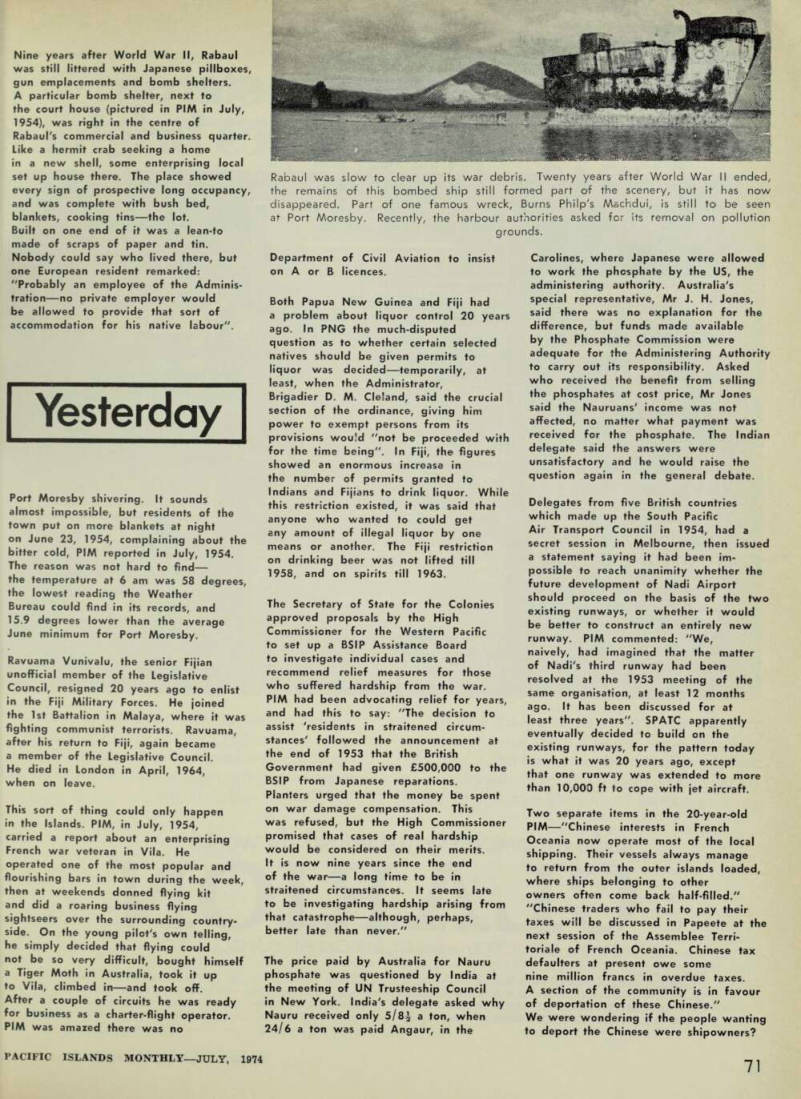
Rabaul was slow to clear up its war debris. Twenty years after World War II ended, the remains of this bombed ship still formed part of the scenery, but it has now disappeared. Part of one famous wreck. Burns Philp's Machdui, is still to be seen at Port Moresby. Recently, the harbour authorities asked for its removal on pollution
grounds.