Magazine Section
pp. 63-65 · Read in the full issue
The Warrior Liliboi And The
Great Feud Of Choiseul
By Jim Boutilier
When Sir Hubert Murray, the Lieutenant - Governor of Papua, visited the Solomon Islands in 1916 he observed that the protectorate was “the queerest place imaginable . . . (where) no attempt (was) made to preserve order or punish crime”. One of the islands to which Sir Hubert referred was Choiseul, where spo radic fighting had been taking place for 15 years between the inhabitants of Seqa and Vurulata, two districts which spanned the centre of the island in the shadow of Mount Matabe.
The feud had its origins in a cus tomary act of retaliation but soon increased in scope and violence until it accounted for 140 deaths by the time it ran its course in 1921, In its later phases the feud centred around two fighting men, Liliboi and Lakiti.
Their pursuit of revenge and con cern for prestige is a classic example of conflict in Melanesia, and its re solution marked the passing of the old order on Choiseul.
Fighting began in 1901 when a sorcerer of the Kuboro clan, in the Seqa district, Gnu by name, killed Kumbala of the Selavaqa clan in the Vurulata district. The latter’s kins men felt obliged to retaliate and nor mally would not have anticipated counter vengeance as it was deemed permissible to murder a demon strated sorcerer. However, the Choiseulese concept of revenge is not limited to “an eye for an eye” but argues in favour of visiting more grievous injury on the perpetrator than that which had been suffered by the victim. Thus, when Kumbala’s relative, Semoto, retaliated, he killed not only Gnu but two of the child ren in his village; thereby setting in train a long and sanguinary pro cess of attack and counter-attack.
Many of the killings were the work of professional assassins, some of whom, like Aranai, were not above selling their services to both sides. In 1910, Ngavala, of the Vurulata district, hired two killers, Nodoro and Dalaele of Boe in
Babatana, to do away with a num ber of Aranai’s kin. They, in turn, retaliated, killing the two daughters of one of Liliboi’s clansmen. Liliboi counted his kesa, which, in the Choiseulese context, is a way of say ing that he assessed his resources in terms of kesa, or shell arm rings, and obligations due to him by his Vurulata kinsfolk, and decided to employ the murderer, Buki, against the Seqa people.
It was at this stage that the feud began to take on the appearance of regular warfare, embracing the dis tricts of Varese, Rereo, and Seqa on the north coast and Babatana and Vurulata on the south coast. Villages were fortified, lone assassins gave way to marauding bands of up to 100 warriors, and casualties began to mount dramatically.
Deaths galore!
Buki’s activities led to a full-scale counter-attack on the Vurulata vil lage of Raqe. Liliboi retaliated against the Seqa settlement of Konjo on the east coast, taking more than 30 lives. The Konjo people, in turn, launched two raids into Vurulata territory, the second of which wit nessed a large number of warriors descending on the village of Pakisake where they slew 40 and took a num ber of women prisoners.
Eleven months later, in September, 1918, Stanley Knibbs, the Govern ment Surveyor, visited Choiseul. He stayed with Mr Davies, the manager of the Solomon Islands Development Company’s plantation at Luti.
Knibbs was anxious to explain to Liliboi the government’s interest in establishing peace throughout the island and so he sent word for the big man to come down to the coast.
Liliboi arrived a short while later with 20 retainers from Torom bangara, his village 10 miles in the bush.
The islanders, Knibbs observed condescendingly, were “incapable of quick thought” and he found it necessary to allay their suspicions by giving them a “feast” of tinned meat, rice, dry biscuits and sweet tea. They were unused to such fare and pro nounced it “luscious beyond imagin ation”. After they had eaten, Knibbs lectured them on the functions of the administration and the need for good order, but Liliboi was unmoved and maintained that there could be
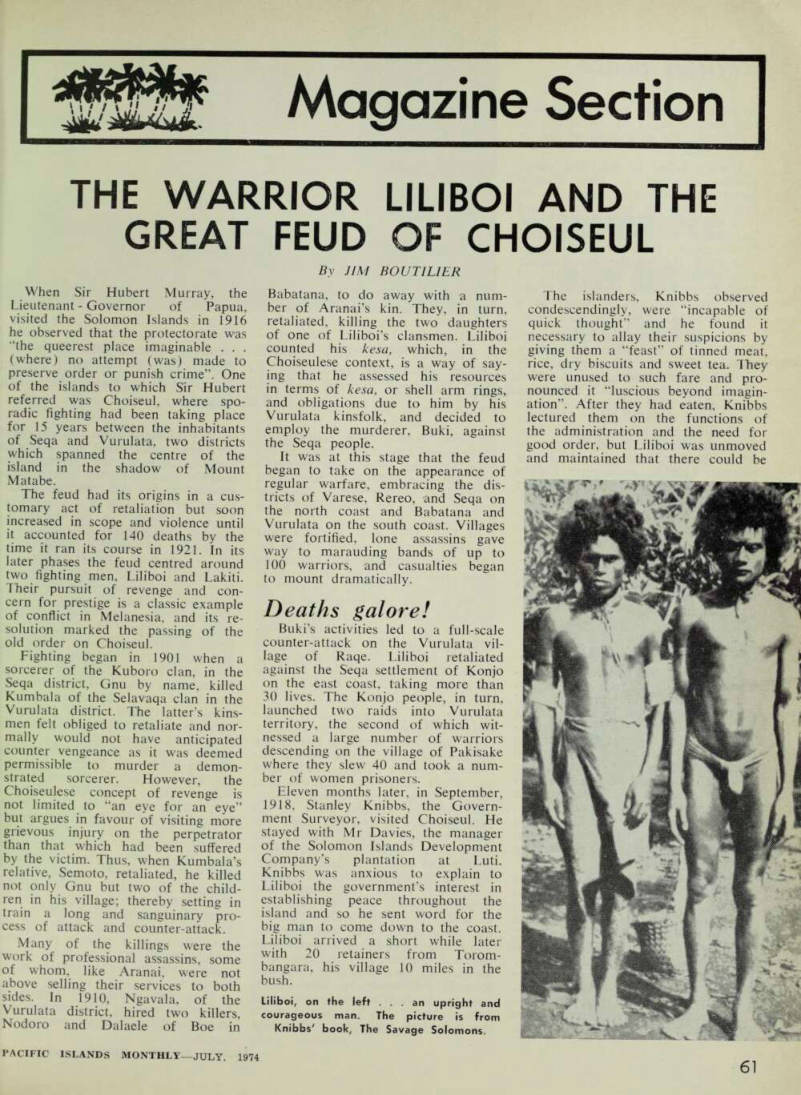
Liliboi, on the left ... an upright and courageous man. The picture is from Knibbs' book, The Savage Solomons.
Refuses peace
no peace until the raid on Pakisake had been avenged by an attack on Ngingipela, the stronghold of the big man, Lakiti.
Having failed in this first essay, Knibbs arranged to visit Torom bangara the following week. He set out with Davies and a guide and they worked their way up the Vuru lata River until they were greeted by an escort from Liliboi’s village.
The track lay up the mountainside and eventually, at an altitude of 1500 ft, they came upon the stock aded settlement, which stood in a large clearing at the crest of a ridge.
The big man received them cor dially but refused to contemplate a peace settlement; bringing forth in his defence two knotted strings which showed the number of deaths on each side and indicated that he would need to inflict 30 or 40 deaths on Lakiti’s people in order to even the score. He did, however, agree to let his brother, Singana, and another villager, Lulukia, accompany Knibbs back to Tulagi to meet the Resident Commissioner, Charles Workman.
It was Knibbs’ hope that a visit to the colonial capital would con vince the two islanders of the ad ministration’s authority and goodwill, especially at a time when there was open contempt for the government’s ability to affect the course of events on Choiseul.
‘A superior native 9
Once there, the two men were in troduced to the “marvels of civilis ation”, plied with presents, and shown a Lewis gun in action which left them filled with awe and amaze ment, Knibbs reported to Workman that Liliboi was “an upright and courageous man, and . . .altogether a superior native”. He assured his superior that if the administration could apprehend Lakiti and a num ber of fighting men, like Ongeli and Buki, peace could be restored and Liliboi safely vested with government authority.
Workman returned Singana and Lulukia to Choiseul aboard the Belama and took the opportunity to speak with Liliboi himself. He found the big man quite “the finest native” he had met in the Solomons and came away convinced that the “only prospect of pacification lay in the capture of Lakiti and his fellows”.
The Western Pacific High Commiss ioner, however, was not prepared to authorise a punitive expedition to
Choiseul, despite “the necessity of suppressing inter-tribal fighting and of establishing government prestige”, and was only willing to establish a police post on the island. Long before that could be done Liliboi’s fate was sealed.
In July, 1919, the District Officer for Gizo relayed a warning from the High Commissioner to Liliboi to cease hostilities. The latter stood firm. Unless his rivals, a number of whom enjoyed the protection of the Methodist Mission, were surrendered he was not about to compromise.
Instead he laid his plans to mount a final assault on Ngingipela, 15 miles away. It was duty to “change him along Lakiti”. r . 7 . 7 . / ±
Liliboi S/iOt
At dawn, one morning late in the month, Liliboi and his followers surrounded Lakiti’s village. Accounts of the attack vary. One suggests that several young boys, all unsuspecting, unbarred the narrow gates of the twin palisades in order to throw out some rubbish. Liliboi, seizing the opportunity, darted from the undergrowth and rushed through the opening with his warriors. Another relates how the “raging, screaming mob surged up to the stockade” and tried to scale the 15 ft walls. Whatever the case, Liliboi was shot at pointblank range and fell with a shattered thigh. A number of his men were killed but the remainder managed to rally sufficiently to drag Liliboi into the bush where they concealed him in haste. “In hot pursuit came the defenders, whooping and yelling
as they plunged down the slopes of the hill and into the steaming jungle”. Two women among them found the wounded man and smashed in his skull with an axe.
About six weeks later, the Rev John F. Goldie of the Methodist Mission visited the spot. He was ac companied by a retired British Army officer, Major Clifford Collinson, whom' one of the High Commission staff described as “quite a young man w j t h plenty of means”, who “appeared to have been entirely un der the wing of Mr Goldie”. Col iinson described the visit in his Life an( j L aug hter ‘Midst the Cannibals, ut no doubt, because of the un pleasantness which came to sur round the event, he chose to omit Goldie’s part and instead described how he visited Choiseul with his friend, the trader Pybus.
They went ashore from the mission yacht (in Collmsons book, the schooner Lily) and made their way inland. Perspiring profusely, they struggled upwards through the “green twilight of the bush , stumo ling over tree roots and squelching through the mud. After three hours they emerged in a cleared space at the foot of a hill beneath Lakiti s village. The whole of the hillside was honeycombed with carefully camouflaged pits, filled Wlth shar P" ened stakes. In the heart ot me stockade stood a solitary palm tree, with a small platform built m me crown, which served as a watcn tower. n They were greeted by Ongeli, an “imposing looking old rooster clad in a gee-string and carrying an old
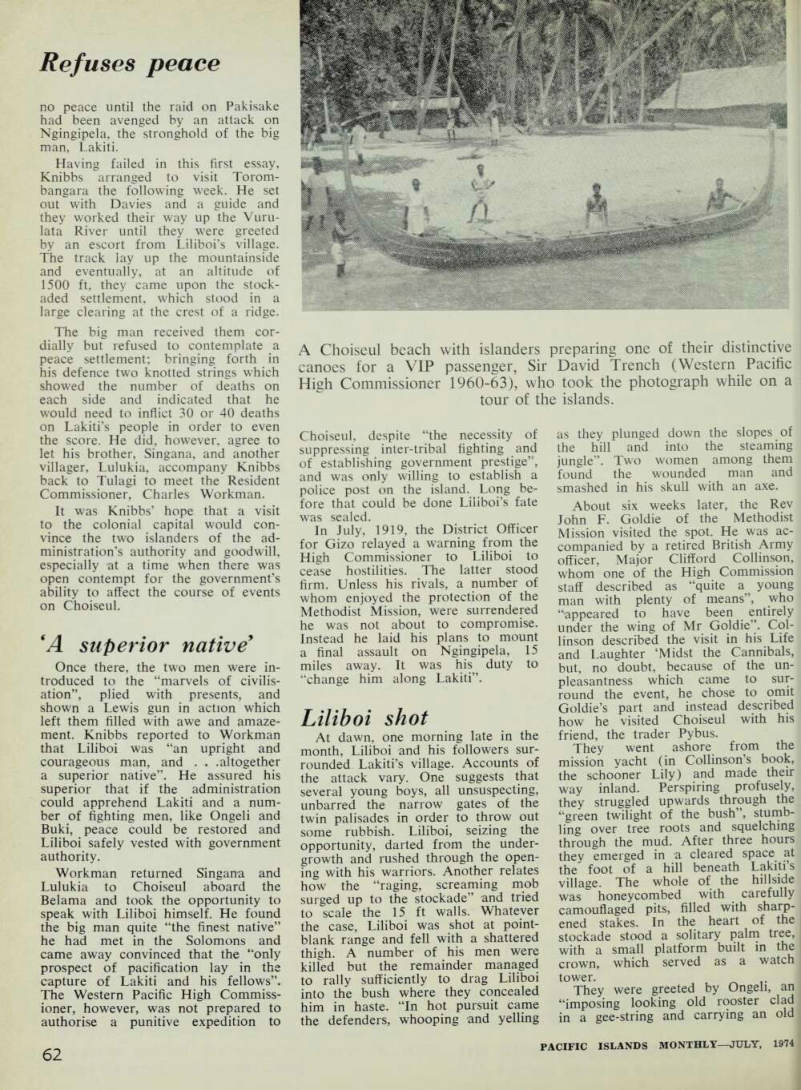
A Choiseul beach with islanders preparing one of their distinctive canoes for a VIP passenger, Sir David Trench (Western Pacific High Commissioner 1960-63), who took the photograph while on a tour of the islands.
Skull on a spear
Tower musket at the ready”. He showed them the shallow grave where Liliboi had been buried, and “quite thoughtlessly, but rather
foolishly . , . (Collinson) suggested
. . . that it would be rather sporting of (Ongeli) to give (him) Liliboi’s skull as a little souvenir of the occasion”. The latter at first refused, profering instead the axe which had dispatched Liliboi, but, by the time Collinson was ready to leave, Ongeli came forward with the big man’s skull thrust on the end of a spear.
Having convinced himself, through Goldie’s enquiries, that Liliboi’s people would not be annoyed by the fate of the skull, Collinson distri buted some cotton and beads and set off for the coast, “blissfully un conscious of the devil’s brew (they) bad left behind (them)”.
However, Liliboi’s kinsmen were furious when they discovered what lad happened and began to prepare for war. Anxious to avoid hostilities, he administration recovered the ikull from Collinson’s collection of curios just as he was about to de part from the protectorate in July 1920 aboard the Mindini. Brodhurst 3HI, the acting Resident Com nissioner, was convinced that Goldie vas responsible for the removal of Jliboi’s head. This, the missionary lemed emphatically, claiming that t was not customary for the choiseulese to preserve their skulls >ut rather to cremate their dead and :ast their enemies’ heads onto ullage dunghills.
Murky ’ mission role
The Methodist Mission’s role in he Liliboi affair is murky. Father loch, the Prefect Apostolic for the Northern Solomons, alleged that jo die was exploiting the Choi eulese feud in an effort to discredit “5 Roman Catholic church there.
The natives Mr Goldie cannot get y persuasion he wants to get y fear”, Boch informed Workman!
He lets them understand that he ictates his own will to the govern ment and that (those) . , . who re use to join his church will be unished”.
Tippett, in his study, Solomon dands Christianity, makes no men on of the part Goldie played in the scovery of Liliboi’s head and em hasises instead the role of the lethodist Mission teacher, Amos ozaka, Tozaka acted as a mediator
in the traditional fashion, travelling long distances under hazardous cir cumstances to conduct negotiations between the two factions.
While he was doing so there was a resurgence of unrest between the Seqa and Vurulata people. As a con sequence, Kane, the Resident Com missioner, decided to send Captain Turner, the Officer Commanding the Armed Constabulary, with a force of police to Choiseul in an effort to halt the fighting. Turner took Lili boi’s skull with him, and while Tippett characterises the expedition as “utterly foolish”, the return of the head, the execution of one of the murderers, and the imprisonment of an accomplice, coming as the did in conjunction with Tozaka’s peace making, terminated the feud.
“I have not the slightest doubt”, Kane reported to the High Com missioner, “that the manner in which (Turner) took hold of proceedings on behalf of the government, his hoisting of the flag, and the presence of 20 constabulary drawn up with fixed bayonets made a great im pression on the native mind and made for a successful conclusion of the proceedings”.
An era ends
With the cessation of hostilities, the warring parties came together for the felling of the suqu. The suqu was a great basket of food resting on the top of a tower, the collapse of which symbolised the overthrow of enmity between the Seqa and Vurulata. Hie ceremonies began with mock battles and the exchange of kesa which had been worked into the sand to show the burial of ill will. The tower was toppled, the suqu crashed to the ground, and the food was distributed in an act of recon ciliation.
The feud was an expression of the dynamics of Choiseulese society.
Warfare encouraged group cohesion, the marshalling of resources, and the appearance of strong leaders. Those leaders, like Lakiti and Liliboi, drew upon vast networks of obligations, promoted assistance by feasting, and sought to maintain their prestige by leading their kinsmen into battle.
When the great feud was over, the traditional avenues for expressing revenge and status began to dis appear. The old order was passing.
Choiseulese society was departing from paganism and the new Christian order gave little oppor tunity for raids and murder as dis plays of power.