Isle of milk and honeymoons
pp. 26-33 · Read in the full issue
In June PIM, Joe Murphy gave the background to the squabbling which has endangered Guam's chances of staging the Fifth South Pacific Games. Here he tells about life on Guam, and the changes that have brought about an unprecedented economic boom.
From JOE MURPHY, editor of the Pacific Daily News
How will other Islands athletes find Guam and its people?
They should find them interesting.
The difference between Guam and most of the islands of the South Pacific is startling. Guam is more a small piece of America than an island in the North Pacific. It’s 204 square miles in size and its people, after 400 years of Spanish domination and 75 years of American admini stration, have lost any semblance of being Islanders in the traditional South Pacific sense. They have no native dances, no native songs, and little native culture other than what has been carried over from Spanish times. They have no native dress, no native fishing boats.
But they do have modern concrete apartments, colour TV sets, washers and dryers, air-conditioners, two cars in every garage, and the largest McDonald hamburger stand in America.
Guam is in the midst of what noted Catholic theologian and psychologist Cornelius van der Poel said is a
change unequalled anywhere in the world. Rapid economic and techno logical changes in Guam, especially in the past 10 years, have transformed the island from a quiet, rural, un pretentious spot to a hustling, bustling cosmopolitan community.
Guam was practically blasted out of existence during World War 11, its people were imprisoned and scattered, its agriculture ruined, its buildings levelled. Then, just as the island began to emerge from the war scars, Typhoon Karen, one of the strongest winds ever recorded in world history, slammed into Guam, levelling 90 per cent of its buildings.
This 1962 disaster resulted in a heavy input of US Government rehabilitation funds, with as much as $lOO million being spent on schools, public and private buildings, sewer systems, etc.
Also in that year the Navy abandoned its hated “security clearance” re striction which had kept outsiders away from Guam and thus isolated the islanders from the rest of the world.
Seven years ago Pan American air lines hit Guam with a different kind of blow. It began flying direct Guam flights from Tokyo, only three hours away. With dramatic suddenness, the move began an unprecedented eco nomic boom. Guam’s tourism picture shot up from a bare 3,000 visitors in 1966 to an estimated 300,000 visitors this year, 95 per cent of them from Japan. Income from the tourists should approach $lOO million in 1974.
Thus again life styles are rapidly changing. In 1966 Guam had but 12 hotel rooms. This year the 18-storey Reef Hotel opens on lush Turnon Bay, making it the ninth major hotel to open in a five-year period. Seven of the hotels, the Reef, the Tokyu.
Fujita, Cliff, Kakuei, Dai-ichi, and the Okura are Japanese-owned or operated. Two American hotels, the Guam Hilton, and the Continental, complete the picture. All except the Cliff are located in a sweeping arc along Turnon Bay—the palmy, breezy spot which, ironically, the Japanese
invasion forces hit shortly after Pearl Harbour.
The new Japanese invasion consists mainly of honeymooners, armed with dollars instead of rifles. It has brought about the most dramatic growth rate of any place in the world. In the last six years, fuelled by the Japanese, the shrewd Taiwanese, and the Koreans, Guam’s gross national product has soared by 30 per cent a year for each of those years. Construction alone jumped from $8 million in 1963 to more than $BO million last year, and there is no sign of this letting up. Guam now has a dozen or more high-rises, from eight to 18 storeys. One huge apartment complex under construction has 400 units.
Only eight years ago, only 10,000 private vehicles plied the island’s highways. Currently, there are more than 50,000 private vehicles for 100,000 people, a rate higher than any place in the United States. The popu lation of Guam has jumped from a bare 25,000 immediately after the war to a bustling 100,000 plus today.
An automobile has always been a necessity here because of a lack of a bus system. Just recently, the Guam Government has ordered buses to establish such a system, but whether anybody will use them is anothei thing.
Bank deposits, gross business sales, government tax receipts, any and all indices concerning economic growth, have soared to new heights. Per capita income on Guam is over the $3,000 mark, certainly the highest in the Pacific, excepting perhaps, Japan and Nauru. Thousands of new concrete —
typhoon resistant—homes have been built. Guam’s minimum wage is at $2.05 an hour, but plans are to move it up to $2.25 soon, again one of the highest in the US.
There is such a shortage of labour, particularly in the construction and hotel trades, that there are an estimated 18,000 alien workers on the island, mostly from the Philippines or Korea, but including some Micronesians and Taiwanese. Many Japanese also work for, or manage, the hotels and related tourist plant.
The Japanese, from their own cold, crowded islands, delight in taking one of the several Jumbo jets daily to Guam, to partake of the sunshine, the fishing and snorkelling, to 101 l about on the warm beaches to explore the jungles, and in fact
to visit a “foreign country”—a piece of America.
All these changes, predictably, have brought new problems to Guam, including a crime rate that has doubled, tripled and quadrupled in recent years. It has also brought power shortages, although a $33,000,000 power plant under con struction should resolve that; tele phone problems, with 6,000 residents awaiting phones; the labour shortages; destruction of close family ties; and horrendous traffic jams.
Father van der Poel’s study sug gests that the values of the Guam anian people on religion and culture, and their self-image, are undergoing a serious crisis. He’s afraid that the island may be in the “grip of a night mare”, because of personal insecurity
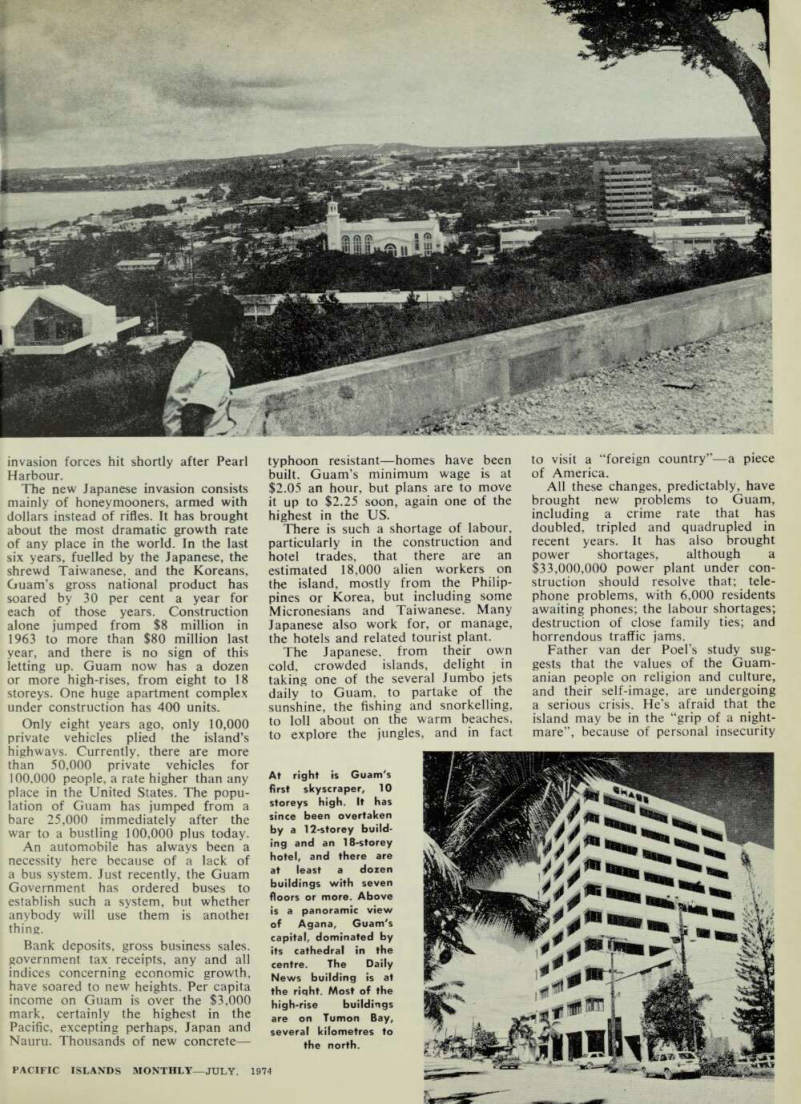
At right is Guam's first skyscraper, 10 storeys high. It has since been overtaken by a 12-storey build ing and an 18-storey hotel, and there are at least a dozen buildings with seven floors or more. Above is a panoramic view of Agana, Guam's capital, dominated by its cathedral in the centre. The Daily News building is at the right. Most of the high-rise buildings are on Turnon Bay, several kilometres to the north.
brought about by the rapid changes. (One delegate to last year’s South Pacific Conference, looked around at the high-rises, the plush hotels, the bustling economy, the traffic, and remarked that he wouldn’t mind having the problems that Guam had.) Island life here is of course sophisticated, with a mixture of Guamanian, “stateside” American, Japanese, Chinese, Korean, Filipino and Islander all living together in harmony. Nearly 100 different restaurants allow the visitor virtually to eat anything, from German food to Mongolian barbecue.
Islanders visiting Guam for the Games will find prices high although not much higher than in Tahiti.
Some delegates to the South Pacific Conference stayed in their hotel be cause they found it too expensive to travel about by taxi. But the Games committee will provide buses and other easy transportation for the athletes and their entourage, and some prices on Guam, which is a duty free port, are probably lower than you’ll find elsewhere as, for example, liquor, cameras, stereo equipment and jewellery.
Because very little produce or meat is raised on Guam, almost all food stuffs are imported, mostly from the US, which pushes up the cost of living. The tourist trade has brought
better entertainment, and on any night as many as 10 different shows ca n be seen, including Tahitian and Hawaiian dancing and rock ’n’ roll.
Visiting athletes might be fascinated to see the extent of the American military community on Guam. The Navy, for instance, operates at least 10 different commands around the island, including an atomic submarine base, an atomic-laden naval magazine, a naval air station, naval hospital, ship repair facility, communications station and a supply depot.
The Air Force has ali its eggs in one basket, at the sprawling Andersen Air Force base that occupies much of the north end of the island. It’s a strategic air command base, and as many as 120 gigantic 852 s were regularly flying out of Guam to bomb Vietnam at the height of that war.
Some of the vicious looking 852 s are still stationed here.
Guam long had the reputation of being “only a military bastion”, but that of course is far from true any more. Civilian and military com munities go their own way, although there is usually good co-operation.
The Department of Defence spent an estimated $240 million on Guam last year, and employs several thousand local residents.
Politically, the Guamanian people have so far managed to keep control of their island. They have elected their own governor since 1970. The present governor, a dentist and a graduate from the University of Marquette in the States, is a Guamanian, as are 19 members of the 21-member legisla ture. Virtually all of the department heads, from Public Works, to Educa tion, to Agriculture, including the president of the University of Guam are Guamanian-born and raised, although many were educated on the mainland.
Hie legislature passes its own laws, and has virtual autonomy from US decisions, except in such areas as defence and foreign affairs. Some Guamanians want more self-rule in the areas of immigration and air landing rights, but others are perfectly happy with the American system, and would opt for statehood, or a closer
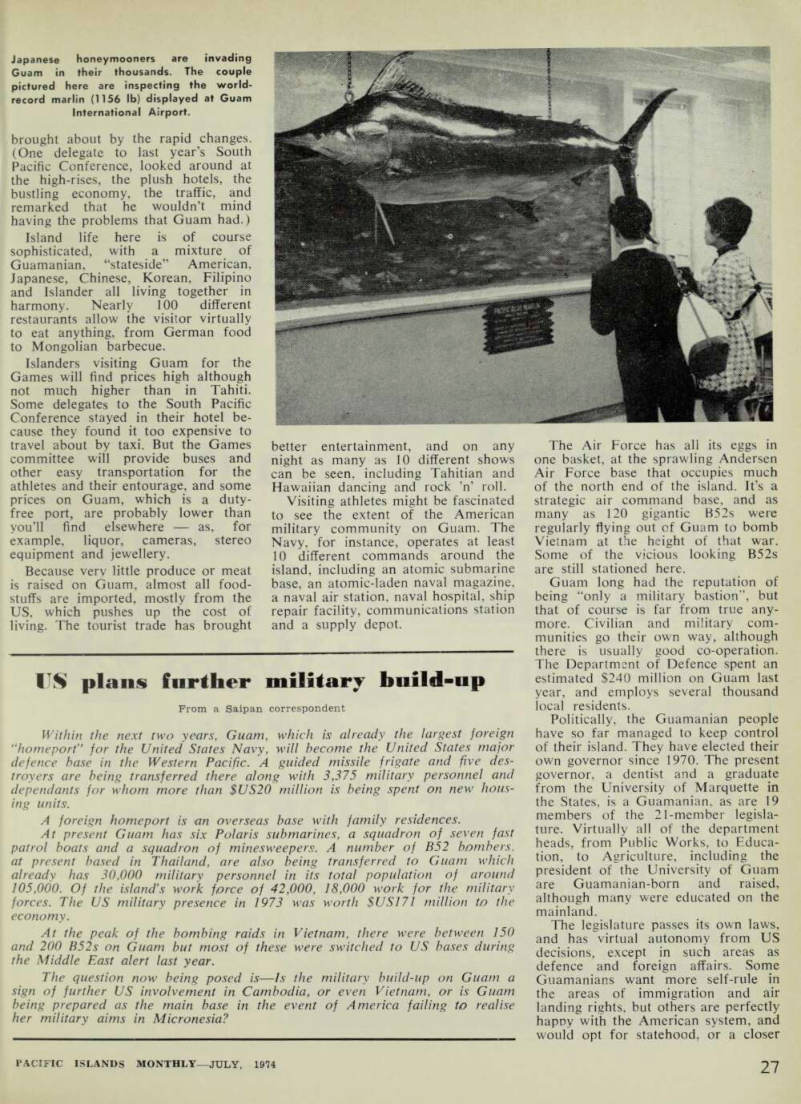
Japanese honeymooners are invading Guam in their thousands. The couple pictured here are inspecting the world record marlin (1156 lb) displayed at Guam International Airport.
Autonomy from US
alliance with the US if given the opportunity.
Guam is watching the political status talks between the US and the nearby northern Marianas (head quarters of the US Trust Territory of Micronesia) with interest, as the Marianas presumably are going after a Commonwealth arrangement with the US. This arrangement would allow the northern Marianas to choose their own constitution, an opportunity Guam never had—a fact that makes the Guamanians a bit envious of their northern neighbours.
All taxes paid into the federal in come system, an estimated $5O mil lion, stay on Guam, including that of the substantial military population, an estimated $ll million. This gives the Guam Government a huge $lOO million annual budget, and local taxes, including property taxes, are thus kept at a minimum. Guam also participates in many federally founded programmes including low-cost hous ing, highway improvements, school lunches, and weather predictions.
All this has created the typical bureaucracy, with over 6,000 people working directly for the Government of Guam, fully one quarter of the work force. Roughly another quarter works for the federal government, or military with another quarter work ing in construction.
Island schools are generally modern, and staffed largely by con tract teachers from the mainland, although more and more islanders are going through training at the excellent University of Guam. The local people speak fluent English, although most of them prefer their Chamorro tongue at home.
The major problem facing Guam anians today isn’t the high cost of living or the traffic situation, but the fact that they may be losing control of the economy of their own island.
They have seen what has happened in Hawaii, and aren’t eager to let this happen on Guam. But the Guaman ian, as a US citizen abides bv US law, which can’t restrict the free movement of citizens. Thousands of Guamanians have moved to the US mainland looking for more op portunity, but additional thousands of mainland citizens have come to Guam looking for travel, sunshine and a slow-paced island life. In recent years thousands of Filipinos have come in on work visas, stayed on, and have applied for permanent residence status. Many eventually be come US citizens here. In 1945 the
Migration control wanted
Guamanians made up 95 per cent of the population. By 1970 they only made up 55 per cent of the popu lation, a fact that makes many Guam politicians extremely nervous; although another fact is that 80 per cent of voters in the current elections will be of Guamanian ancestry.
Naturally, the Guamanian is be coming increasingly more vocal in his demands for control over im migration.
But the islanders still enjoy their “fiestas”, a sort of village-wide feast; their hot local food; their “ranches” out on the fringes of the jungle; and most of them are strong Catholics.
Despite the high-rises, and the highways, and jumble of cars, and the military bases, Guam has main tained much of its natural beauty, its picturesque villages, and historical settings. Huge sections remain in jungle growth, with one area having concealed a Japanese war-time straggler for over 27 years. There may still be other stragglers on the island, because sightings have been reported.
Guam is “Where America’s Day Begins”, and the people of Guam, some of the most patriotic of all Americans, are looking forward to hosting the South Pacific Games, politics aside. They’re proud of their island, and the way it has grown.