The Politics
pp. 14-15 · Read in the full issue
Are New, Not
The Economy
The Gilbert and Ellice Islands House of Assembly started on the road to self-government when it be gan its first session under its new constitution. For the first time minis ters fielded the awkward questions tossed onto the floor of the house; and an opposition emerged, with its unofficial leader claiming he had the support of the majority of voters.
Mr Naboua Ratieta took his place as Chief Minister.
The Governor, Mr John Smith, did away with the pomp and cere mony associated with the official opening of previous legislative coun cils. There was no police guard, no formal opening. Immediately after prayers, the 28 elected members were sworn in. Then the Governor addressed the assembly on the legis lative programme, and other mat ters that, hopefully, will get the economically poor GEIC into better shape for going it alone.
Mr Smith promised an early examination of the copra industry to ensure that the producer was paid the best possible price at all times.
There would also be an examination of the development of copra-based industries, such as soap-making, to give more work opportunities to local people, to give a cheaper pro duct to the home market, and to earn foreign exchange if exports could be built up.
The government would also look for cheaper sources of supply— Singapore, Malaysia, Taiwan and Japan—to satisfy local production without inflationary price increases.
As the GEIC was now a member of the Asian Development Bank, the government proposed to ask for “soft” loans to finance expensive projects such as major land re clamation on outer islands, the Betio- Bairiki causeway and shipping re placements. Advantage would be taken of overseas aid from all sources.
Mr Smith said that as there had long been a need for definite policies to guide the country in commercial and industrial development, a Minis try of Commerce and Industry had been set up. One of its first duties would be to prepare commercial and industrial policies for the approval of the Council of Ministers. Foreign investment would be encouraged, but foreign investors would be ex-
>ected to accept local participation n ownership.
Other matters which will receive ittention are the marine training cheme, to provide more opportuni ies for employment; possible migra ion so that people with skills could >e resettled in friendly and co >perative metropolitan countries; abour and union legislation, to in ;lude measures for the smooth ettlement of industrial disputes; a e-examination of the Gilbert and illice Islands Development Author ty, so that its development function ;an be exercised; and ways of re labilitating more than 500 British Tiosphate Commission employees md their families when the Ocean sland phosphate runs out.
In picking his executive council of ninisters, the Chief Minister had obviously relied as far as possible >n the old team from the defunct legislative Council. But perhaps with he idea of placating the Ellice slanders, who will vote in August in whether to opt out of the GEIC ir not and go it alone as an ad imct of the UK, Mr Ratieta ap lointed two Ellice men to the coun -11. This is one-third of his six-man earn although the Ellice Islands lopulation is only one-sixth of the otal of the whole GEIC.
The two ministers are Isakala •aeniu who retains his portfolio of Natural Resources and Sione Tui Lleis who becomes Minister of Com merce and Industry. Mr Paeniu is Likewarm about secession although ie’ll go along with what the majority if Ellice people want; but ex-priest Cleis is one of the leaders of the ecessionists and although he has •ersonally more to lose now that ie is a GEIC minister, it is not bought that this would influence uch an idealist.
The Chief Minister had invited members of the opposition to serve s ministers but had been turned own. Mr Toalipi Lauti who claims d have more followers than the
government—s 9 per cent of Gil
bertese and 71 per cent of Ellice Islanders—has promised to give the government a hot time.
Party politics are still pretty new in the GEIC where for hundreds of years it was against tradition for in dividuals to put themselves forward and raise their heads above their fellows; where the social unit was the classificatory family, ruled by the old men. There are, therefore, still likely to be shifts in power and in fluence although like true politicians everywhere the members of the House of Assembly were in accord over one thing.
One of the first measures to go be fore the new House was the possi bility of pay rises for members. The Chief Minister moved that a com mission be appointed to inquire into the matter. It was passed un
animously.
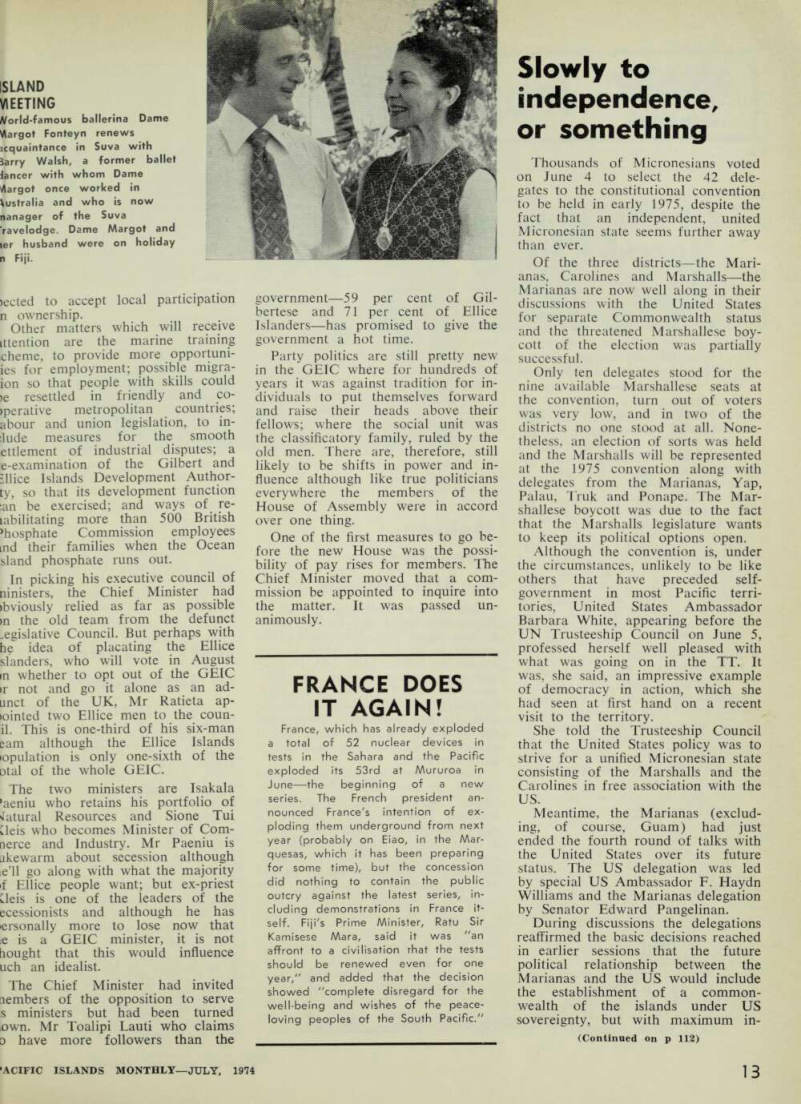
Island
Meeting
World-famous ballerina Dame Margot Fonteyn renews [?]icquaintance in Suva with Barry Walsh, a former ballet dancer with whom Dame Margot once worked in Australia and who is now manager of the Suva Travelodge. Dame Margot and her husband were on holiday [?]n Fiji.