"De- Emphasised"
p. 13 · Read in the full issue
Tv And English
In Am Samoa
From a Pago Pago correspondent After ten years of operating one of lie world’s largest educational tele vision facilities, geared to teaching in English, American Samoa’s Depart ment of Education has decided that English is not the best way.
A recent policy change by the Department of Education will result in the closing of the territory’s only English language public school, Fia [loa, and will gear the system towards teaching in Samoan with far ess use of educational television which has been almost eliminated anyhow ;hrough the territorys current power iifficulties.
For a number of years Fia Iloa has been the only public school in the territory where English was the anguage of instruction. It has tradi ionally been attended by those students who spoke English as a first language. This group is about 60 per :ent Samoan, most of them being students who have returned to Samoa Tom the United States, New Zealand, md other English speaking areas.
The reason given by the Depart nent of Education for the sudden change in policy was that federal ’unding would be cut off if the policy )f having an English language system md a Samoan language system was lot ended by consolidating the two groups. All such discrimination, even hough it is based on language ability •ather than race, now must be ended.
However the problem isn’t as iimple as that and what is likely to esult is the same sort of chaos as hey had in the United States when ichools were integrated willy-nilly, iven to the extent of sending bus oads of children commuting across ities in order that individual schools night have the right mixture of black md white.
American Samoa’s large public ducation system, which covers almost 2,000 students from pre-school to ommunity college level, is finding ;self caught in a tough situation. As
more Samoans return to the islands after years of life in the United States or New Zealand, they arc demanding that the qualitv of educa tion be equal to that which they left.
Many of their children do not speak Samoan or do not speak Samoan well enough to be taught only in Samoan, This growing portion of the local community is becoming much more outspoken in its demands that the Government of American Samoa provide quality education.
At the same time, a large number of students still speak Samoan and have been, to a large degree, by passed by the decade of educational television. These students need to be taught in Samoan as their English language ability is not developed to a point where they can receive adequate instruction in English.
Another group of students—those who seem to have above average ability to learn languages—have be come bi-lingual and can operate within either system.
The policy of the Department of Education, for the last ten years, has seemed to be aimed only at English language instruction. Now English is being de-emphasised and Samoan language instruction being em phasised.
It is going to become increasingly difficult for the Department of Education to meet all of the com munity needs and demands in the coming years. In fact, some think that a government controlled educational system, which is virtually autonomous, since most of its funding is from federal monies, rather than local revenues, may not be able to meet the needs at all.
There is a growing feeling among parents that the department should be made more responsible to community needs. One solution would be for the department to be run by an elected school board, which would hire and fire directors,
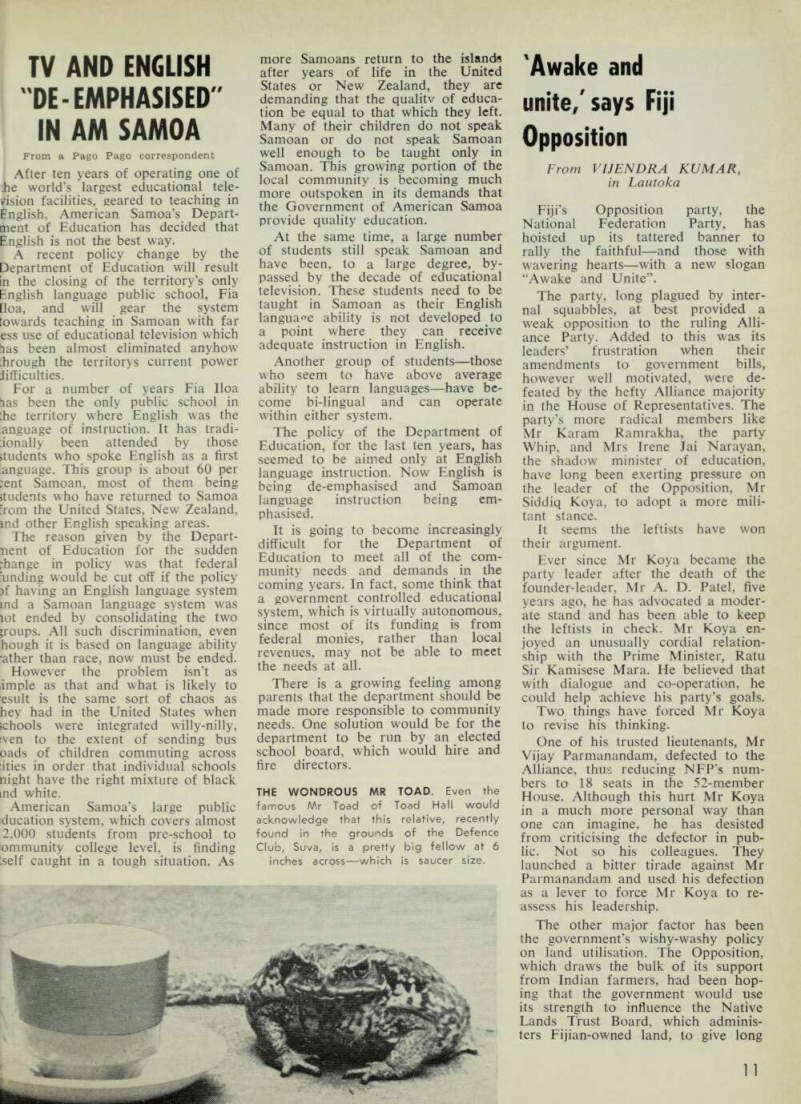
The Wondrous Mr Toad. Even The
famous Mr Toad of Toad Hall would acknowledge that this relative, recently found in the grounds of the Defence Club, Suva, is a pretty big fellow at 6 inches across—which is saucer size.