Pacific Islands Monthly
pp. 9-10 · Read in the full issue
On The Rampage Against
Galloping Islands Inflation
From correspondents in Port Moresby and Suva
Workers, university students and housewives in the South Pacific’s two biggest territories Papua New Guinea and Fiji took it in turns in [ate May and June to protest at the high cost of living.
Most publicised protest came from Port Moresby, where for two days in succession hundreds of angry women hurled insults and sometimes dicks and stones at Chief Minister Michael Somare.
On the first occasion they besieged bis city office, led by PNG’s only woman member of parliament, Papuan Miss Josephine Abaijah.
Some of the group forced their way into the office complex, overturning furniture and writing “We want more money please” on a blackboard. Miss Abaijah presented the Chief Minister with a petition demanding increased wages for their men, a freeze on prices, a 50 per cent cut in parliamen tary salaries and fewer overseas trips by ministers. The crowd shouted Mr Somare down.
The next day Mr Somare and Minister for Defence, Foreign Rela tions and Trade, Mr Albert Maori Kiki, agreed to talk to the women in a sports arena, but this turned out to be a debacle, with stones being hurled.
Police protected Mr Somare, who was later driven to the airport to catch an aircraft to Melbourne to address a meeting. But the women followed, storming the airport build ing, smashing glass doors in an attempt to force their way on to the tarmac. They were kept back by police until the Chief Minister’s air craft departed.
Mr Somare said later he didn’t blame the women, who were genuinely concerned about high prices and didn’t realise that inflation was a world wide problem. But he was critical of the part played by Miss Abaijah, and suggested that the violent scenes had been encouraged by her leadership so that she could “have a martyr for her cause”.
He praised the restraint of the police “in face of very real provoca tion and total irresponsibility”.
The university students —at the University of Papua New Guinea in Port Moresby and the University of Technology in Lae —had the same problem as the women —not enough money.
The trouble began at the Univer sity of PNG when students staged a one-day strike in protest at the food and service at the university mess.
But they later included other econ-
omic demands as a kind of bid on behalf of the community at large.
Within a day or two the govern ment announced that they would get an increase of S 3 in their $5 a fort night allowance. They had asked for a $5 increase.
Education Minister Dr Reuben Taureka made it clear that if the offer was not accepted, students hold ing government scholarships would have them cancelled. He said the offer of an increase was made in view of rising food costs, and it was expected that students would use the additional money to pay higher mess fees to enable the mess to feed them at a better standard.
The students were in no mood for threats of cancelled scholarships, and the strike spread to Lae, with private students or those on overseas and company scholarships offering sup port. Many students said they were willing to abandon studies and return home.
The universities shut down for some days. The other demands of the students were that: The salaries of ministers and departmental heads be cut by 10 per cent (which was an improvement on Miss Abaijahs proposal) or frozen indefinitely; that the minimum wages for labourers be increased; that government reduce the number of ministerial and other officials’ trips abroad; the government sell its four acres ministerial retreat outside Port Moresby that it recently bought for $11,000; and that the agreement with Boupainville Copper Ltd be re negotiated giving the PNG Govern ment 60 per cent of equity and eventually the lot, Mr Somare replied that the govern ment had no intention of increasing ministerial salaries although the Constitutional Planning Committee would recommend ways of reviewing them from time to time; the Public Service Association couldn’t be re strained from pressing for increases in pay although it was government policy to keep higher salaries to a
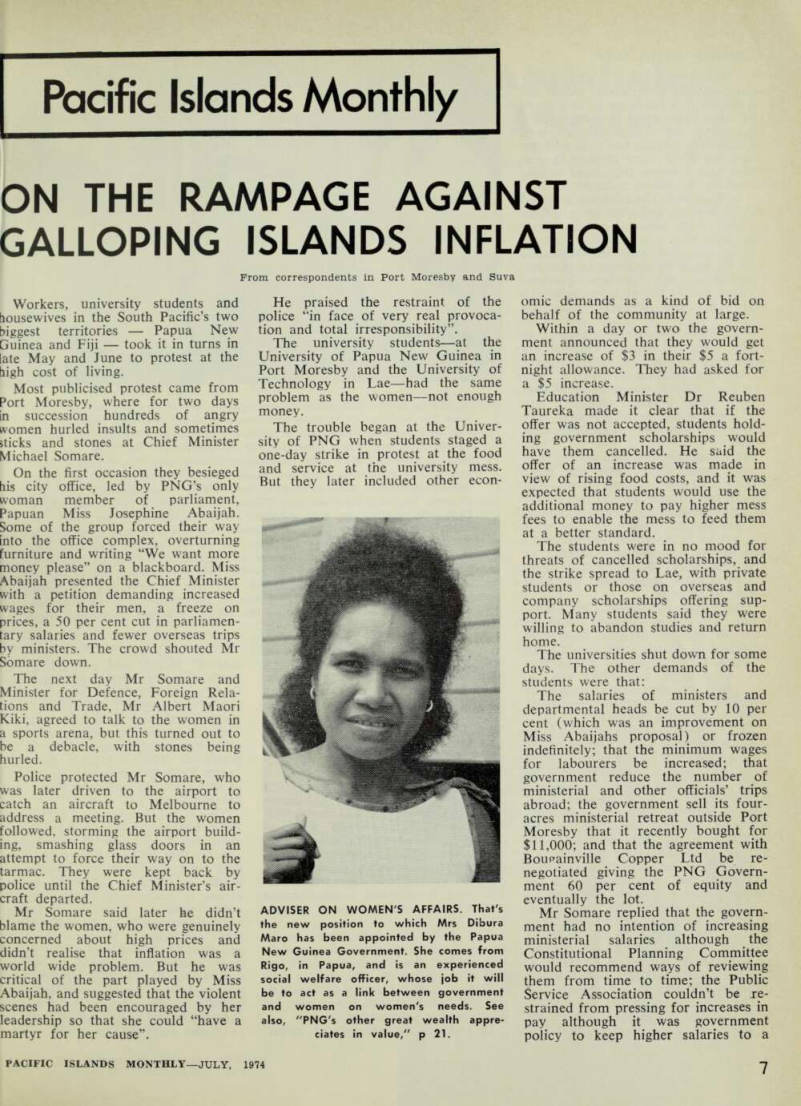
Adviser On Women's Affairs. That's
the new position to which Mrs Dibura Maro has been appointed by the Papua New Guinea Government. She comes from Rigo, in Papua, and is an experienced social welfare officer, whose job it will be to act as a link between government and women on women's needs. See also, "PNG's other great wealth appre ciates in value," p 21.
minimum; the government would sell its retreat if it could do so at a profit and the buyer was a Papua New Guinean; the negotiations with Bougainville Copper Ltd over a bigger share for PNG were already in pro gress; and overseas trips were strictly vetted by a cabinet committee.
On that basis the students accepted the S 3 increase and went back to their studies, with nobody certain about who had won.
The increased students’ allowance will be paid to students at the two universities, the Goroka Teachers College and at the nine teachers’ col leges in the national education system.
The PNG Government reacted to rising pressures and unrest by an nouncing, on June 19, new measures to combat inflation. This was only two days after it was announced that freight rates between Australia and PNG would rise by 18 per cent, plus another $lO a tonne for refrigerated goods.
The government has exempted rice, sugar, flour, tinned fish and meat from the 2i per cent import levy, and has reduced wholesale and retail mar gins by substituting money mark-ups for percentage mark-ups. The date has yet to be fixed for the introduc tion of these measures, estimated to save consumers $3 million a year, but to cost the government $600,000 a year in revenue.
The Finance Minister, Mr Julius Chan, said the government could do little to control inflation, currently estimated at 23 per cent a year. Mr J. Aoae, president of the Public Ser vice Association, said PNG was on the point of explosion because of spiralling costs. Further government delay would bring a crisis.
Fiji in May narrowly avoided an indefinite general strike. It was called by the Fiji Trades Union Congress as a protest against “suppression” of wages by the Fiji Prices and Incomes Board—and it was avoided only because the PIB had some of its teeth removed by the government. The operation on the PIB may turn out to have been the wrong thing.
The PIB has been Fiji’s bogey man since last year, when it was set up to police a government plan to deal with inflation by controlling prices and incomes. For 90 days from April 1 last year, the Fiji Govern ment froze all prices, wages, charges and house rents, and since then it has been systematically easing them, using the PIB as its instrument.
The first relaxation, from July last year, allowed wage increases of up to eight per cent provided that the
last increase was granted not less than 12 months before. There has been a further relaxation since, but the unions have argued that the levels at which wages were frozen last year were too low, and that there is no way that wage-earners can catch up with rising prices under present restrictions.
They felt that the government was prepared to listen to their arguments for “wage justice”, but that the PIB was acting in an arbitrary way and exercising its power indiscriminately.
The Trade Union Congress decided on a national strike to commence on May 20 as a protest against the PIB and also to demand restoration of collective bargaining because of gal loping inflation.
The strike was postponed for 24 hours when the government agreed to talk, and at the end of the talks the strike was called off. The unions won a victory at the expense of the PIB, and the PIB now feels it has been let down by the government.
In essence, the government agreed
that if unions and employers can reach agreement on wage increases that “restore relativity”, then the PIB cannot reject them. The “relativity” clause is open to wide interpretation.
The government also agreed on some other important changes which, in the words of FTUC general secretary James Raman, “achieved a great deal in being able to tame the Prices and Income Board”.
The board, headed by Dr Norman Ross, has since warned the govern ment that as a result of the changes about 6,000 Fiji workers could lose their jobs, and that the government might soon have to take severe action to counteract its new agree ment, such as increasing taxation, restricting imports, credit and govern ment spending. People able to negotiate for higher pay would spend their money on imports, the board said. Relaxation of the anti-inflation ary guidelines would result in wage inflation at the same sort of highly dangerous rate Fiji experienced in 1972 and early 1973.
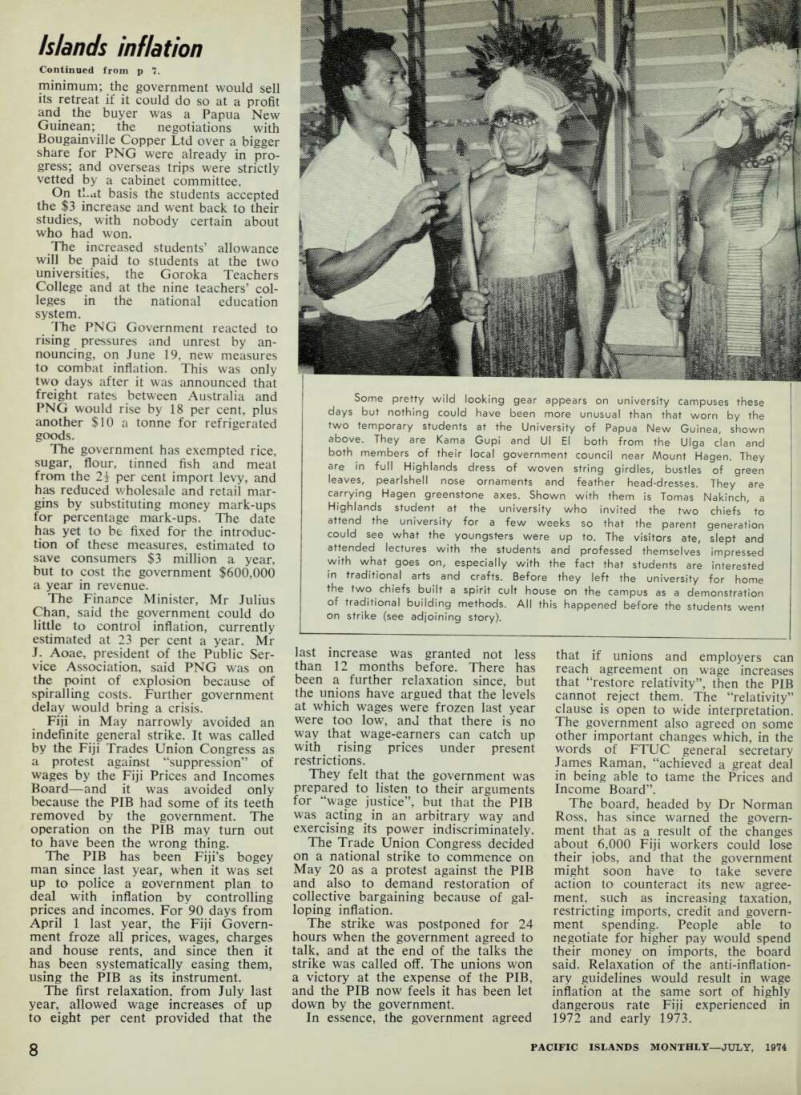
Some pretty wild looking gear appears on university campuses these days but nothing could have been more unusual than that worn by the two temporary students at the University of Papua New Guinea, shown above. They are Kama Gupi and Ul El both from the Ulga clan and both members of their local government council near Mount Hagen. They are in full Highlands dress of woven string girdles, bustles of green leaves, pearlshell nose ornaments and feather head-dresses. They are carrying Hagen greenstone axes. Shown with them is Tomas Nakinch, a Highlands student at the university who invited the two chiefs to attend the university for a few weeks so that the parent generation could see what the youngsters were up to. The visitors ate, slept and attended lectures with the students and professed themselves impressed with what goes on, especially with the fact that students are interested in traditional arts and crafts. Before they left the university for home the two chiefs built a spirit cult house on the campus as a demonstration of traditional building methods. All this happened before the students went on strike (see adjoining story).