Pacific Transport
pp. 77-83 · Read in the full issue


Fiji's Tourism Minister Castigates
Partners In Regional Airline
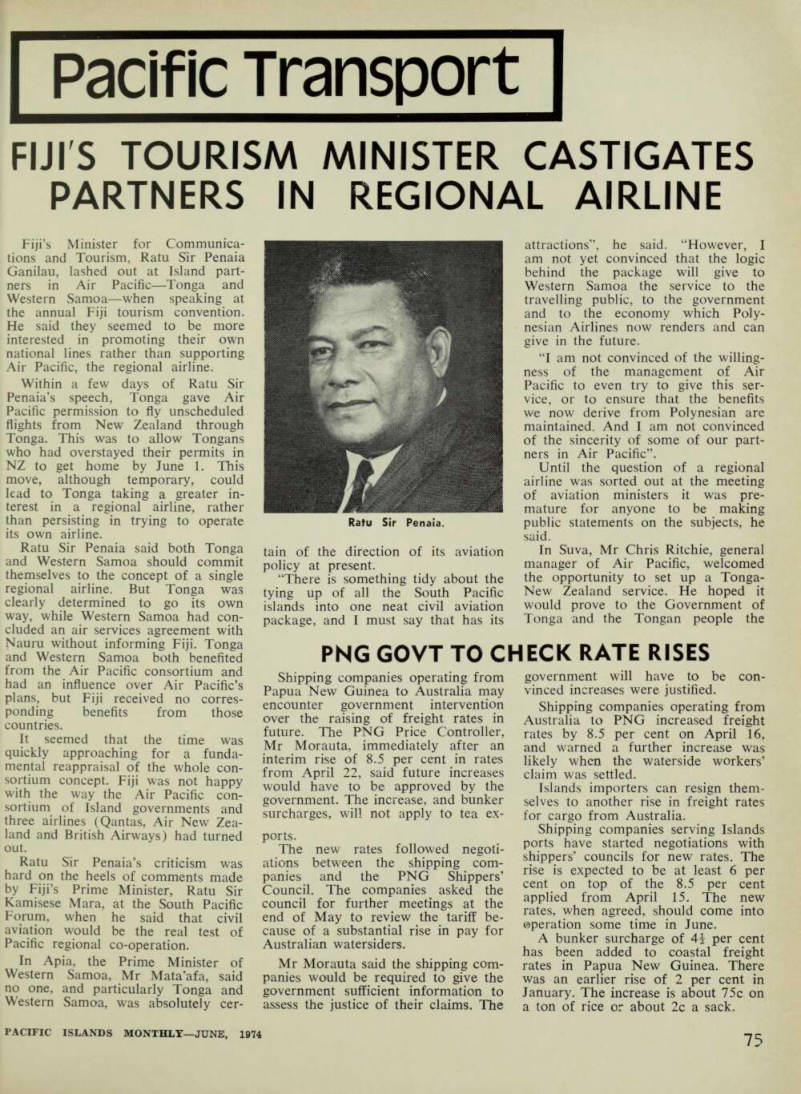
Fiji’s Minister for Communica tions and Tourism, Ratu Sir Penaia Ganilau, lashed out at Island part ners in Air Pacific—Tonga and Western Samoa—when speaking at the annual Fiji tourism convention.
He said they seemed to be more interested in promoting their own national lines rather than supporting Air Pacific, the regional airline.
Within a few days of Ratu Sir Penaia’s speech, Tonga gave Air Pacific permission to fly unscheduled flights from New Zealand through Tonga. This was to allow Tongans who had overstayed their permits in NZ to get home by June 1. This move, although temporary, could lead to Tonga taking a greater in terest in a regional airline, rather than persisting in trying to operate its own airline.
Ratu Sir Penaia said both Tonga and Western Samoa should commit themselves to the concept of a single regional airline. But Tonga was clearly determined to go its own way, while Western Samoa had con cluded an air services agreement with Nauru without informing Fiji. Tonga and Western Samoa both benefited from the Air Pacific consortium and had an influence over Air Pacific’s plans, but Fiji received no corres ponding benefits from those countries.
It seemed that the time was quickly approaching for a funda mental reappraisal of the whole con sortium concept. Fiji was not happy with the way the Air Pacific con sortium of Island governments and three airlines (Qantas, Air New Zea land and British Airways) had turned out.
Ratu Sir Penaia’s criticism was hard on the heels of comments made by Fiji’s Prime Minister, Ratu Sir Kamisese Mara, at the South Pacific Forum, when he said that civil aviation would be the real test of Pacific regional co-operation.
In Apia, the Prime Minister of Western Samoa, Mr Mata’afa, said no one, and particularly Tonga and Western Samoa, was absolutely cer-
tain of the direction of its aviation policy at present.
“There is something tidy about the tying up of all the South Pacific islands into one neat civil aviation package, and I must say that has its
attractions”, he said. “However, I am not yet convinced that the logic behind the package will give to Western Samoa the service to the travelling public, to the government and to the economy which Poly nesian Airlines now renders and can give in the future.
“I am not convinced of the willing ness of the management of Air Pacific to even try to give this ser vice, or to ensure that the benefits we now derive from Polynesian are maintained. And I am not convinced of the sincerity of some of our part ners in Air Pacific”.
Until the question of a regional airline was sorted out at the meeting of aviation ministers it was pre mature for anyone to be making public statements on the subjects, he said.
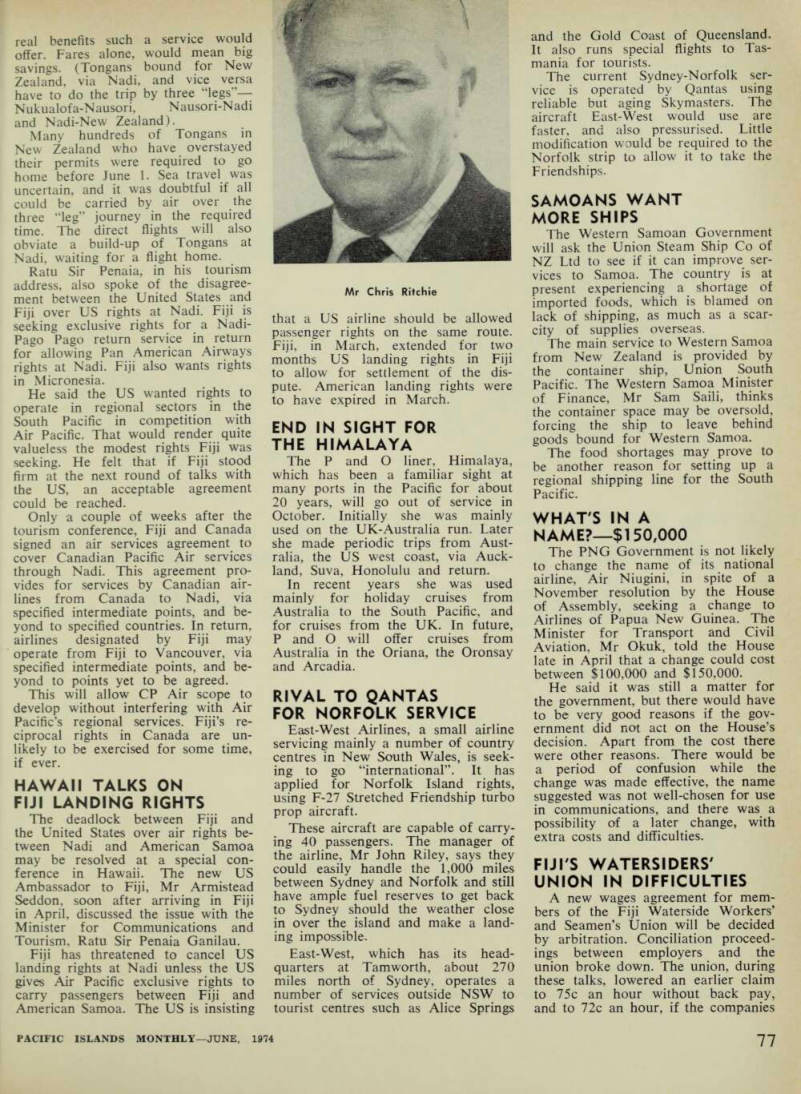
In Suva, Mr Chris Ritchie, general manager of Air Pacific, welcomed the opportunity to set up a Tonga- New Zealand service. He hoped it would prove to the Government of Tonga and the Tongan people the
Ratu Sir Penaia.
real benefits such a service would offer. Fares alone, would mean big savings. (Tongans bound for New Zealand, via Nadi, and vice versa have to do the trip by three “legs”— Nukualofa-Nausori, Nausori-Nadi and Nadi-New Zealand).
Many hundreds of Tongans in New Zealand who have overstayed their permits were required to go home before June 1. Sea travel was uncertain, and it was doubtful if all could be carried by air over the three “leg” journey in the required time. The direct flights will also obviate a build-up of Tongans at Nadi, waiting for a flight home.
Ratu Sir Penaia, in his tourism address, also spoke of the disagree ment between the United States and Fiji over US rights at Nadi. Fiji is seeking exclusive rights for a Nadi- Pago Pago return service in return for allowing Pan American Airways rights at Nadi. Fiji also wants rights in Micronesia.
He said the US wanted rights to operate in regional sectors in the South Pacific in competition with Air Pacific. That would render quite valueless the modest rights Fiji was seeking. He felt that if Fiji stood firm at the next round of talks with the US, an acceptable agreement could be reached.
Only a couple of weeks after the tourism conference, Fiji and Canada signed an air services agreement to cover Canadian Pacific Air services through Nadi. This agreement pro vides for services by Canadian air lines from Canada to Nadi, via specified intermediate points, and be yond to specified countries. In return, airlines designated by Fiji may operate from Fiji to Vancouver, via specified intermediate points, and be yond to points yet to be agreed.
This will allow CP Air scope to develop without interfering with Air Pacific’s regional services. Fiji’s re ciprocal rights in Canada are un likely to be exercised for some time, if ever.
Hawaii Talks On
Fiji Landing Rights
The deadlock between Fiji and the United States over air rights be tween Nadi and American Samoa may be resolved at a special con ference in Hawaii. The new US Ambassador to Fiji, Mr Armistead Seddon, soon after arriving in Fiji in April, discussed the issue with the Minister for Communications and Tourism, Ratu Sir Penaia Ganilau.
Fiji has threatened to cancel US landing rights at Nadi unless the US gives Air Pacific exclusive rights to carry passengers between Fiji and American Samoa. The US is insisting
that a US airline should be allowed passenger rights on the same route.
Fiji, in March, extended for two months US landing rights in Fiji to allow for settlement of the dis pute. American landing rights were to have expired in March.
End In Sight For
The Himalaya
The P and O liner, Himalaya, which has been a familiar sight at many ports in the Pacific for about 20 years, will go out of service in October, Initially she was mainly used on the UK-Australia run. Later she made periodic trips from Aust ralia, the US west coast, via Auck land, Suva, Honolulu and return.
In recent years she was used mainly for holiday cruises from Australia to the South Pacific, and for cruises from the UK. In future, P and O will offer cruises from Australia in the Oriana, the Oronsay and Arcadia.
Rival To Qantas
For Norfolk Service
East-West Airlines, a small airline servicing mainly a number of country centres in New South Wales, is seek ing to go “international”. It has applied for Norfolk Island rights, using F-27 Stretched Friendship turbo prop aircraft.
These aircraft are capable of carry ing 40 passengers. The manager of the airline, Mr John Riley, says they could easily handle the 1,000 miles between Sydney and Norfolk and still have ample fuel reserves to get back to Sydney should the weather close in over the island and make a land ing impossible.
East-West, which has its head quarters at Tamworth, about 270 miles north of Sydney, operates a number of services outside NSW to tourist centres such as Alice Springs
and the Gold Coast of Queensland.
It also runs special flights to Tas mania for tourists.
The current Sydney-Norfolk ser vice is operated by Qantas using reliable but aging Skymasters. The aircraft East-West would use are faster, and also pressurised. Little modification would be required to the Norfolk strip to allow it to take the Friendships.
Samoans Want
More Ships
The Western Samoan Government will ask the Union Steam Ship Co of NZ Ltd to see if it can improve ser vices to Samoa. The country is at present experiencing a shortage of imported foods, which is blamed on lack of shipping, as much as a scar city of supplies overseas.
The main service to Western Samoa from New Zealand is provided by the container ship, Union South Pacific. The Western Samoa Minister of Finance, Mr Sam Saili, thinks the container space may be oversold, forcing the ship to leave behind goods bound for Western Samoa.
The food shortages may prove to be another reason for setting up a regional shipping line for the South Pacific.
What's In A
Name?—Si 50,000
The PNG Government is not likely to change the name of its national airline, Air Niugini, in spite of a November resolution by the House of Assembly, seeking a change to Airlines of Papua New Guinea. The Minister for Transport and Civil Aviation, Mr Okuk, told the House late in April that a change could cost between $lOO,OOO and $150,000.
He said it was still a matter for the government, but there would have to be very good reasons if the gov ernment did not act on the House’s decision. Apart from the cost there were other reasons. There would be a period of confusion while the change was made effective, the name suggested was not well-chosen for use in communications, and there was a possibility of a later change, with extra costs and difficulties.
Fiji's Watersiders'
Union In Difficulties
A new wages agreement for mem bers of the Fiji Waterside Workers’ and Seamen’s Union will be decided by arbitration. Conciliation proceed ings between employers and the union broke down. The union, during these talks, lowered an earlier claim to 75c an hour without back pay, and to 72c an hour, if the companies
Mr Chris Ritchie
agree to back-date the claim to August, 1973.
Mr Manueli Vasea said the union, before the arbitration proceedings, would ask for $1 a hour for perma nent workers and $1.50 an hour for casuals.
The union is having financial problems. Previously employers de ducted 5c in the S from the men’s pay, and paid it to the union. They stopped doing that when the Water side Workers’ and Seamen’s Union was deregistered in 1973.
Mr Vasea said weekly deductions were about $5OO a week. Since the companies stopped deducting dues only a few members paid. Dues now raised only $4O to $5O a week, Mr Vasea said the union wanted to build up its assets to provide club houses for members in Suva and Lautoka.
Keeping Safety Men
On Their Toes
With the memory of the tragic aircraft crash at Pago Pago in January still firmly in mind, Niue Island has begun a programme to knock the rough spots out of its own emergency procedures.
Two simulated air disaster exercises have been held, and the second showed that real progress is being made. The first inevitably showed some room for improvement, but now the Health Department, the Ministry of Transport, the Police, the Public Works Department and the Radio Department are all combining to ensure minimum fuss and delay, and maximum efficiency and co ordination.
The exercises, staged at Hanan International Airport, cover three phases—standby, alert and crash— and everyone knows just what to do at any time. It is intended to hold future periodic exercises without warning . . . just to keep the ground safety organisation on its toes.
New Ship Cost
Double The Estimate
The Fiji taxpayer will have to pay more than double the estimated cost of an 80 ft fishery research ship, the Tui Ni Wasaliwa, launched in 1973.
The ship was to have cost $84,000.
The final cost was $168,755.
The higher cost was blamed on wage increases, higher costs of materials, delays in delivering equip ment ordered from overseas and de ficiencies in the estimate procedure.
The Tui Ni Wasaliwa recently figured in an incident with a Korean fishing ship, alleged to have been fishing illegally in Fiji waters. The
Korean ship escaped to the open sea.
The master was later ordered by the owners to sail to Suva to face possible court proceedings.
Micronesia Loses
76 Containers
Problems with shipping continue to plague Micronesia—the latest the loss of 76 containers. The with drawal of the Transpac charter left a pile of containers at Guam for various parts of the Trust Territory.
The receiver of Transpac, Mr John Meadows, in an effort to get the containers to Ponape, hired a tug boat, the Challenger, and a barge from the Luzon Stevedoring Co, of the Philippines.
The barge, towed by the Challenger and carrying 76 con tainers, broke up and sank in heavy seas about six miles northwest of Truk lagoon. Chances of recovering any of the containers were reckoned to be nil as the break-up was in water 7,000 fathoms deep.
Lost were 68 20 ft containers and eight 8 ft containers. Fifty-two con tainers were from the US west coast.
Thirty-four containers carried “mixed” cargo, which included food and general items, 13 were full of beverages and liquor, one carried unspecified poisons, 14 were full of rice, one held groceries, one soap, one flour, one US mail and nine chickenfeed. The chickenfeed con tainers were loaded at the special request of agriculture officials be cause of the low supply of such feed on Ponape.
Transport officials in the Trust Territory made alternative arrange ments to get food supplies into Ponape as soon as possible. They chartered the Gunners Knot, a government ship, to load cargo in Japan for Ponape.
Mr Meadows filed a claim in the Trust Territory High Court to re cover damages for the loss, estimated at between 52.5 million and $3 mil lion. The amount included the value of the containerised cargo, prepaid freight charges, lost profits, interest and cost. The claim is against the Luzon Stevedoring Co, its agent, the Marianas Maritime Corp, and other unidentified agents.
The complaint alleged several reasons for the break-up and sinking of the barge: • The cargo fittings and deck were not strong enough to allow a crawler crane and containers to be secured to the decks; • The barge did not have ade quate flooding alarms and pumps; • The tug crew was incompetent;
• The barge was abandoned by the tug; • The barge was towed at an “excessive speed”; • It was allowed to broach-to “in the normal seas for this particular time of the year”.
It was stated in the complaint: “The loss of the cargo was in no way due to the plaintiff’s fault”.
Gunboats Arrest
Chinese Catcher
Palau authorities are expected to seek the forfeiture of a Taiwanese fishing ship, the Nob Tei Sheng, over alleged illegal entry into Trust Terri tory waters and unlawful removal of marine resources from Helen Reef.
The ship is owned by Wu Kao Hen, of Kaohsiung, Taiwan.
Two US Navy gunboats, the Gallup and the Canon, while on a routine patrol arrested the ship after watching two small boats on the reef and photographing the occupants taking turtles and shellfish from the reef area. The Nob Tei Sheng was serving as a mother ship for the smaller boats.
Ships Collide,
Then Run Aground
Two ships ran aground on a reef near Matupit Island in Simpson Harbour, Rabaul on April 28 after a collision.
They were the Pacific Wealth, 3,200 tons, a Panamanian log ship, and a Japanese fishing boat, the Takatsu Maru, 66 ft. The Pacific Wealth freed itself and sailed, apparently un damaged, about five hours after the mishap.
Some of the crew of the fishing ship jumped, or were thrown, over board. The master ran the ship hard on to the reef to stop it from sinking.
The engine room was flooded. A troll net boom was put out to take up leaking oil. It was not known whether the ship would be salvaged.
The Rabaul Harbourmaster, Cap tain G. Veale, sent a message to the master of the Pacific Wealth, ordering it to return to Rabaul for an inquiry.
The master replied that his ship had “touched” a Japanese fishing ship.
There was no damage to his ship, and no one was injured.
Fiji Will Have
Port Authority
Control of ports in Fiji will come under a new body, the Port Authority of Fiji, in 1975. This move follows a commission of inquiry into Fiji marine matters. One of the commis sion’s recommendations was that a port authority be established.
The authority will probably take
control of all port operations at present handled by the Marine Department. Its responsibilities will include dredging, hydrographic sur veys, pilotage and cargo handling. The Marine Department will retain respon sibility for matters concerning the registration of ships and seamen, the survey of ships and the examination of masters, mates and engineers.
New Ships
For Micronesia
The first of eight new ships the United States is providing for the Trust Territory has been built at Pusan, Korea, and will be ready for use soon. The 225 ft ship has been named Micronesia Princess.
Mr Raymond Setik, a Truk mem ber of the TT House of Representa tives, testifying in Washington in sup port of a " $6l million budget appropriation for the TT, said TT residents were travelling between islands on outmoded ships, some of them 30 years old, Mr Setik is chair man of the Joint Committee on Pro gramme and Budget Planning.
The Micronesian delegation in Washington asked for speedy handling of a request for $1.6 million to help build new inter-island ships.