Books, Reviews, Writers
pp. 71-73 · Read in the full issue
A beachcomber s story—150 years late
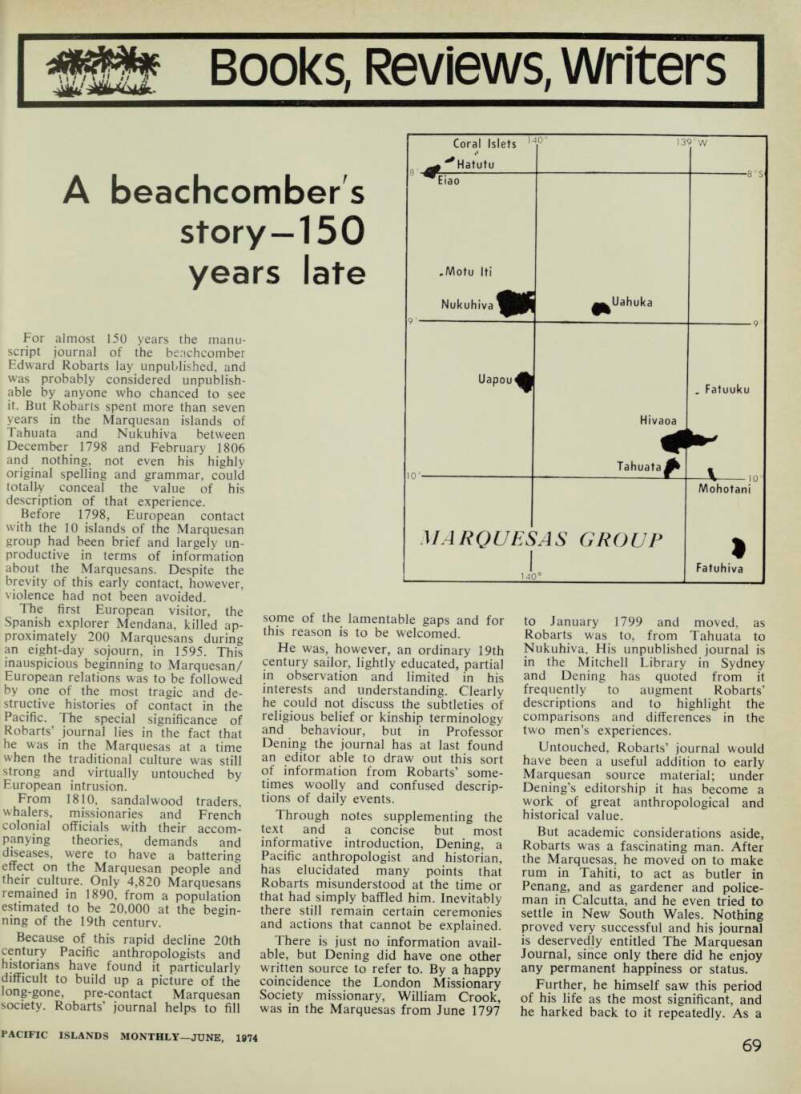
For almost 150 years the manu script journal of the beachcomber Edward Robarts lay unpublished, and was probably considered unpublish able by anyone who chanced to see it. But Robarts spent more than seven years in the Marquesan islands of Tahuata and Nukuhiva between December 1798 and February 1806 and nothing, not even his highly original spelling and grammar, could totally conceal the value of his description of that experience.
Before 1798, European contact with the 10 islands of the Marquesan group had been brief and largely un productive in terms of information about the Marquesans. Despite the brevity of this early contact, however, violence had not been avoided.
The first European visitor, the Spanish explorer Mendana, killed ap proximately 200 Marquesans during an eight-day sojourn, in 1595. This inauspicious beginning to Marquesan/ European relations was to be followed by one of the most tragic and de structive histories of contact in the Pacific. The special significance of Robarts’ journal lies in the fact that he was in the Marquesas at a time when the traditional culture was still strong and virtually untouched by European intrusion.
From 1810, sandalwood traders, whalers, missionaries and French colonial officials with their accom panying theories, demands and diseases, were to have a battering effect on the Marquesan people and their culture. Only 4,820 Marquesans remained in 1890, from a population estimated to be 20,000 at the begin ning of the 19th centurv.
Because of this rapid decline 20th century Pacific anthropologists and historians have found it particularly difficult to build up a picture of the long-gone, pre-contact Marquesan society. Robarts’ journal helps to fill
some of the lamentable gaps and for this reason is to be welcomed.
He was, however, an ordinary 19th century sailor, lightly educated, partial in observation and limited in his interests and understanding. Clearly he could not discuss the subtleties of religious belief or kinship terminology and behaviour, but in Professor Dening the journal has at last found an editor able to draw out this sort of information from Robarts’ sometimes woolly and confused descriptions of daily events.
Through notes supplementing the text and a concise but most informative introduction, Dening, a Pacific anthropologist and historian, has elucidated many points that Robarts misunderstood at the time or that had simply baffled him. Inevitably there still remain certain ceremonies and actions that cannot be explained.
There is just no information available, but Dening did have one other written source to refer to. By a happy coincidence the London Missionary Society missionary, William Crook, was m the Marquesas from June 1797
to January 1799 and moved, as Robarts was to, from Tahuata to Nukuhiva. His unpublished journal is in the Mitchell Library in Sydney and Dening has quoted from it frequently to augment Robarts’ descriptions and to highlight the comparisons and differences in the two men’s experiences.
Untouched, Robarts’ journal would have been a useful addition to early Marquesan source material; under Dening’s editorship it has become a work of great anthropological and historical value, But academic considerations aside, Robarts was a fascinating man. After the Marquesas, he moved on to make rum in Tahiti, to act as butler in Penang, and as gardener and police man in Calcutta, and he even tried to settle in New South Wales. Nothing proved very successful and his journal is deservedly entitled The Marquesan Journal, since only there did he enjoy any permanent happiness or status, Further, he himself saw this period of his life as the most significant, and he harked back to it repeatedly. As a
beachcomber, Robarts seems to have been a cut above the normal run. It appears that he spoke a little Russian and French and had made ac quaintance with well-connected people when he visited St Petersburg.
When he finally left Nukuhiva, he did so for honourable reasons, even taking his Marquesan wife with him, an act very few beachcombers, if any, risked. Coloured wives were not well received in early 19th century white society. But these motives should be looked at rather carefully.
We only have Robarts’ explanation of his deeds, and his self-justification is at times fulsome. But it is clear that however Robarts saw himself, he played an important and useful role in the Marquesas, as so many early beachcombers were to do in other parts of Polynesia.
It is interesting that when, after his experience in the Marquesas, Robarts met the beachcomber, George Bruce, in the Bay of Islands, New Zealand, he spoke rather patronisingly of him. Robarts conceded that the trade between the Maoris and the ship, for which Bruce was responsible, had been well conducted but not once did he admit, or perhaps even realise, that this was exactly the nosition he had filled in the Marquesas.
Obviously Robarts’ conception of his own role—“guiding and nourishing the weary navigator”—had been very much more elevated. But despite these shortcomings—his egotism, partial understanding, and his misuse of the English tongue—Robarts’ journal is a distinguished addition to the file of published beachcomber accounts, which includes James Morrison, Archibald Campbell and William Mariner.
Much about Robarts is still un known—the dates of his birth and death, his life before he reached the Marquesas and after the journal ends in Calcutta in 1824. But this is presumably a small loss. His years in the Marquesas were the one out standing period in his life; he was lucky to find himself there, and 150 years later he was lucky to attract a sympathetic and informed editor to make the most of his unique
journal.
Caroline Ralston.
(The Marquesan Journal Of
EDWARD ROBARTS 1797-1824, edited by Greg Dening, Australian National Univer sity Press, Canberra, $9.9&.)