Pacific Art
pp. 66-67 · Read in the full issue
In Germany
By Marjorie Crocombe
There is a wonderful collection of materials from the Pacific at the Museum fur Volkerkunde in Ham burg. Most of the materials from Polynesia and Micronesia are very rare and old but a lot of the material from Melanesia and particularly New Guinea is more recent.
About 60 years ago the Hamburg Museum sent a large expedition to the Pacific Islands. They made many hundreds of photographs which are now a very interesting record of life as it was in the early 1900 s and they also collected large quantities of tools, clothing, housing, canoes and tapa cloth etc from various islands.
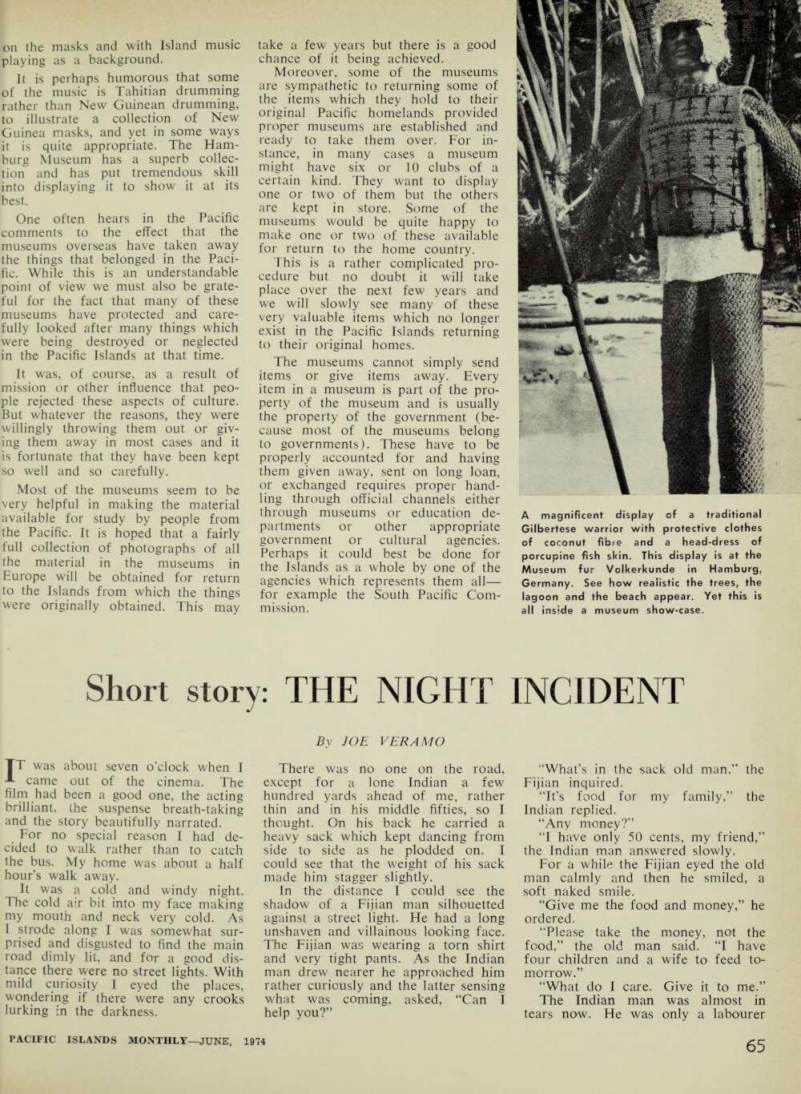
The Pacific collection at the Ham burg Museum is beautifully dis played. There are life-size represent ations of people and life-size photo graphs in the walls at the back of the display cabinets showing the scenery, house types and other aspects of the environment so that the artifacts are put into a very realistic context. There is a beautiful New Zealand Maori carved meeting house—complete—the whole meeting house, not a miniature of it—and some beautiful samples from Samoa, Tonga and elsewhere in Polynesia.
Of course between 1900 and 1914 Western Samoa was a colony of Germany and before that German traders, missionaries and sea captains had been travelling in the Pacific for many years. Many of these people had collected items from various parts of the Pacific—especially the Gilbert Islands, Samoa, Marshall Islands and Caroline Islands as well as from northern New Guinea. A lot of these things have found their way into the museum at Hamburg be cause Hamburg was at that time perhaps the most important port in Germany from which the trade to the Pacific Islands originated.
The Hamburg Museum has de voted one very large room to a very realistic display of New Guinea masks. They have an enormous number of masks—some of them eight or 10 feet high, some of them only a few inches high; some of them from the Trobriand Islands, some from the Sepik and so on, but many of them are very beautiful.
All of them are hung from the ceil ing in a rather realistic setting in a room which is very dark but with selected lights playing intermittently
on the masks and with Island music playing as a background.
It is perhaps humorous that some of the music is Tahitian drumming rather than New Guinean drumming, to illustrate a collection of New Guinea masks, and yet in some ways it is quite appropriate. The Hamburg Museum has a superb colleclion and has put tremendous skill into displaying it to show it at its k est v 3 b One often hears in the Pacific comments to the effect that the museums overseas have taken away the things that belonged in the Padfit. While this is an understandable point of view we must also be grateful for the fact that many of these museums have protected and carefully looked after many things which were being destroyed or neglected in the Pacific Islands at that time.
It was, of course, as a result of mission or other influence that peopie rejected these aspects of culture.
But whatever the reasons, they were willingly throwing them out or giving them away in most cases and it is fortunate that they have been kept so well and so carefully.
Most of the museums seem to be very helpful in making the material available for study by people from the Pacific. It is hoped that a fairly r it „ i. .. r y . , r full collection of photographs of all the material in the museums in Europe will be obtained for return to the Islands from which the things were originally obtained. This may
take a few years but there is a good chance of it being achieved.
Moreover some of the museums f. re sympathetic to returning some of thl r hems which they hold to their on «' nal Pacific homelands provided P ro Per museums are established and r fady to take them over. For in st?n“. >» many cases a museum might have six or 10 clubs of a certa ' n kind. They want to display one or two of them but the others are kept in store. Some of the museums would be quite happy to ma ke one or two of these available f or return to the home country, This is a rather complicated pro cedure but no doubt it will take place over the next few years and we will slowly see many of these very valuable items which no longer exist in the Pacific Islands returning to their original homes. miloQlirv , o . . , , The museums cannot simply send items or give items away. Every item in a museum is part of the pro perty of the museum and is usually the property of the government (be cause most of the museums belong to governments). These have to be properly accounted for and having them given away, sent on long loan, .°. r ex £hanged requires proper hand 'nB tf ; rou S h offlclal channe ? either through museums or education de- P artments , or oth f f r appropriate government or cultural agencies, Perhaps it could best be d “ ne for the Islands as a whole by one of the agencies which represents them all— for example the South Pacific Com mission.
A magnificent display of a traditional Gilbertese warrior with protective clothes of coconut fibre and a head-dress of porcupine fish skin. This display is at the Museum fur Volkerkunde in Hamburg, Germany. See how realistic the trees, the lagoon and the beach appear. Yet this is all inside a museum show-case.