family planning
pp. 45-47 · Read in the full issue

OK for Samoa's family planning
From a Pago correspondent American Samoa’s family planning programme has received strong sup port from Dr Louis M. Heilman, of the Department of Health, Educa tion and Welfare in Washington, DC.
Dr Heilman is one of the world’s foremost authorities on population control and family planning.
The Heilman Report, which was released in late March, was the re sult of an in-depth study made of the family planning programme in American Samoa, which was at tacked last year by American Samoa’s Delegate-at-Large A. U.
Fuimaono. Fuimaono charged that the family planning programme in American Samoa was a “mass cam paign to eradicate future generations of Samoan children”. He also charged that a “mass sterilisation programme” was being carried out ‘in the Territory of American Samoa by Dr Carlo Crim”. His charges of genocide were made to the President of the United States and to a num ber of high-ranking government officials and congressmen.
In his report, Dr Heilman said that “there is no evidence whatsoever of coercion nor is there any evidence of ‘mass sterilisation’.” Not only did Dr Heilman dispute Fuimaono’s charges, but he recommended “that increased access to family planning services in the dispensaries be con sidered”.
The family planning programme in American Samoa is headed by Dr Carlo Crim, who has been the staff gynaecologist and obstetrician at
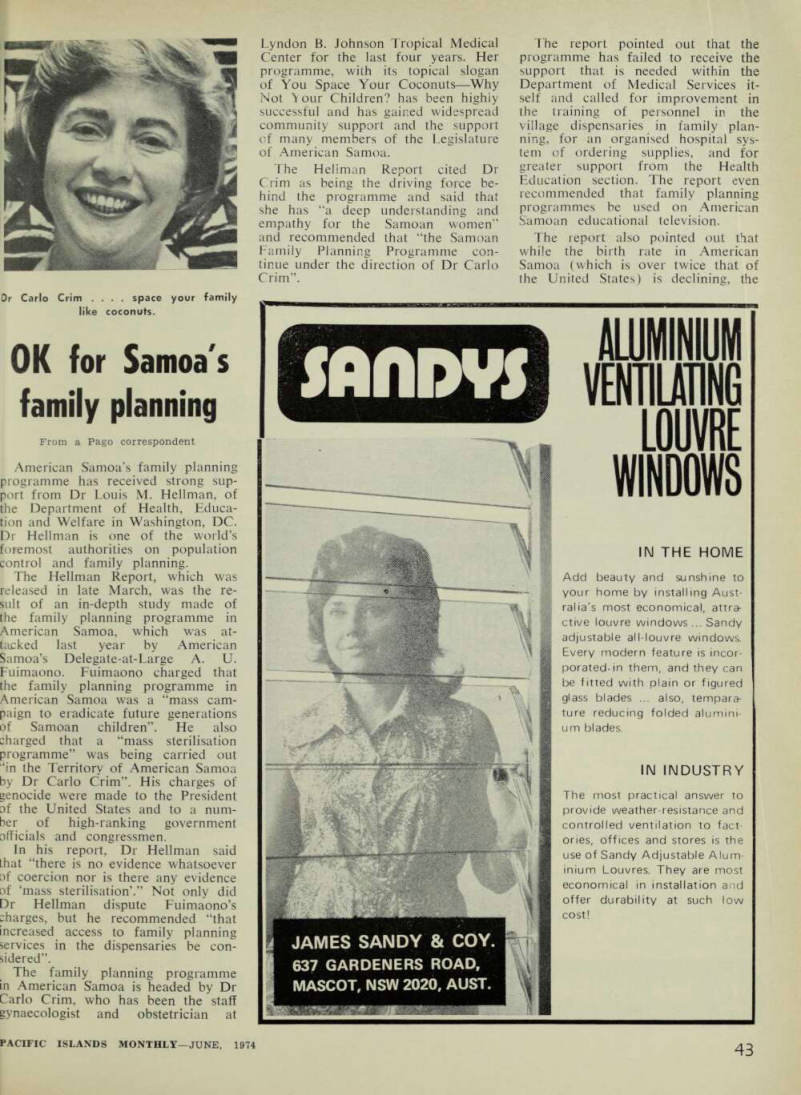
Lyndon B. Johnson Tropical Medical Center for the last four years. Her programme, with its topical slogan of You Space Your Coconuts—Why Not Your Children? has been highly successful and has gained widespread community support and the support cf many members of the Legislature of American Samoa.
The Heilman Report cited Dr Crim as being the driving force be hind the programme and said that she has “a deep understanding and empathy for the Samoan women” and recommended that “the Samoan Family Planning Programme con tinue under the direction of Dr Carlo Crim”.
The report pointed out that the programme has failed to receive the support that is needed within the Department of Medical Services it self and called for improvement in the training of personnel in the village dispensaries in family plan ning, for an organised hospital sys tem of ordering supplies, and for greater support from the Health Education section. The report even recommended that family planning programmes be used on American Samoan educational television.
The report also pointed out that while the birth rate in American Samoa (which is over twice that of the United States) is declining, the
Dr Carlo Crim ... space your family like coconuts.
decline is due to a number of fac tors, including emigration and that “the introduction of a family plan ning programme has been exceed ingly timely”.
“The infant mortality rate”, said the report, “is double that of the United States”, and “higher than the neighbouring Pacific islands of Fiji, Western Samoa and Niue”.
I One of Fuimaono’s charges had to do with the use of the drug Depo-Provera, which had been used n the family planning clinic since 1968. While the drug was not ap jroved by the Food and Drug Administration, it was listed in the widely-used Physicians Desk Re ference and was, as the Heilman Report points out, “widely used as i contraceptive in Australia, New Zealand and the United States”.
Even though the drug lacked FDA ipproval, the Heilman Report stated hat the question was “the right of i physician to use an approved drug : or a purpose which the physician relieves to be ia the best interest of he patient, though it be other than hat specifically listed” by the FDA. ‘Clearly”, the report said, “the prac itioner of medicine has a right to ise drugs in this manner”. The drug Depo-Provera is used, with FDA ipproval, for the treatment of cer ain types of cancer.
The Heilman Report recom nended that Depo-Provera, which las been discontinued for use as a :ontraceptive in the family planning :linic in American Samoa, be used igain, as soon as full FDA approval las been made.