the gloomy
pp. 39-43 · Read in the full issue



Moresby confounds the gloomy prophets
From a Port Moresby correspondent After several months as capital of a self-governing Papua New Guinea, Port Moresby shows no signs of suf fering the decay, disaster and doom predicted by expatriate pessimists.
For a few weeks over Christmas and in January, the town was notice ably quieter than usual, the stores were less busy and for the first time in many years it was possible to find easily a place to park in the city centre. However, trade soon picked up again at the end of the school holidays and traffic density was quickly back to pre-December 1 level.
The appearance for the first time of diplomatic plates on the vehicles of the newly-established consulates pro vided signs of the new times.
A surprise has been the marked improvement in the appearance of the city in recent months. An un usually long wet season has helped, as did also the clean-up for the Royal visit, but the energetic first city council can claim most of the credit.
Development
During its term of office, which ended in March, it achieved a remark able amount of road-sealing, foot path-making, street-cleaning, grass cutting and park-developing. And these improvements were not re stricted to the more prosperous suburbs but spread throughout the town. A new council has since been elected (see panel on p 41).
City development continues apace.
Houses of the high, medium, low and non-covenant variety appear, seem ingly overnight, most of them built by the energetic Housing Commission in the far reaches of the Waigani Valley.
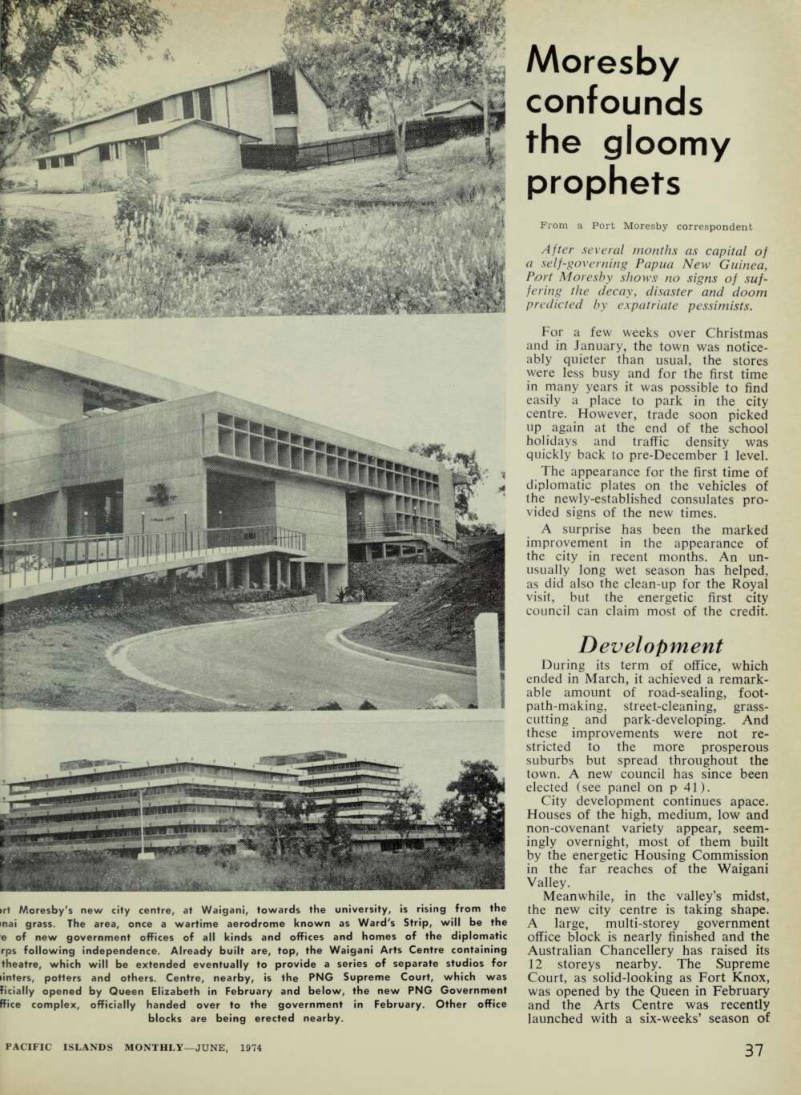
Meanwhile, in the valley’s midst, the new city centre is taking shape.
A large, multi-storey government office block is nearly finished and the Australian Chancellery has raised its 12 storeys nearby. The Supreme Court, as solid-looking as Fort Knox, was opened by the Queen in February and the Arts Centre was recently launched with a six-weeks’ season of
[?]rt Moresby's new city centre, at Waigani, towards the university, is rising from the [?]nai grass. The area, once a wartime aerodrome known as Ward's Strip, will be the [?]e of new government offices of all kinds and offices and homes of the diplomatic rps following independence. Already built are, top, the Waigani Arts Centre containing theatre, which will be extended eventually to provide a series of separate studios for [?]inters, potters and others. Centre, nearby, is the PNG Supreme Court, which was [?]ficially opened by Queen Elizabeth in February and below, the new PNG Government office complex, officially handed over to the government in February. Other office blocks are being erected nearby.
comic opera, drama and dance pro vided by both local and overseas groups.
The Islander Hotel, between Hohola and Waigani, is well on the way to completion and its public bar already open. In the old town centre, the site is being cleared for the new Travelodge, and the Harbours Board has just reclaimed three acres of land for port development. Above, on Touaguba Hill, the first large houses of the private “dress-circle” develop ment are going up.
Nightlife
The city’s once bright and busy night life does not seem to have re covered from the effects of the riots towards the end of last year. Owners of public transport, weary of replacing rock-shattered windshields at the time, and drivers apprehensive for their safety, withdrew their services after dark. The long lines of buses waiting outside the cheap cinemas to take the patrons home are no more to be seen.
The new liquor laws, which close the bars at 8 pm. have had their effect on the night life, as has also the fuel crisis which shut down the all-night service stations. These were bright oases of light and activity on the night scene. With their soft-drink and cigarette-vending machines, they provided social centres for restless night people who never bought a gallon of petrol in their lives.
Confrontation
There seems to be a general reluctance on the part of both motorists and pedestrians to be about much after dark even though there has been little trouble of late. All has been quiet since the spectacular Defence Force/Police confrontation early in the year. The authorities were eventually unanimous in declar ing that the affair was of little im portance or significance. However, a Y-shaped barbed-wire entanglement did later appear on the top of the high fence surrounding the single soldiers’ quarters at Murray Barracks.
There is speculation as to whether these fortifications are designed to keep the soldiers in or the policemen out.
One opinion is that the young soldiers have an inflated view of their own importance. They are accused of tending to throw their weight around, especially on payday, and are fond of declaring that they are “the back bone of the country”. They called the police much less complimentary names on the night of the fracas, mocking them as “blue blowflies”, along with other imaginative insults less printable.
The poor police have enough to worry about without being called from their beds to deal with fractious soldiers. Car-stealing has suddenly be come a popular activky while house, school and store-breaking flourishes as never before. Some smart operators are combining both varieties of law lessness and use the stolen cars, some times changing number-plates to evade detection, to transport easily the proceeds of their robberies.
Hardly a household in the city seems to have escaped the attentions of the intruders, who often display remarkable daring and ingenuity in their thieving. The stories of their
brazen activities are legion.
New Police Commissioner Brian Holloway has stepped up foot patrols and pleaded for the public’s co operation but, as he has pointed out, the police cannot be everywhere at once.
One exasperated victim has suggest ed setting up a network of paid police informers. Others point out the difficulty the police experience in finding the scene of reported crimes in a city with no house numbers.
Often by the time they arrive, the criminals have long-since made their get-away.
One encouraging development from both the police and the public’s points
Restricted drinking
of view is the dramatic reduction in drunkenness and violent crime brought about by the restricted drinking hours. The appalling brawls, often with fatal results, which were a feature of Friday and Saturday nights seem to be a thing of the past.
The drinkers have accepted the restrictions on their alcoholic con sumption with remarkable docility.
Some are to be seen patiently sitting on the steps of the bars after they close at 2 pm waiting for them to reopen at 6 o’clock.
There were areas of uncertainty in the new legislation but these have been resolved and it is now agreed that the publicans are still able to buy themselves a drink on their own premises! By juggling their trading hours the clubs are permitted to re main open and serve drinks after 8 pm on a couple of nights each week.
The new liquor laws, along with the departure of many expatriates, threatened the city’s many clubs with an uncertain future. However, most seem to be surviving and some even flourishing still.
The Yacht Club, perhaps encourag ed by a visit of Princess Anne and Captain Phillips, is pressing on with elaborate extensions even though its premises are in the path of future wharf developments. Most clubs
have managed to secure at least token New Guinea membership and even in the Papua Club, the most exclusive of them all, a black face is occasion ally to be seen.
The car parks of the RSL establish ments are often full, especially on housie nights, but the Ela Beach branch recently painted over the yard high letters on its facade which pro claimed its identity. Perhaps the members, by keeping a low profile, hope to retain for a while longer their site on a choice section of the public beach reserve?
The service clubs have been more enthusiastic and successful in recruit ing local membership and, of course, the sporting bodies continue to flourish.
For most citizens, black or white, entertaining friends at home is probably the main social activity.
There is a choice of several movies every night of the week but they tend rather to be doing their second or third turn around the circuit. The censors do not allow us to see films with the Australian R (for restricted) rating and this cuts out many of the new productions. It is interesting how quickly the word is passed when a good new film makes an appearance and how much the audiences grow for the occasion.
Drama groups, local and expatriate, continue to entertain us and the
Granville Speedway has reopened after being affected by the fuel shortage. Boxing is enormously popular, the crowds are out again for the current Rugby League season and a visit from Slim Dusty and Company is eagerly looked forward to.
The National Broadcasting Com mission has efficiently taken over the old ABC’s task of entertaining, instructing and informing us. How ever, the sound of the new is, as yet, little different from that of the old. Many of the programmes still come from overseas and some of the school broadcasts, made years ago with European females reading the parts of New Guinean boys, are being heard again for about the fourth year running. However, interesting new programmes both for school and for general consumption are being made.
The NBC’s mail bag is full as usual with listener’s requests and the record library’s task is made easier by the fact that the same 20-odd discs enjoy eternal popularity.
Douglas Lockwood, back at the Post-Courier as managing editor, also has a large mail from readers who feel compelled to write to the news paper. Long may they continue to do so. Their letters form one of the most interesting features of this Moresby-based national daily.