tourism blue-print
pp. 12-13 · Read in the full issue
Future is looking black for Fiji's tourism blue-print
From L. G. USHER in Suva
At the 1973 annual Fiji Tourism Convention, a master plan (the Beit- Collins report) which was to be the blue-print for the future of the tour ist industry in Fiji was unveiled.
This year’s conference at Suva’s Tradewinds Hotel, met with the plan still on paper, and delegates soon learned that the government was having some second thoughts, and had some reservations, about the re port’s contents and even its basic concepts.
In his opening address, the Deputy Prime Minister, Ratu Sir Penaia Ganilau, who is also Minister for Tourism and Civil Aviation as well as Communications and Works, slap ped down The Fiji Times for sug gesting that perhaps he was carrying too heavy a ministerial burden, and this was why decisions were being delayed.
Ratu Sir Penaia’s retort was, in effect, that he would decide things in his own good time, after giving them the amount of thought he con sidered necessary for sound judg ment.
This was quite a good excuse for inaction, but was not particularly in spiring for people and organisations whose own planning depended on knowing how much of the master plan the government proposed to adopt.
There was another blow when the government’s Director of Economic Planning, Mr Akuila Savu, said that the thinking of his organisation was that the 18 per cent growth rate for tourism predicted in the master plan should be held down “in the national interest” (that blessed phrase that usually means whatever politicians and civil servants choose to make it mean) to 12 per cent.
This was not quite the sort of thing to encourage bold enterprise
or stimulate heavy risk-taking by pri vate investors.
The Deputy Prime Minister was uncompromising in his attitude to the American Government’s refusal to give Air Pacific landing rights in Pago Pago unless Pan American was allowed to compete on the Nadi-Pago Pago sector of the South Pacific regional service.
If the Americans remained stub born, Ratu Sir Penaia said, then it would be just too bad for the future of Fiji’s permission for any American airline to continue to use Nadi air port.
This is opening up the possibility that yet another international airline —-Pan American—would stop bring ing visitors to Fiji from overseas.
It followed American Airline’s withdrawal from the Pacific, Air- India’s decision (said to be because of fuel prices) not to fly beyond
Sydney, and strong rumours tha British Airways was about to yiel to pressure to leave Pacific air sei vices to Qantas and Air New Zet land.
But however much initial moanin at the bar there was about all thi: within the conference room the dele gates showed a refreshing sense c
responsibility.
In former days, when it wz fashionable to make the governmei the whipping boy, there was a faint! distasteful aroma of arrogance an self-interest about these annul gatherings.
This year, the spirit was noticeabl different.
OK. The government’s obstinac over landing rights might lose tl Pan-American planes, but tl Government of Fiji had played tc complaisant a role in the past in tl face of IATA-dictated fare increas and the like. It was good to see bit of toughness for a change.
And if the predicted growth ra of tourism was going to stretch tl economy too far, or divert mow from socially-desirable activitie then the industry would like to 1 told the details.
So the convention appointed : investigation committee, charg( with doing some really intensi' study to enable it within 90 days come up with ideas, based on e perience from within the tourist i dustry, for the government to co sider.
The government agreed to wait f these ideas. When Mr Savu offer to serve on the investigation coi mittee his offer was warmly accepte There were complaints about t drabness of the remodelled termir buildings at Nadi airport. All rig! said the convention, let us ma some practical suggestions for ii
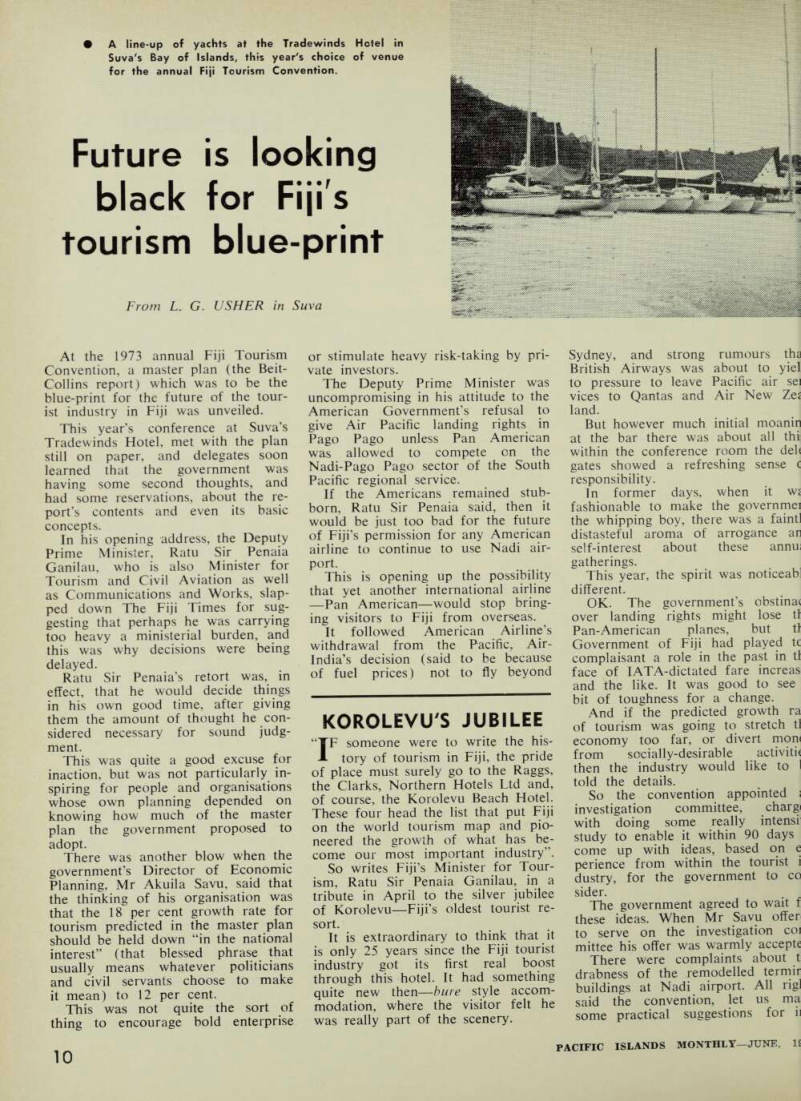
• A line-up of yachts at the Tradewinds Hotel in Suva's Bay of Islands, this year's choice of venue for the annual Fiji Tourism Convention.
provement. In two cases, offers of money were made to back up the suggestions.
All this showed a pleasing sign of maturity in the industry, and a re cognition that those who benefit should share responsibility, and the cost.
If the government was spared the severity of former criticism, its place in the firing line was taken by the airlines.
Why, said a “simple” question from the floor, were Pacific air and sea fares higher than those anywhere else in the world?
And why, others asked, was Qantas dragging its feet on charter services to Fiji when it is always taking many hundreds of Australians on similar trips to Singapore?
And why was the Pacific denied the allocation of charter group space on ordinary flights airlines elsewhere found possible?
And why is Air Pacific, in which the big airline boys have a control ling interest, not allowed propor tional fare concessions to travellers from overseas at excursion fare rates?
About the best that can be said for the uneasy replies from airline representatives present, apart from the perfectly valid argument that airlines are in business to make money, was that they did include an assurance that the points raised would be discussed with the bosses back home.
That made them worth raising at what was, all in all, one of the most useful of the convention series.