Independences
pp. 10-11 · Read in the full issue
lone voice in a New Guinea wilderness
From a Fort Moresby correspondent
Salesman for independence Mr Michael Somare, Papua New Guinea’s Chief Minister, had six of the toughest days of his career in May when he stumped from centre to centre in a campaign to “explain'’ independence to villagers and demo lish opposition to his plan for in dependence on December 1.
It was a tough nut to crack and his tour showed no sure cracks in the nut. In fact, some of the argu ments he heard might have weak ened his resolve over the date. Both in Menyamya and Wau he was told to delay independence for 15 years.
He argued, when speakers cast doubts on PNG’s ability to get on without outside assistance, that they were asking for continued foreign domination. They had a rich country which had plenty of water, timber, coffee, gold and a copper mine which had a profit almost equal to the country’s total Budget.
But that argument weighed little with some of his opponents. Their criterion to back up their case, that the country wasn’t sufficiently de veloped for independence, was the land around them.
It wasn’t developed, they said; they had no roads, no schools, no hos pitals and they didn’t understand business.
Morobe District saw most of Mr Somare, who operated from Lae during the six days. The villagers were eager to see him. Nearly 200 of them had massed near the Mo robe patrol post the week before in a noisy protest against the indepen dence date and threatened to burn down their council house if he didn’t visit them.
Eventually, they agreed to see him in Lae. They had two problems they wanted to discuss —independence and land claims in the Lae city area. He didn’t seem to get far with his in dependence arguments and said in several places that, if he found there was great opposition from the peo ple, he would change the date. But
he had a success over the land claims.
The Ahi Association had refused a cheque for $160,000 from Minister of Lands Mr Kavali as compensation for the land which is between the Markham and Bumbu rivers and was originally taken from the villagers by the German New Guinea Com pany early this century.
The dispute, which has lasted since 1965, looked like lasting another nine years but, after nearly a day, May 7, spent in talks and a meeting of the association, the association agreed to a settlement, a more favourable one than the one pro posed by Mr Kavali in March. The settlement, described by Mr Muttu Gware, the Ahi president, as a com promise, gives them the $160,000 and 1,410 acres of the disputed land, 570 acres in the Bugandi area of Lae and 840 acres to the city’s north which goes back to the Kamkumun villagers.
Nine outposts were visited in the Morobe District in 3i days and Mr Somare, who travelled with Minister for State Mr Boyamo Sali and 10 pressmen including a television crew from the Australian Broadcasting Commission, finished his tour at Goroka Show on the Sunday. That was when he nearly got into serious trouble with the warriors.
There were about 8,000 colour fully-garbed warriors and women in the ring when Mr Somare opened the show. It was a good time, the Chief Minister decided, to sell his independence date, so he did. The Highlanders didn’t want indepen dence, even before the show. When Mr Somare spoke they wanted it even less. They were obviously an noyed that he had chosen to talk politics when they wanted to get on with winning prizes worth $2,000 for dancing.
Some tried to accost him after the opening ceremony but his security men kept them away although for a
few moments the Chief Minister looked slightly anxious.
Earlier, Mr Somare had done a 3i-day stint in the House of Assem bly when he was again challenged on his date for independence by Leader of the Opposition Mr Tei Abal who asked for a referendum on the date. He claimed that leaders from both the coast and the High lands had asked for it.
Patiently, Mr Somare explained that he had answered that question 21 times already. The date would be resolved at the June sitting of the House of Assembly. He said he didn’t like referendums. The House must take the responsibility to lead How far Mr Somare will get with his proposal at the June sitting is anyone’s guess. Constitutional Plan ning Committee Deputy Chairman Fr John Momis announced several days after the House of Assembly adjourned that the Constitutiona Planning Committee wants the for mal debate on its report delayed until the August sitting, and the in troduction of the draft Constitutiona Bill in the November sitting.
This delay is sure to give op ponents of independence by Decern ber 1 some propaganda to use at thu June sitting.
Fr Momis is hoping that the com mittee’s report will be available foi the public by around May’s end. H< suggested there should be an in formal meeting of MHAs to stud} the proposals and give vent to theii feelings and between then and th( November sitting the public wouk have several months in which tc talk about the report and make theii opinions known to the MHAs.
Fr Momis, speaking on the radic on May 2, voiced the opinion that if the Constitutional Bill wasn’t read} for introduction in the House ol Assembly until November man} MHAs might be reluctant to vote for December 1 as the independence date.
The House of Assembly met foi
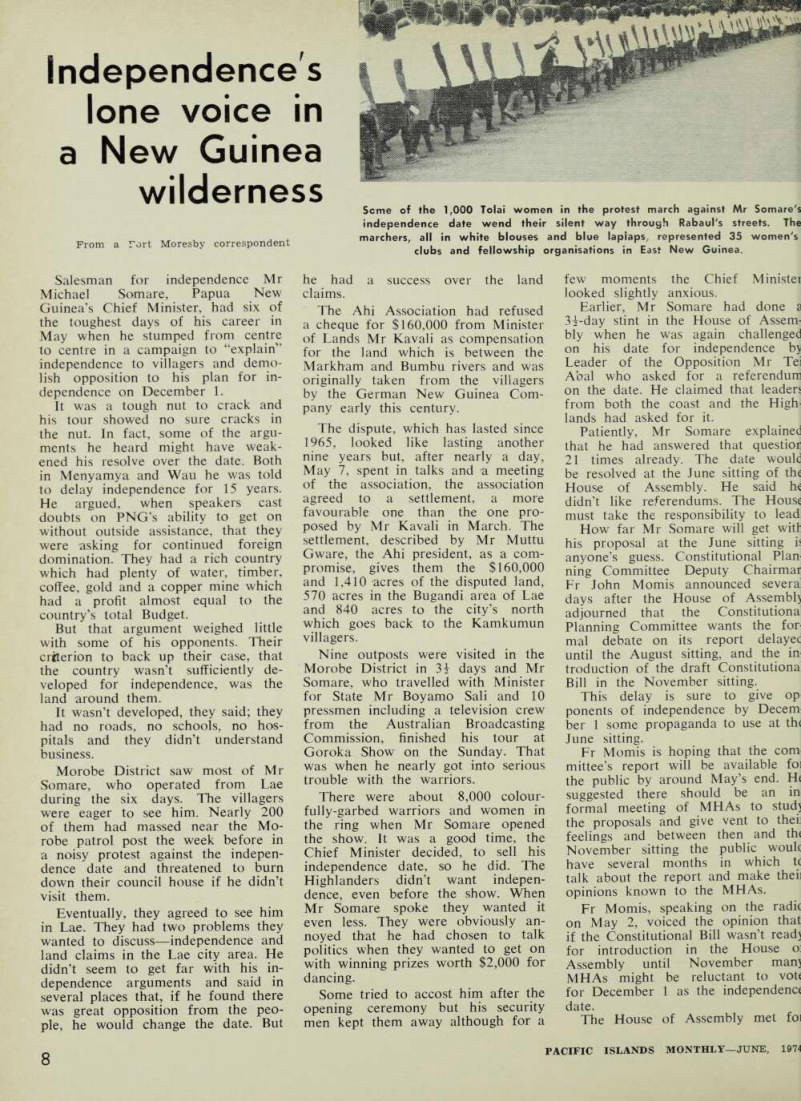
Seme of the 1,000 Tolai women in the protest march against Mr Somare's independence date wend their silent way through Rabaul's streets. The marchers, all in white blouses and blue laplaps, represented 35 women's clubs and fellowship organisations in East New Guinea.
3+ days towards the end of April.
The government, bowing to demands from the backbenchers agreed to allocate three days to private mem bers’ business and take only half a Jay for government business. As it transpired, it was a happy choice.
Fhe members, dealing mainly with sarish pump matters, got through 57 ff the 83 items tabled. Many of them vere of little consequence but they jave backbenchers the opportunity o demonstrate to their constituents hat they were on the ball and this, n a country where politics don’t re solve around political ideologies, pells victory or defeat for the sit ing member at the next election.
Little of real importance was ransacted. All government business vas put off for another day, as, for nstance, the Lands Acquisition Bill, /hich gives the government powers o acquire plantation land compul orily. This will be debated at the une sitting which will begin on June 4 and is expected to last three reeks. The second week will be de oted to informal discussion of the Constitutional Planning Committee’s ;port.
The debates on the private mem ers’ motions produced one import nt and controversial result—the re ealing of the law against playing
cards. On the surface, at least in more sophisticated countries, this seems but a small thing. However, to many New Guineans card-playing is on a par with pot-smoking. Several members opposed the repeal and they were backed up by the Minister for State (Police) Mr Peter Lus.
He warned that people would go without clothing and food so that they could spend their money on gambling with cards.
Mr Oscar Tammur (Kokopo) said the repeal of the playing cards law would add to the many problems caused by alcohol.
Despite strong opposition, the bill went through.
The House hadn’t adjourned when Mr Sinake Giregire (Daulo) threw a spanner into the works so far as the opposition United Party was con cerned. He announced that he was forming a new party, the Country Party, and had broken with the United Party. Its policies and con stitution would be revealed in time for the June session. His party, he said, would be entirely New Guinean. It wouldn’t have imported ideas and would have the support of all business men and every Papuan New Guinean who wanted to de velop his land.