Manifesto
Bsi Outlaws'
Comes To Light
From a Honiara correspondent A carbon-copy of what could be [escribed as the Ma’asina Rule’s Marching Rule) manifesto has ome to light after being hidden in lamboo for nearly 30 years.
The document, covering several oolscap typed pages, lists the post war movement’s aims, objects and easons. It had been kept hidden by r estus Lokei of Loina village. North rtalaita, ever since the Ma’asina tule was outlawed.
Lokei claims the original was iven to the administration at the utset of the movement to be passed m, as a petition for self-government, d King George VI.
Malaitans still vehemently claim hat Ma’asina Rule was not inspired y cargo-cult ideas, but was a genu [ie attempt to attain self-government.
It was while discussing Ma’asina tule with his elders that the Hon eriel Ausuta, Govco member for Jorth Malaita, discovered the docu lent in January this year. His uncle, .okei, had been fearful for many ears that he would be in trouble nth the white man if it was known e had the papers in his possession.
According to Ausuta, the paper ras written in English by a leading
Ma’asina Rule man, Timothy George, for the nine leaders of the movement. Timothy George was at the time one of y the best-educated Solomon Islanders, having had secondary scho oling in Queensland during the blackbirding davs. f .. „ . J he documei Jt tells of natives bem 8 , horse-whipped and towed thr ° u 8 h Plantations by white planters on orset) ac .
Ausuta, a strong member of the United Solomon Islands Party, has likened the document to the USIPA Manifesto. Indeed, Ma asina Rule once again became a household word of honour on Malaita with the election of Philip Solodia, one of the key founders of USIPA.
In the Governing Council meeting in June last year, Solodia made a
moving speech honouring the leaders of Ma’asina Rule for having sown the seeds of self-government which the Solomons was soon to achieve.
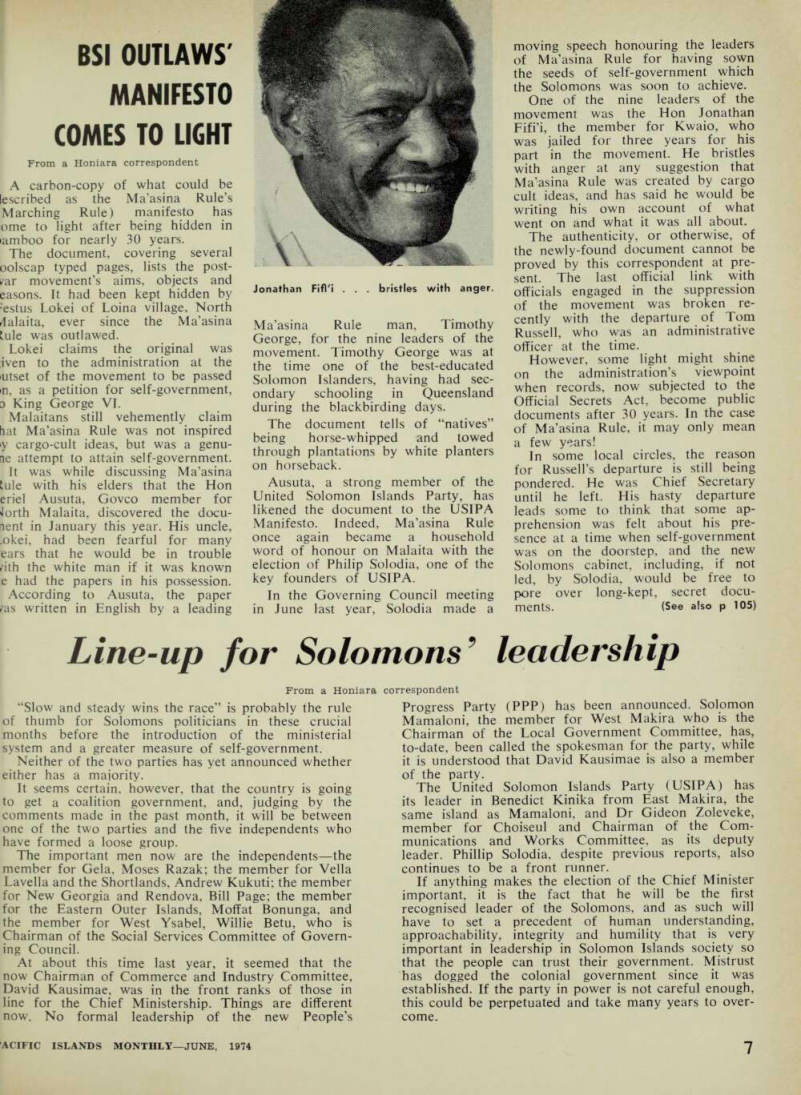
One of the nine leaders of the movement was the Hon Jonathan Fifi’i, the member for Kwaio, who was jailed for three years for his part in the movement. He bristles with anger at any suggestion that Ma’asina Rule was created by cargo cult ideas, and has said he would be writing his own account of what went on and what it was all about.
The authenticity, or otherwise, of the newly-found document cannot be proved by this correspondent at pre sent. The last official link with officials engaged in the suppression of the movement was broken re cently with the departure of Tom Russell, who was an administrative officer at the time.
However, some light might shine on the administration’s viewpoint when records, now subjected to the Official Secrets Act, become public documents after 30 years. In the case of Ma’asina Rule, it may only mean a few years!
In some local circles, the reason for Russell’s departure is still being pondered. He was Chief Secretary until he left. His hasty departure leads some to think that some ap prehension was felt about his pre sence at a time when self-government was on the doorstep, and the new Solomons cabinet, including, if not led, by Solodia, would be free to pore over long-kept, secret docu ments. (See also p 105)
Jonathan Fifl'i . . . bristles with anger.