Pacific Islands Monthly
pp. 6-7 · Read in the full issue
While Britain And France Fiddle
Stateless New Hebrideans Burn
By STUART INDER, recently in Vila
The decolonisation committee of the United Nations has been looking at the situation in the New Hebrides, that strange condominium of islands 1,400 miles north-east of Sydney which is governed by both Britain and France but whose people are neither British nor French. Nor indeed are they New Hebridean.
The situation has virtually re mained unchanged since 1906 when Britain and France, who were then locked in an argument over whose sphere of influence those islands should be, resolved it at least to their own satisfaction by agreeing to share the responsibility.
They made it formal on August 6, 1914, in a “Protocol”, which is the constitution of this extraordinary group of islands that ever since has been consigned to political limbo.
The New Hebrideans are not the only stateless people in the world, but I should think they must be the only stateless people occupying their own country. One article of the pro tocol states that “No native shall ac quire in the group the status of subject or citizen or be under the protection of either of the two sig natory powers”. To this day, the New Hebrideans have no passports, although they do have something which looks like a passport, and which states on the cover, “Anglo- French Condominium of the New Hebrides, travel document for use as passport”.
This document, current for five years, contains a photograph and the name, address and birthplace of the holder, with the following note: “This travel document is the pro perty of the Joint Administration of the Anglo-French Condominium of the New Hebrides by which it is issued. It may be withdrawn at any time. The holder of this travel docu ment travelling abroad may in the case of need request the protection of the British or French authorities”.
Thus the 90,000 people of the New Hebrides have less than colonial status in the world.
Britain and France each operate mini-governments in the islands, sup porting their own schools, hospitals, legal system, etc, while paying lip
service to a joint condominium government which has little author ity. Its joint responsibilities include, among other things, construction and maintenance of roads and bridges, ports and harbours, buoys and lights.
There is an advisory council, but the British and French Resident Commissioners are not bound by it, and in any case it is not popularly elected. Strictly speaking there is no advisory council at this moment, as it finished its formal life last De cember 31, and the details of the next stage of the condominium’s headlong rush towards political de velopment have not even been de cided.
The condominium is currently awaiting a top-level conference in Paris to discuss changes in the pro tocol which will permit a legislative council. This meeting was first scheduled for last year, but it has been continually postponed by ad ministrative crises either in London or Paris, none of which has had any thing to do with the New Hebrides.
This is an indication of just how seriously the developing problems of the New Hebrides are taken in Lon don and Paris, where the major de cisions have to be made.
The problems of the New Hebrides are serious, and if this fact is not recognised by London and Paris then I believe we can expect violence in the New Hebrides.
Should it occur, it can be laid at the door of the governments in Europe.
In the condominium itself the British and French manage to get on quite well at all levels. They have learned to manage their affairs com fortably enough under a protocol formulated for reasons which have long since lost their significance.
There is even some sympathy for the plight of the stateless New Hebrideans.
Much is sometimes made about the difference between British and French attitudes to political develop ment in the Pacific Islands, and this is sometimes used as a prediction that the British and French are never likely to co-operate on the matter of political development in the New Hebrides. But I do not think this is true in the New Hebrides; the ad ministrators who live on the spot, British and French, realise that the New Hebrides has to be broken free of the restraints of the present pro tocol, and that the future of the New Hebridean is more important than British or French power politics.
Britain and France have to stay together in the New Hebrides until the job is done, or exit together.
Each would be sorely embarrassed if either pulled out of the condominium and left the other holding the bag alone against the growing wrath of the United Nations, and the increas ingly vocal demands of the New Hebrideans for control of their own islands.
The current interest by the UN (see separate report) is only a be ginning of the new pressures which are developing in the New Hebrides, by the New Hebrideans.
There has arisen a number of New
Hebridean political parties, the
strongest being the New Hebrides National Party, which has as its main objectives citizenship for the New Hebrideans, one system of government instead of the present three systems (British, French and Joint), an elected legislative coun cil to replace the present advisory council and eventual independence.
The National Party is demanding single systems of law, education and health—all of which, of course, would flow from the single system of government. The party also wants land reforms and an end to land
speculation, whereby New Heb rideans have seen large parcels of land over which they have no con trol, subdivided and sold, and resold, at profit for foreign speculators.
The National Party is not the pro duct of radicals, but of new nationals. It has developed simply from the frustrations of New Heb rideans at the way progress in the New Hebrides has been stunted by :he self-centred political interests of London and Paris.
It is the matter of land which has aeen the rallying point for this up iurge in political development. As •ecent PIM reports have shown, New Tebrideans are actively picketing larcels of land which they feel have ?een unjustly alienated by outsiders, fhere have been numbers of public lemonstrations, and frequent accusa ions that lands were illegally taken Tom native owners in the days be bre the establishment of the con lominium.
This last is a familiar cry in the iouth Pacific, of course, but in the 'Jew Hebrides the chances are that he complaints of the New Heb ideans have a substantial foundation n law. Some of the measures idopted in alienating land in the 4ew Hebrides towards the end of ast century were scandalous.
Today this fact is being officially ecognised, and land is now being landed back. The French adminis ration deserves credit for its action lere, for it is currently in the pro ess of handing back 70,000 hectares if land occupied by the French ontrolled SFNH company. During 974, 2,500 hectares on Santo and 5,000 hectares on Malekula are •eing released from company con
trol, and in 1975-6 a further 40,000 to 45,000 hectares will be handed back. When these lands are disposed of, SFNH will retain only about 20,000 hectares, comprising four cattle stations, one each on Malo and Efate and two on Santo. Australia is supposed to be in the process of handing over to condominium con trol 10,000 hectares of Common wealth land which was a long time ago part of Burns Philp’s assets, but it is extremely slow about it.
The British administration has had working for it a land tenure adviser, Mr J. T. Fleming, who has com pleted a report on how to put some sort of order into the whole New Hebrides land tenure mess. Both London and Paris have been making noises in support of it, but whether this means that eventually there will be joint agreement on the reforms is another matter. Past experience has shown that once key proposals go to London and Paris for bureau cratic consultation, the results seldom reflect the original intent, and cer tainly never are handled with the speed required.
Meanwhile, any outside investor
should give the matter long and earnest thought. Some people with extensive and seemingly long-term interests in the New Hebrides have lately been selling off their freeholds, and retaining only leaseholds.
The problems facing the condo minium will not be resolved by con tinuing amendment to the protocol.
It is a colonial document designed half a century ago to protect the interests of British and French settlers, and until recent years this interpretation has been put on it, particularly by the Joint Court in respect of land claims and registra tion. Britain and France should tear up the protocol and start again.
The three essential matters to be resolved are (1) citizenship for the New Hebrideans; (2) a common code of law for all; (3) a satisfac tory procedure for the settlement of land disputes.
The present inflammatory situation surrounding land can probably be attributed to the colonial-protective interpretation put upon the protocol by the Joint Court in past years and especially to the fact that there is no appeal from the Joint Court to any higher judicial body.
Land reforms could possibly be achieved by amendment to the pro tocol, but the matters of citizenship and law reform need an entirely revised “constitution”. And this in turn depends on London and Paris being able to reach agreement on the future of the condominium.
Simply, the system of separate national administrations must go, and the support of the two metro politan powers must be given to the development of one strong condo minium government, to be managed by an elected legislature of New Hebrideans who are given citizenship in their own country.
And there is no time left.
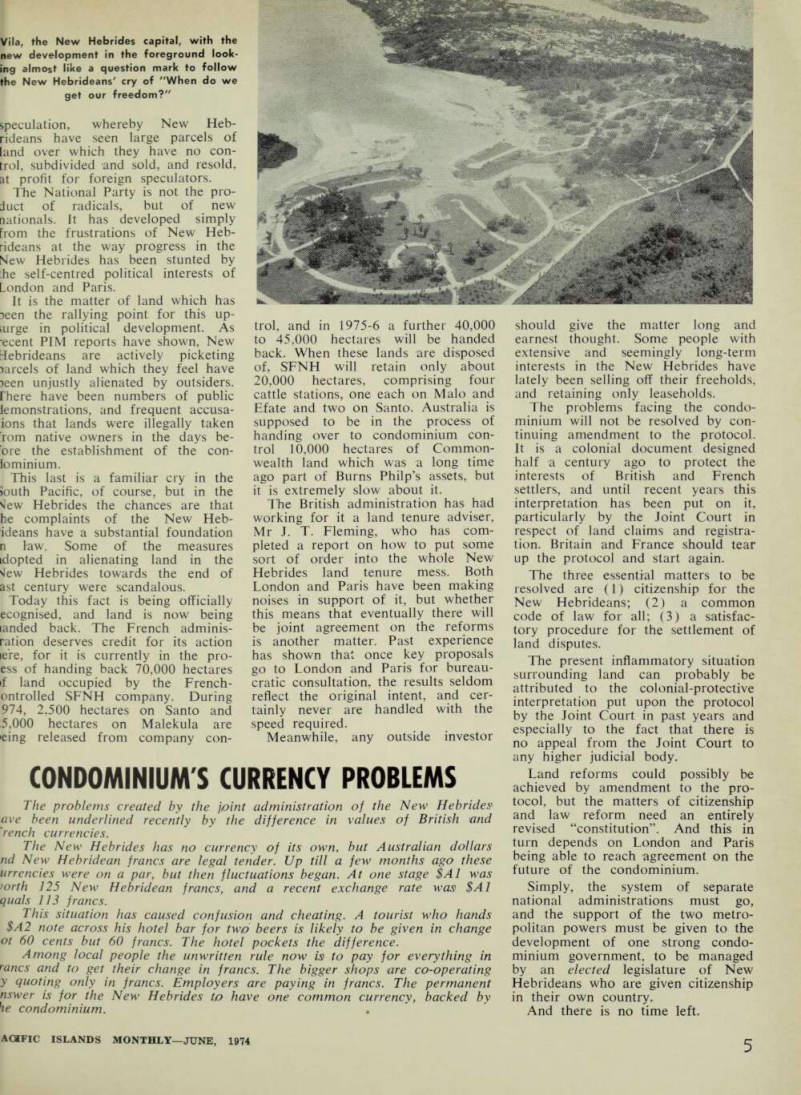
Vila, the New Hebrides capital, with the new development in the foreground look ing almost like a question mark to follow the New Hebrideans' cry of "When do we get our freedom?"