for local up-and-comers'
pp. 121-123 · Read in the full issue

The Big Two run schools for local up-and-comers'
W.R. Carpenter (South Pacific) Ltd and Bums Philp (SS) Ltd, so long business competitors in Fiji, Western Samoa and Tonga, are now unofficial competitors in training local people for top management positions. Both companies, although retaining some expatriates in top positions, have shown a willingness to “localise”, and make sure that the “up-and-comers” are trained properly.
Burns Philp recently made a num ber of top-level staff changes, and streamlined the Fiji organisation.
And in the Carpenter stable there are a couple of young Fijians aspir ing to the top posts, doubtless seek ing to emulate Mr Mosese Qioni baravi, managing director of Naviti Investments Ltd, who is the only Fijian in such a post.
Mr Charlie Walker, general man ager, personnel, in the Carpenter group, explaining the scheme, said that six youngsters were being groomed for senior positions. If they could stand the pace of train ing and study, any one could be come managing director.
These cadets are taking part in a three-year “sandwich” course at the Derrick Technical Institute, which involves alternate periods of on-the job training and assignments and studies for a business diploma. At the end of each week the cadets meet in the Carpenter training de partment to discuss what they have learned.
In the last year of the course they will be given a choice of specialising in accountancy or straight management. When they get
their diplomas they should be ready for junior managerial positions.
During training, cadets who have passed the University Entrance examination, get 51,500 a year.
Those who narrowly missed a certi ficate get $1,300.
Besides the cadet project, the Carpenter group also has an in service scheme which gives em ployees a chance to climb the management ladder. Selected staff attend a four-year, business-study, day-release course at the Derrick Technical Institute. The company pays them on their study days. If they gain a business diploma they are eligible for more senior positions.
The Carpenter group has a man agement training committee of senior executives, which meets regu larly to review the progress of both schemes. The cadets are Penisoni Usumaki, Hans Ah Sam, Paul Kid, Anil Maharaj, Sebastian Morris and Eroni Tulele.
The Burns Philp training scheme was described in PIM in July, 1973.
The general manager of the com pany, Mr Phil Best, said recently it was hoped that nine full-time management trainees would take over senior posts in Fiji before very long. Two graduates who went to the University of the South Pacific on Burns Philp scholarships have just started work with the company.
So have three local graduates of NZ universities.
Bums Philp streamlined its Fiji organisation by doing away with the system of two main branches in Suva and Lautoka and a number of
sub-branches, all under centralised control from Suva, in favour of five trading divisions and three adminis trative divisions. This is aimed at increasing efficiency and spreading responsibility over a wider section of the staff.
The new set-up includes 180 Fiji citizens who help to control a work force of about 2,000.
Several of Burns Philp’s top management are Fiji citizens, although not all were born there.
They include Messrs Best, Ranjit Singh (company secretary), Kalyan Ghose (travel manager), Alfred Varea (Fiji credit manager), Michael Light (training officer), Harry Bossley (manager of the new motor division), Harry Leong (spare parts manager, Fiji) and George Powell (shipping manager, Lautoka.)
BSIP struggles to
make ends meet
The Solomon Islands Government is battling to make ends meet in the face of the increasing effects of over seas market changes, a Japanese sea men’s strike and increased costs at home. With nowhere else to turn for the time being, it has been forced to lift the politically unpopular and un palatable levies on the country’s main export earners—copra and :imber.
The copra levy, taken from the srice received by the Copra Board, ose from the former 10 per cent to 15 per cent on March 25. The tim ber levy is now 4.5 c a cubic foot, ip from 2.5 c, since March 21. The neasures are expected to raise an :xtra $200,000 for the rest of the 'ear, depending on overseas market >rices and now doubtful Japanese hipping for timber.
This would give what the
unancial Secretary, Mr Reginald
Vallace, called “breathing space”
riffle the Fiscal Committee of Governing Council, set up in Janu ry, gets legislation and collection leasures ready for other revenue aising activities. There are no tips n these yet, but income tax collec on in rural areas is one, as yet, un ipped source.
The government requires $185,274 su PP lement the recurrent budget, nd $322,611 to add to the capital udget. The cost of living allowance )r civil servants, from January 1 974 will take $92,777 of the addi onal amount required for the capi ij budget. The recent royal tour ill require $50,000. However, very ttle of the $20,000 granted in 1973 • cover initial expenditure for the sit, was used.
Niueans are
all 'lit up 7
New Zealand’s offer of handouts at the South Pacific Forum in Raro tonga did not end with members of the forum. On the way home, the leader of the NZ delegation, Prime Minister W. H. Kirk, stopped off at Niue and said NZ would give $5.5 million in aid to the island over the next three years.
An announcement that his govern ment intended to see that every village had an electricity supply was greeted with enthusiasm. He be lieved it was important for all Niue Islanders to have power in their homes and be able to switch on a light or refrigerator as they wished.
NZ would see the electricity project was finished in the shortest possible time.
To help boost Niue’s economy, Niue’s air services would be ex panded, hotel accommodation would be provided for tourists and a passionfruit processing and canning factory would be finished.
Mr Kirk and Mr Robert Rex, the Leader of Government Business were in accord over self-government —that the decision had to be made by people living on the island. This was a direct “slap” at a vocal Niue community living in NZ, which is against self-government.
Business Briefs
<9 The New Hebrides Joint Ad ministration has raised loans of $2 million from two local banks to finance several major projects. These include improving telephone lines in Vila and Santo, residual construc tion costs of Vila wharf, housing for civil servants and compensation for landowners in widening Ellouk Road, Vila. The Joint Administration plans to raise further loans for other projects, including the Vila and Santo water supplies, low cost hous ing and staff housing. • Steamships Trading Co Ltd is prepared to help its employees in Papua New Guinea to buy shares in the company. The company has asked the government to amend the Companies Ordinance to allow it to finance share purchases by indigenes if authorised by the government.
The cempany has not yet heard from the Treasurer about its submission, and is now considering helping the native staff to buy shares in the com panies. Steamships Trading has about 3,500 local staff in PNG. • Emperor Mines Ltd could earn a $3.3 million profit from Vatukoula in Fiji in 1974 if gold prices remain at SUSI2B an ounce, according to a survey by Cowan Investment Sur veys, an Australian investment sur vey company. The estimate was based on the assumption that mine output would expand to increase gold production by 10 per cent, profits from tellurium and silver production would total more than $250,000, costs would rise by 12J per cent, and profits from the non-gold mining business would increase by 5 per cent.
USP Vice-Chancellor
resigns
Dr Colin Aikman, Vice-Chancellor of the University of the South Pacific from its opening in 1968, resigned in April and will leave the university at the year-end. He was appointed in May, 1968, three months after the first students enrolled. Before going to Suva, Dr Aikman was dean of the faculty of law at Victoria University in Wellington, NZ. His resignation has been accepted by the university council’s executive committee “with deep regret”. He does not yet know where his next post will be but, he said in Suva that he was looking at several openings.
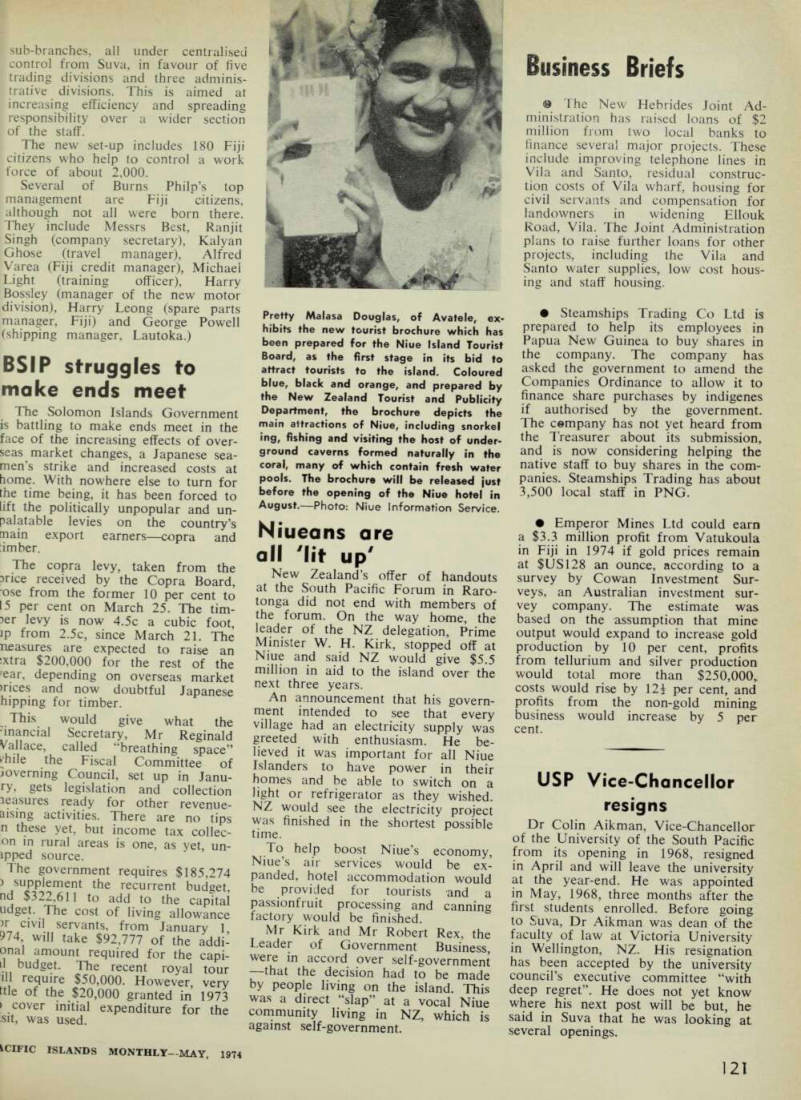
Pretty Malasa Douglas, of Avatele, ex
hibits the new tourist brochure which has been prepared for the Niue Island Tourist Board, as the first stage in its bid to attract tourists to the island. Coloured blue, black and orange, and prepared by the New Zealand Tourist and Publicity Department, the brochure depicts the main attractions of Niue, including snorkel ing, fishing and visiting the host of under ground caverns formed naturally in the coral, many of which contain fresh water pools. The brochure will be released just before the opening of the Niue hotel in August.—Photo: Niue Information Service.