Business and Development
pp. 119-121 · Read in the full issue
Cook Islands Open Cautious
Arms To The Tourist
From JOHN CARTER in Rarotonga
Now that the 40-room Trailways Hotel has opened for business on Rarotonga and Air New Zealand is back on the Coral Route with its DCBs and landing them on Raro tonga’s new international airstrip, the Cooks are ready to leap into the jet tourist age, or they would be if the Cook islanders would stay at home.
The Cooks have decided they want a tourist industry, a strictly con trolled one, but the expected flood is just a trickle. The NZ tourists, who arrive in these, as yet, unspoiled islands, find that getting out again isn’t so easy. The majority of seats on the homeward-bound planes are occupied by the islanders going to the Promised Land, New Zealand.
The Cooks returning and depart ing sons and daughters are proving an embarrassment to the tour pro moters who can’t guarantee a date 0 the tourist as there is a large back og of islanders waiting to travel to Zealand. Every departing plane s. full and it may be months before he tourist traffic can begin to flow.
So far few rooms are taken at the frail ways because the tourist is :hary of risking a trip which might md with his being stranded for days, [here are high hopes, however, that hmgs will improve and the tourist ndustry will be fully extended to ope with the expected traffic.
Air New Zealand is co-operating, ymg in as guests tour promoters nd journalists, who are now pre ared to write up the Cooks as the ist Paradise in the Pacific.
But the islanders are nervous, ney want tourism as a secondary idustry, as a back-stop to a poor itrus season, but they’re afraid of tourist take-over and its effect on leir culture.
One man who isn’t afraid, who is mrndent that he can keep tourism ithm bounds, is Premier Sir Albert enry. He’s fought hard for a place 1 tourism’s sun for his islands. He’s 3t his jet airstrip, after many vicissi ides, and his modern hotel.
He has managed, with the NZ
Government which has pledged $3 million, to form a partnership with the NZ Government and Air New Zealand. Work is scheduled to begin in May on a new, international-type 150-bed hotel at White Sands, on Rarotonga. More will follow, but not much more, Sir Albert told me.
“We have been cut off from the outside world for a long time”, he said. “Now, to be hit suddenly bv a big change, with a new hotel, with jet planes coming in, is like being hit by a hurricane, but we’ve de cided that it will be controlled.
“We will control the growth of tourism by the number of beds that we will make available, and the various types of accommodation which we will allow”.
Sir Albert is fighting shy of the big hotel chains, “Travelodge wanted to come here”, he said. “They wanted to build a 300-room hotel, but we de cided that no one comes in here with more money than the government’s got, because we must rule. Big in vestors have asked for too much.
“They want to decide how many
hotels and motels should be built and who should have them, but I told them ‘No, you are asking too much; you are taking over decisions that we must make’.
“Those people who were willing to play along with us hadn’t the money, unfortunately, so several plans have petered out”.
Not that there has been a short age of offers, only that the investors with the money thought that who ever paid the piper should call the tune.
“There was one man from Eng land”, said the Premier. “He wanted to put in £lO million—pounds— not dollars—but that frightened us. We told him our own budget was only $5 million, and we wouldn’t mind £1 million, but he didn’t think that was worth the bother, so he went back home”.
Sir Albert is hoping to control tourism but still give his people a good share of the tourist cake by limiting the number of beds over the next three years to 400. The hotel at White Sands will cater for the tourist out of the top drawer; Trailways, and another one like it,'
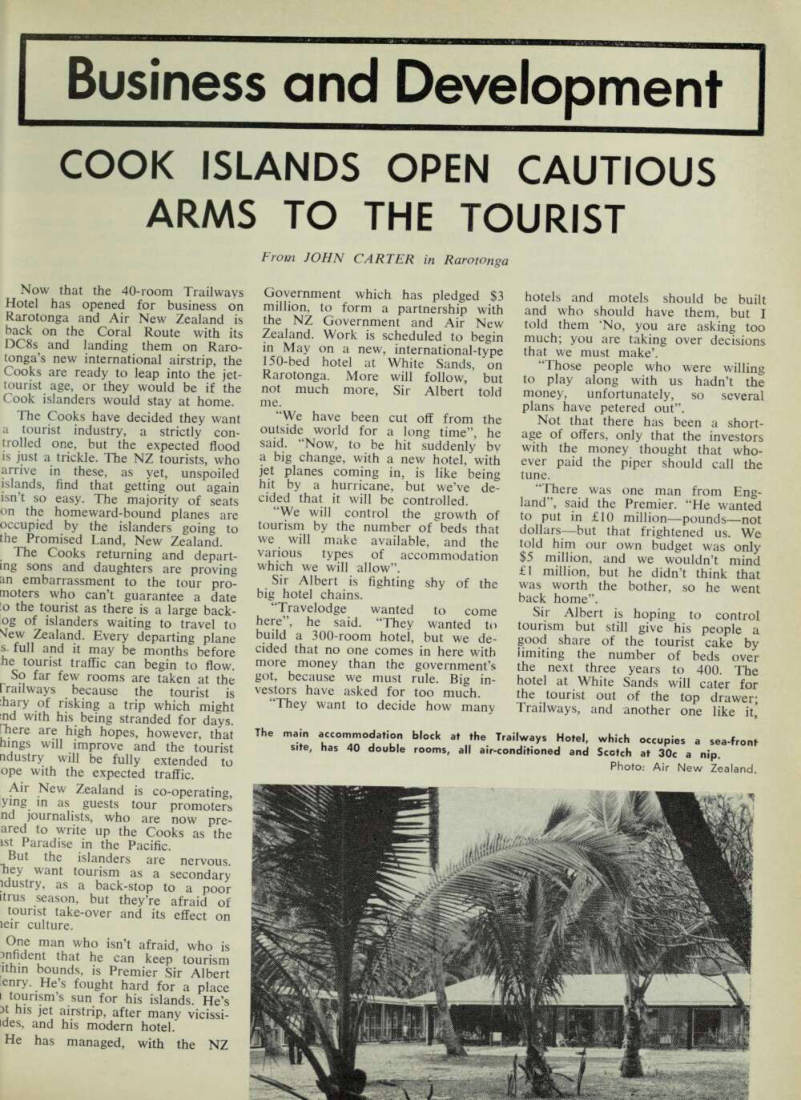
The main accommodation block at the Trailways Hotel, which occupies a sea-front site, has 40 double rooms, all air-conditioned and Scotch at 30c a nip.
Photo: Air New Zealand.
will take care of the middle class spender and a few more motels will look after the rest, the Premier hopes.
It’s not the tourist he’s frightened of. It’s his own people who might be affected by the visitors and their alien culture.
“I honestly believe the tourist doesn’t harm a country”, he said.
“The bad thing that can develop is greed among our local people, who want to make money the wrong way.
The tourist really improves a country. It is the people in the country who dream up the wrong ideas; like in the Caribbean where a taxi driver will tell you he can find anything for your entertainment. On the surface the country seems all right, but underneath it’s rotten. We don’t want anything like that here”.
Sir Albert doesn’t think the exodus of Cook islanders will worry the tourist much longer. There’ll be plenty of seats on the planes for he plans to control the comings and goings of his countrymen.
PNG may have
another copper mine
Papua New Guinea has a rich copper mine in Bougainville. The Ok Tedi project near the border with West Irian could be developed in the years ahead, when all parties in terested are able to reach agreement.
Now there is a strong possibility of a third copper mine—at Frieda River in the Western Highlands.
MIM Holdings Ltd, the parent company of Mt Isa Mines, early in April announced preliminary indica tions suggesting the prospect con tained about 366 million tonnes of ore, of an average grade of 0.45 per cent of copper. The MIM group, through an exploration subsidiary, Carpentaria Explorations Pty Ltd, has been working in the Frieda River area for some years.
The Frieda River project will not be as big as Bougainville, but it will be bigger than Ok Tedi.
MIM Holdings Ltd announced early in April that subject to the PNG Government’s consent, Mt Isa Mines Ltd, a MIM subsidiary, had entered into a farm-out agreement with a consortium of Japanese com panies in relation to Frieda River.
The companies are Sumitomo Metal Mining Co Ltd, Dowa Mining Co Ltd, Sumitomo Shoji Kaisha Ltd and Marubeni Corporation. Under the agreement the Japanese consortium will be obliged to spend S 5 million on exploration and other work over five years to earn a 40 per cent interest.
A land flowing
with honey
Western Samoa is prepared to en courage overseas firms to set up a honey industry, with certain strings.
A special committee which investi gated the possibility of setting up the industry, reported that the quality of Samoan honey was among the world’s best.
Any potential investor in the in dustry must, initially, give the government the right to buy up to 49 per cent of the total capital structure of the company. It must have the right to buy up to 65 per cent of the total shareholding after 10 years.
Kelsall Farms Ltd, of New Zea land, and other overseas companies have applied to start honey produc tion in Western Samoa.
The committee reported that in the warm Western Samoan climate, and with plenty of flowers, local hive bees were capable of producing 200- 300 lb of honey a year from each hive. In comparison, the NZ hive average was 70 lb a year.
Fiji tightens
her imports belt
A decision by the Fiji Government on April 10 to cut down the import of vehicles will give an impetus to the training of more first-class mechanics. The move is aimed at saving on foreign exchange by cut ting down the country’s fuel bill, which was likely to soar through re cent increases in world fuel prices.
The annual quota of new cars will be cut from 2,000 to 1,500, so exist ing cars will just have to last longer.
Immediately banned is the import of private vehicles with an engine capacity of more than 2,000 cc. The government is also ending the exemption from the quota system which allowed people to buy vehicles with money they had overseas.
Finance Minister Mr Charles Stinson, said the government would license the import of light 99 m ’ merciy.l vehicles, including utilities,
four-wheel drives and runabouts, earthmoving equipment and other heavy machinery.
The importation of domestic elec tric hot water heaters has been banned. Import licences will be necessary for commercial electric water heaters. , To illustrate how serious the position is, Mr Stinson said the higher oil prices would cost between $2O million and $22 million a year in foreign exchange. He warned there could be further restrictions to curb spending on luxury and semi luxury goods. All restrictions were aimed at cutting down fuel consump tion and the need to import it.
Mr Stinson said that on top of the higher prices for oil, private in vestors had to repay overseas loans of between $lO million and $l5 million a year during the next three years.
NSW trade mission
for the Islands
A 20-strong trade mission from New South Wales sponsored by the State Government will visit Hawaii, Fiji, New Caledonia and New Zea land in May and June. Membership will be divided among representa tives of primary industry, food pro cessing industries and manufacturing industries.
The mission will leave Sydney on May 11 and will open for business in Honolulu on May 13. It wil spend five days displaying product samples, and meeting Hawaiian businessman. On May 17, the miss ion will fly to Fiji. May 20 and 21 will be working days in Nadi, and May 23 and 24 working days in SU The mission will leave Fiji for New Caledonia on May 26, and will have four working days in Noumea before flying to New Zealand, where there will be five working days, and a day of rest for the mission.
Sir John Fuller, MLC, Minister for Planning and Environment will be the mission leader. Sir John has been leader of seven other overseas trade missions. The leader was to
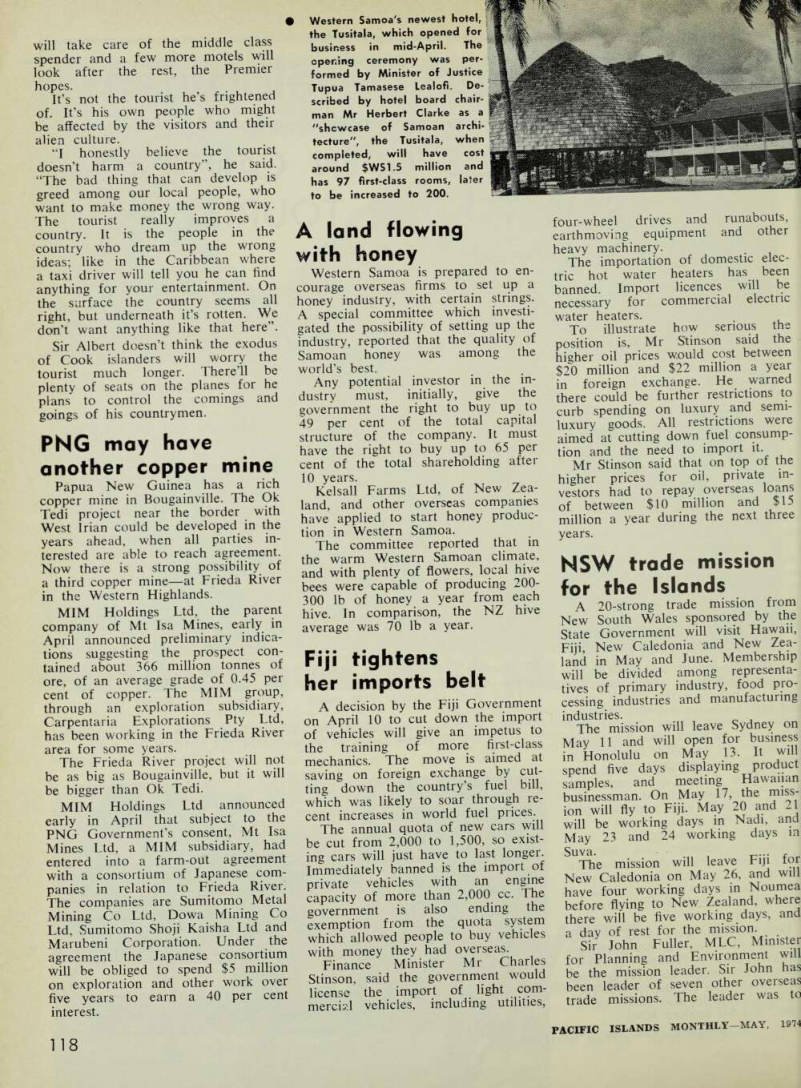
Western Samoa's newest hotel, the Tusitala, which opened for business in mid-April. The opening ceremony was per formed by Minister of Justice
Tupua Tamasese Lealofi. De
scribed by hotel board chair man Mr Herbert Clarke as a "showcase of Samoan archi tecture", the Tusitala, when completed, will have cost around SWS 1.5 million and has 97 first-class rooms, later to be increased to 200.
have been Mr J. C. Bruxner, MLA, Minister for Decentralisation and Development, but another overseas matter has claimed his attention. Sir John held Mr Bruxner’s portfolio till a recent shuffle of posts in the NSW Cabinet.
Dearer living
on Norfolk Island
Norfolk Island was hit by a real round of price increases in March, and the end is not in sight. First to go up were super petrol, to 75c a gallon, home kerosene to 68c a gal lon and distillate to 61c a gallon.
Surcharges on bunker fuel were ex pected to “rub off” on Norfolk Island, and the price of liquefied petroleum gas was expected to double, if a price increase sought by Shell in Australia was approved.
In the pipeline is an expected rise in air fares following a recent lATA decision to lift them by 5 per cent from June 1, following sharply on recent rises of 7 per cent and 6 per cent.
Rising world sugar prices are ex pected to force the retail price of a 2 kg packet of sugar over the $1 mark,
Fiji Air flying higher
Fiji Air Services earned a profit of $21,410 in 1973. Income rose during the year to $342,461, which was 50 per cent higher than the 1972 income. The company carried 20,252 passengers on regular ser vices, an increase of 260 per cent over 1972.
On the service from Suva to Levuka there were 8,800 passengers.
There was also growth in services to Malololailai, around the Coral Coast and to Lakeba and Vatukoula.
The company added a third Islander aircraft to its fleet in 1973.