The Founding Of
p. 92 · Read in the full issue
Legend
Rotuma
By John Antonio
THE legendary founder of Rotuma was a chief named Raho, who lived on the island of Savai’i, but he was not a Samoan. He had three sisters. The eldest was Mamaere; the second one, Mamahiovare; and the youngest, Mamafiarere.
Mamaere became pregnant but no one admitted to having been intimate with her. In due course she pro duced twin girls called Hani Lepi He Rua (the two sandy-point girls), who from birth appeared to have mono (miraculous powers) and began giving orders to Raho, at the same time telling him not to call on them for help unless he was desperate.
Raho had a daughter, named Vaimarasi, who was the second wife of the Tu’toga, a Samoan chief, whose first wife was about to be confined when Vaimarasi was found to be pregnant as well. In order to have the birth feast made in honour of Vaimarasi’s child, Raho called on the two sandy-point girls for help. They staved off the Samoan wife’s child and hastened by months that of Vaimaiasi’s so that the feast already prepared for the first-born child was given for Vaima rasi’s baby, a girl, named Maiva.
Later, the Samoan wife gave birth to a son, called Fumaru, who as he grew up, constantly quarrelled with his half-sister, Maiva, so that finally Raho decided to seek a new home for his family.
Once again, Raho called on the two sandy-point girls and they prepared two baskets of sand—a presentation basket (la agai ta) and an ordinary basket (la se agai ta), and carried them to the canoe which had been made ready for Raho and his household.
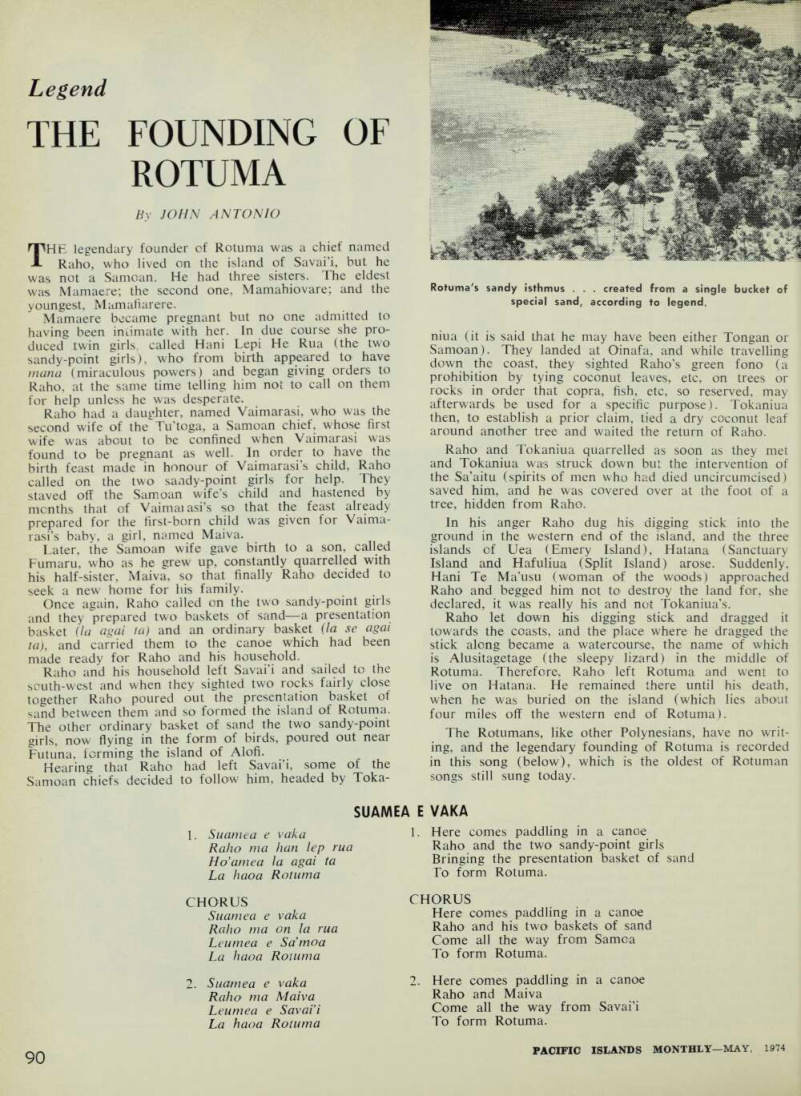
Raho and his household left Savai’i and sailed to the south-west and when they sighted two rocks fairly close together Raho poured out the presentation basket of sand between them and so formed the island of Rotuma.
The other ordinary basket of sand the two sandy-point girls, now flying in the form of birds, poured out near Futuna, forming the island of Alofi.
Hearing that Raho had left Savai’i, some of the Samoan chiefs decided to follow him, headed by Toka-
niua (it is said that he may have been either Tongan or Samoan). They landed at Oinafa, and while travelling down the coast, they sighted Raho’s green fono (a prohibition by tying coconut leaves, etc, on trees or rocks in order that copra, fish, etc, so reserved, may afterwards be used for a specific purpose). Tokaniua then, to establish a prior claim, tied a dry coconut leaf around another tree and waited the return of Raho.
Raho and Tokaniua quarrelled as soon as they met and Tokaniua was struck down but the intervention of the Sa’aitu (spirits of men who had died uncircumcised) saved him, and he was covered over at the foot of a tree, hidden from Raho.
In his anger Raho dug his digging stick into the ground in the western end of the island, and the three islands of Uea (Emery Island), Hatana (Sanctuary Island and Hafuliua (Split Island) arose. Suddenly, Hani Te Ma’usu (woman of the woods) approached Raho and begged him not to destroy the land for, she declared, it was really his and not Tokaniua’s, Raho let down his digging stick and dragged it towards the coasts, and the place where he dragged the stick along became a watercourse, the name of which is Alusitagetage (the sleepy lizard) in the middle of Rotuma. Therefore, Raho left Rotuma and went to live on Hatana. He remained there until his death, when he was buried on the island (which lies about four miles off the western end of Rotuma).
The Rotumans, like other Polynesians, have no writ ing, and the legendary founding of Rotuma is recorded in this song (below), which is the oldest of Rotuman songs still sung today.
Rotuma's sandy isthmus ... created from a single bucket of special sand, according to legend.